


Earth's orbit could develop Saturn-like rings: Scientists are concerned
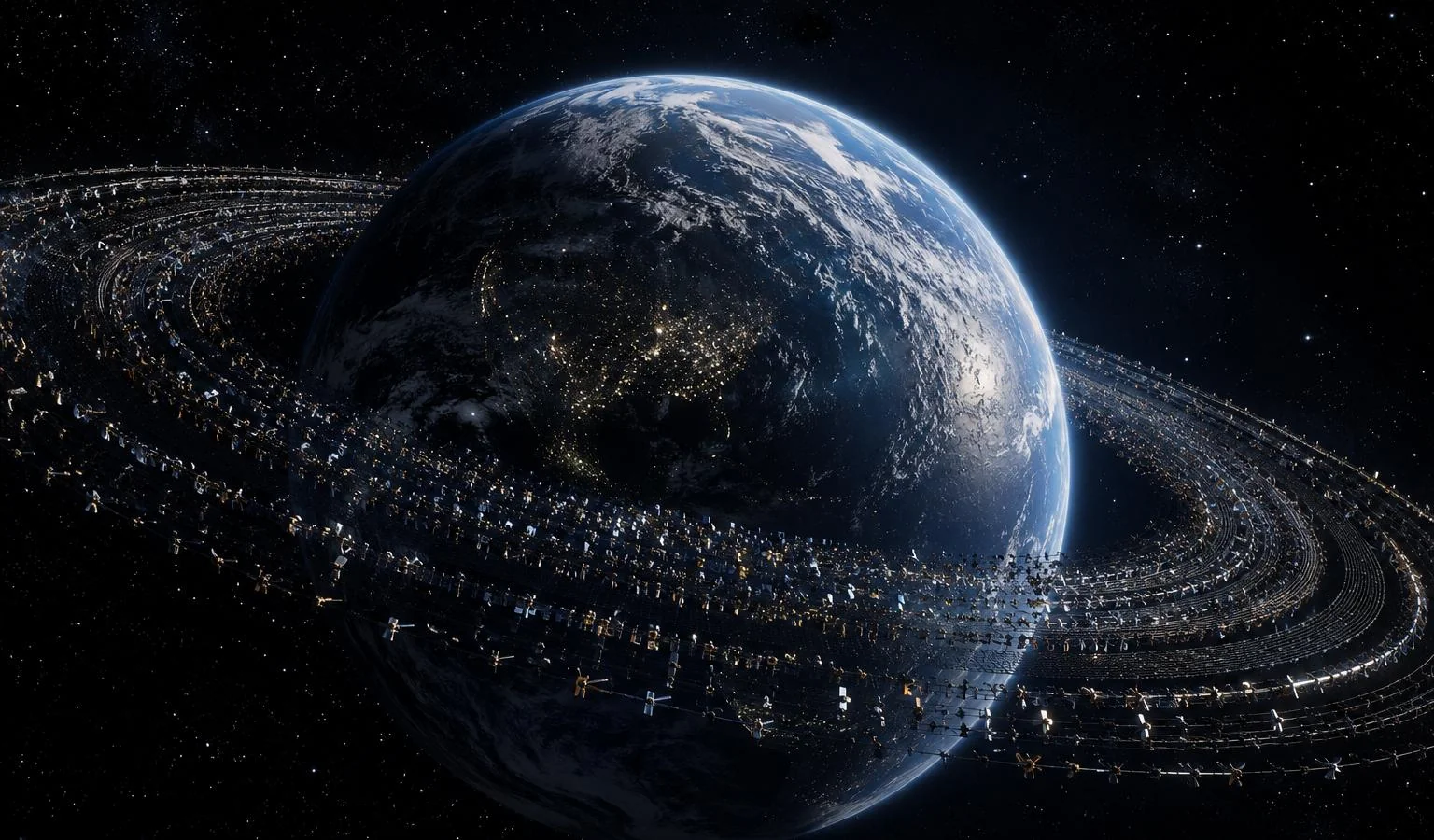
In the near future, Earth may completely change its natural appearance and develop bright rings like Saturn. However, these rings will not consist of ice or dust, but of hundreds of thousands of artificial satellites. Astronomers and space technology experts are warning that projects to create orbital data centers and solar reflectors could radically alter the night sky. This is reported by Ixbt.com reports .
Currently, major companies such as SpaceX, Blue Origin, Starcloud, Cowboy Space, and Orbital are working on creating orbital data centers. According to ixbt.com, fully implementing these projects would require launching over one million satellites into space. Additionally, the company Reflect Orbital plans to deploy 50,000 mirror-equipped devices to illuminate specific areas of Earth after sunset.
Bright lines in space and their consequences
Hugh Lewis, a professor of astronautics at the University of Southampton, explains that such devices are primarily placed along the terminator line—the boundary between Earth's day and night sides. In this region, satellites can receive almost continuous solar energy, which is crucial for orbital servers. If these plans are realized, a massive bright line moving in one direction and located in a single plane will appear in the sky.A team led by astronomer Samantha Lawler from the University of Regina in Canada used computer modeling to study the impact of projects like SpaceX's Starmind, Blue Origin's Project Sunrise, and Cowboy Space. Research results indicate that artificial objects will become so numerous that at certain hours they will appear brighter and more visible than many stars in the sky.
The Reflect Orbital project is of particular concern. The company has already received permission from the US Federal Communications Commission (FCC) to launch the Eärendil-1 experimental device, which features an 18x18 meter mirror. According to calculations by the European Southern Observatory, if 50,000 such mirrors are launched into orbit, the brightness of the night sky will increase by 300 percent. This would make the work of the world's largest telescopes almost impossible.
The American Astronomical Society (AAS) has also sharply criticized the FCC's decision. Experts believe that artificially reflected sunlight not only interferes with scientific observations but also poses the following risks:
- Causing accidents by blinding pilots and drivers;
- Technically interfering with the work of astronomical telescope operators;
- Disrupting the natural rhythms of nocturnal ecosystems.


Comments 0
…