


Large Hadron Collider upgraded: CERN achieves record power
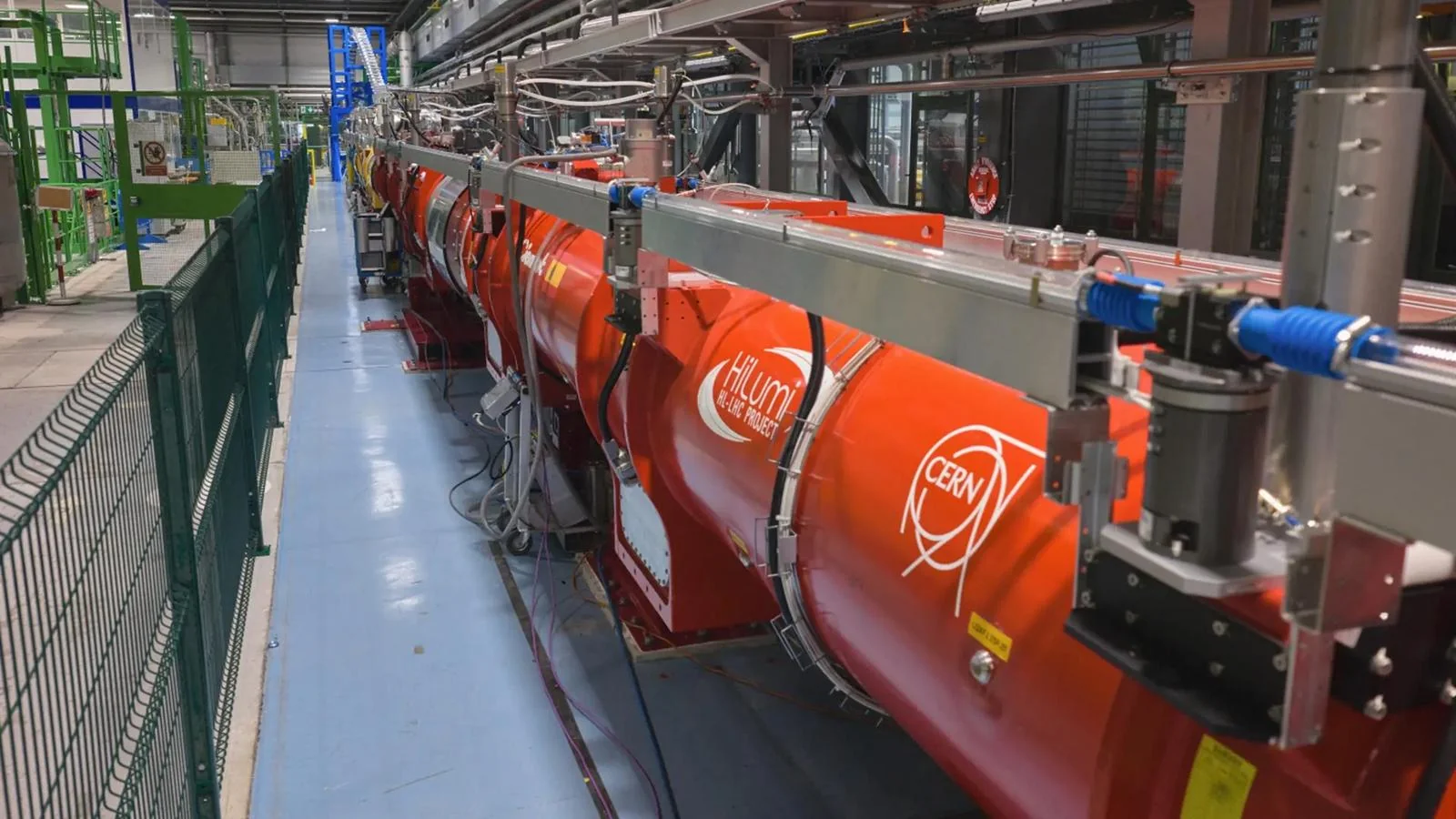
The European Organization for Nuclear Research (CERN) has successfully completed one of the most important milestones in the modernization of the Large Hadron Collider (LHC). At the Inner Triplet (IT String) test facility, engineers managed for the first time to bring the new generation of superconducting magnets to their full calculated operating current of 16,230 amperes. This was reported by Ixbt.com reports .
These tests are being carried out as part of the High-Luminosity Large Hadron Collider (HL-LHC) project. According to ixbt.com, the main goal of this large-scale upgrade is to increase the number of elementary particle collisions several times over. This will allow scientists to collect more experimental data and discover new physical phenomena beyond the Standard Model.
Technological revolution: Niobium-tin compound
The main feature of the new system is manifested in its quadrupole magnets. Unlike the current niobium-titanium conductors, the new magnets use windings made of a niobium-tin compound. This made it possible to increase the magnetic field strength to 11.3 Tesla, which is approximately 35 percent higher than current systems.Engineers also expanded the working channel diameter of the magnets by almost double — from 70 millimeters to 150 millimeters. As a result, proton beams are focused much more precisely before collision. This increases the luminosity of the accelerator, meaning the number of recorded particle collisions increases dramatically.
The most surprising result of the tests is that the magnets reached the calculated operating current immediately without losing their superconducting state (quench). Usually, new magnets require a long-term "training" process, but this time the devices proved their stable operation in nominal mode on the very first attempt.
Safety and future plans
During the experiment, specialists checked all 17 electrical circuits of the complex, including the new dipole magnet that separates the beams after collision. A protection system capable of safely dissipating up to 38 megajoules of energy in a liquid helium environment (at a temperature of approximately −271 °C) was also successfully tested.CERN representatives noted that the completion of this stage means the most complex process in checking the hardware part is behind them. Currently, engineers are analyzing the collected data and optimizing the collider's startup procedures. The next tests are scheduled for September.
The full launch of the High-Luminosity LHC project is scheduled for the beginning of the next decade. This upgrade is expected to open a new era in fundamental physics and fundamentally change our understanding of the structure of the universe.


Comments 0
…