


AMD Announces Unexpected Victory Over Nvidia With New Zen 6 Processors
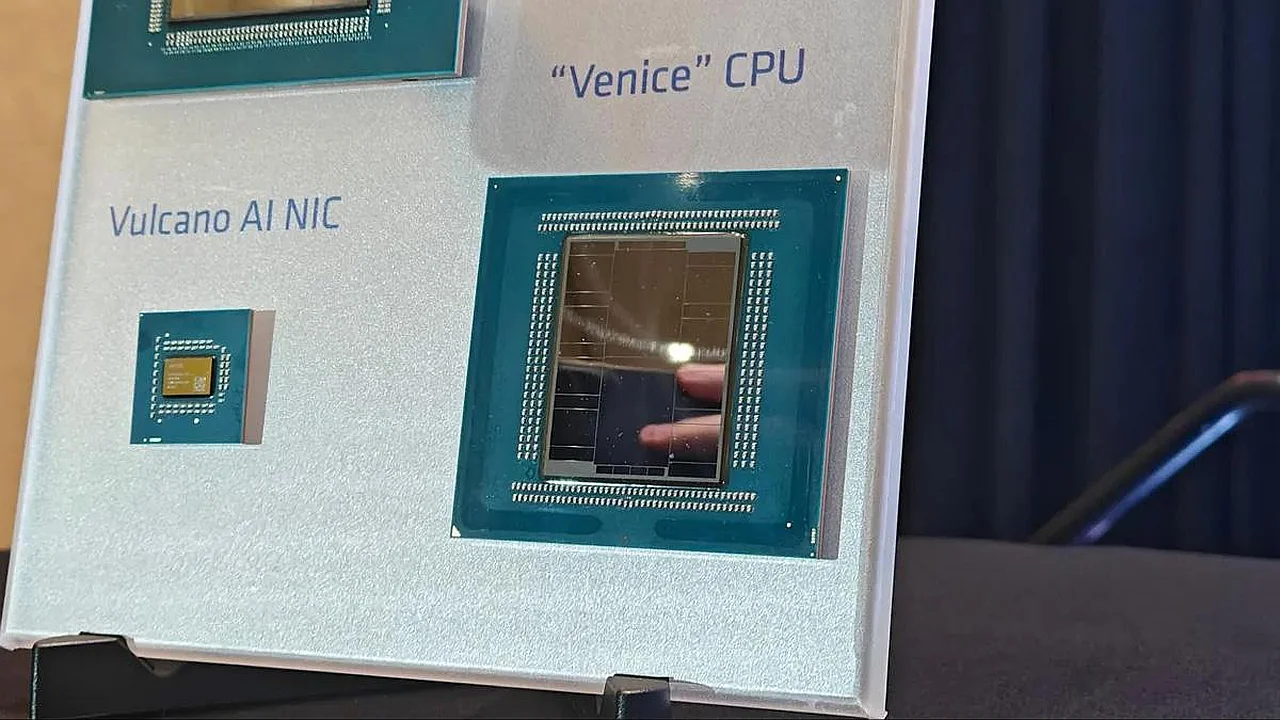
The competition between two major giants in the semiconductor market — AMD and Nvidia — is entering a new phase. AMD announced that its next-generation EPYC Venice server processors based on the Zen 6 architecture have significantly outperformed the Vera chips developed by Nvidia in terms of performance. This was reported by Ixbt.com reports .
Speaking at the Advancing AI 2026 conference, AMD Corporate Vice President Ravi Kuppuswamy noted that engineers initially expected modest results. According to him, the company planned to surpass Nvidia Vera processors by approximately 10 percent, but initial tests demonstrated much higher figures than expected.
Twice the expected result
According to ixbt.com, AMD officials claim that at the current stage, Zen 6 chips are working 20 percent faster than their competitor. The most interesting aspect is that this result was achieved even before final optimization work was completed. This indicates that the balance of power in the server market may shift in AMD's favor in the future.In its calculations, the company relies on SPEC CPU 2026 benchmark results. During the tests, a dual-socket system consisting of 256-core EPYC 9996 Venice processors was compared with the Nvidia Vera platform. Overall, the AMD system outperformed its rival by 2.2 times in computing power.
Difference in core performance
Experts note that comparing overall power might be somewhat inappropriate, as the number of cores in EPYC chips is almost three times higher than in the Nvidia Vera chip. Additionally, the thermal design power (TDP) of AMD processors is 600 W, while for Nvidia's product this figure is 450 W.Therefore, comparing single-core performance is of greater significance. In SPECint tests, it was found that each core of the 96-core EPYC Venice processor is 20 percent faster than the Nvidia Vera core. This exact indicator is considered the main factor showing how efficient the processor architecture is.
However, industry experts advise approaching these figures with caution. So far, the data provided by AMD has not been published in the official SPEC database and has not been verified by independent expertise. For now, these numbers hold only the status of an "estimated evaluation".
This news is of great importance for Uzbek IT specialists and engineers dealing with server infrastructure. Because at a time when data centers (DCs) are developing in our country, the choice of energy-efficient and high-performance processors will help optimize future costs.
To draw a final conclusion, we will have to wait for both companies' products to hit the market and be tested under real workloads in independent laboratories. For now, AMD is limited to declaring its technological superiority.


Comments 0
…