


CERN is testing a neutrino detector prototype at 300 thousand volts
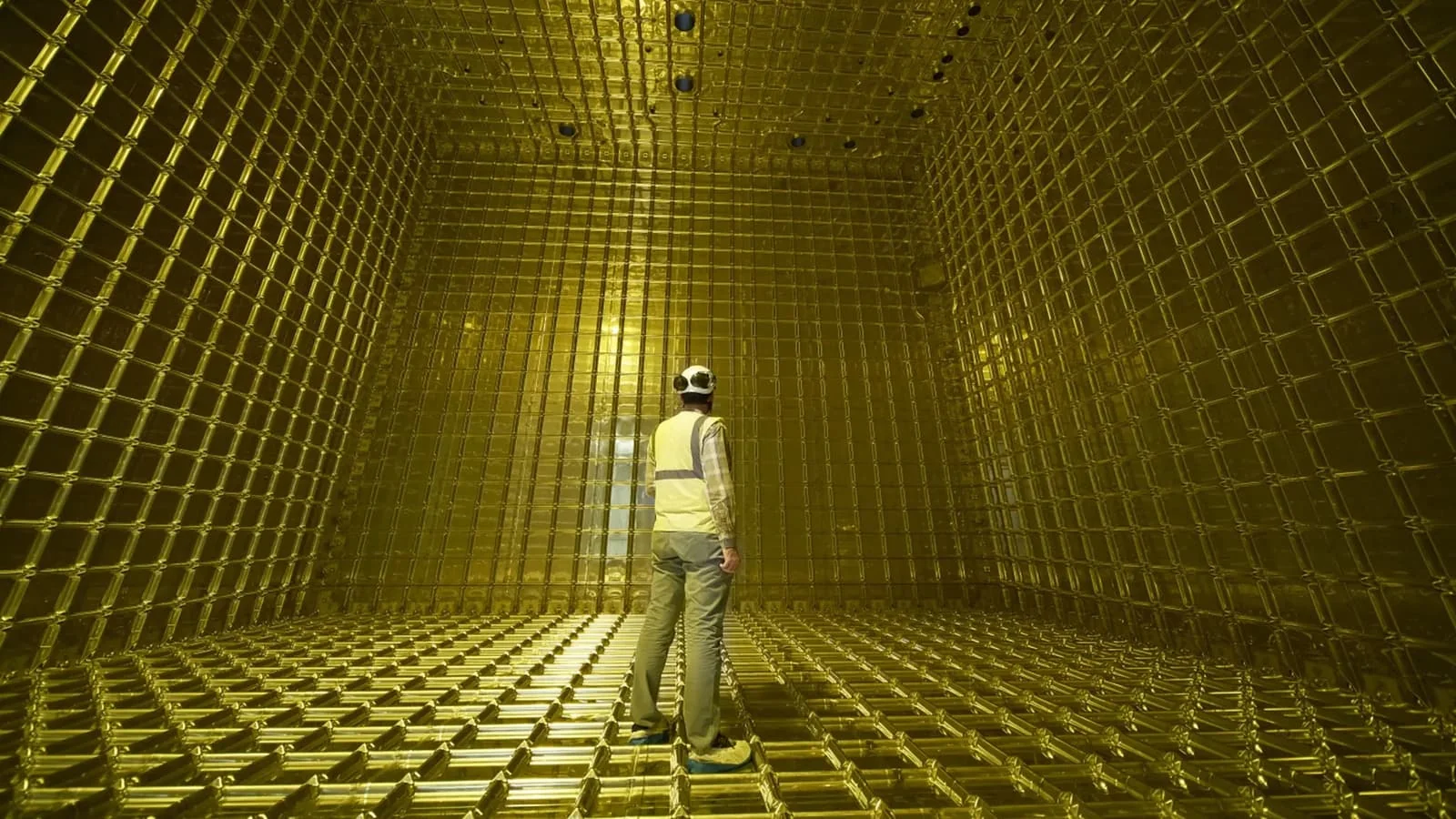
Research centers have taken another important step towards uncovering the secrets of the universe. According to ixbt.com, testing of a detector prototype designed for the future large international DUNE (Deep Underground Neutrino Experiment) project has begun at CERN facilities. Scientists are applying about 300 thousand volts to the device to test its durability under extreme conditions. This is reported by Ixbt.com reports.
Led by the Fermi National Accelerator Laboratory (Fermilab) under the US Department of Energy, the main goal of this massive project is to determine why significantly more matter than antimatter remained in the universe after the Big Bang. Answering this fundamental question is expected to help explain the reasons for the existence of stars, planets, and life in general.
Revolutionary design and ultra-high voltage
Currently, tests are being carried out using a full-scale prototype called ProtoDUNE Vertical Drift. Researchers abandoned traditional wire readout elements in the new design in favor of industrial printed circuit boards. This approach significantly simplifies detector manufacturing, reduces the number of components, and allows for more efficient recording of neutrino interactions.At the same time, the new scheme has a specific feature: electrons are required to travel almost twice the distance inside liquid argon before reaching the system. For this process to take place without any losses, it is necessary to create a super-strong electric field inside the detector. That is precisely why engineers are testing the equipment under a stress of around 300 kilovolts.
Underground laboratory and guarantee for decades
According to Steve Kettell, one of the technical leaders of the project, specialists are deliberately operating the system in limited and extreme modes. If electrical breakdowns occur during the testing process, this will make it possible to identify the weak points of the design in advance and ensure that the equipment works continuously for decades.This safety margin is of utmost importance because once construction is completed, the main DUNE detectors will be installed at a depth of nearly 1.5 kilometers at the Sanford Underground Research Facility in South Dakota, USA. Once the reservoirs are filled with liquid argon, the opportunity to service the equipment will be limited, so all potential problems must be eliminated in advance.
During operation, DUNE will record the rarest collisions of atoms with neutrinos, allowing scientists to determine the energy, motion direction, and type of these particles. Furthermore, the device can record the neutrino flux resulting from supernova explosions even before the light reaches Earth. If the tests, which will continue until the autumn of this year, are successfully completed, this technology will become the foundation for the largest physics experiments in the coming decades.


Comments 0
…