


Did the "Rassvet" Satellite Network Start Signaling Over Ukraine?
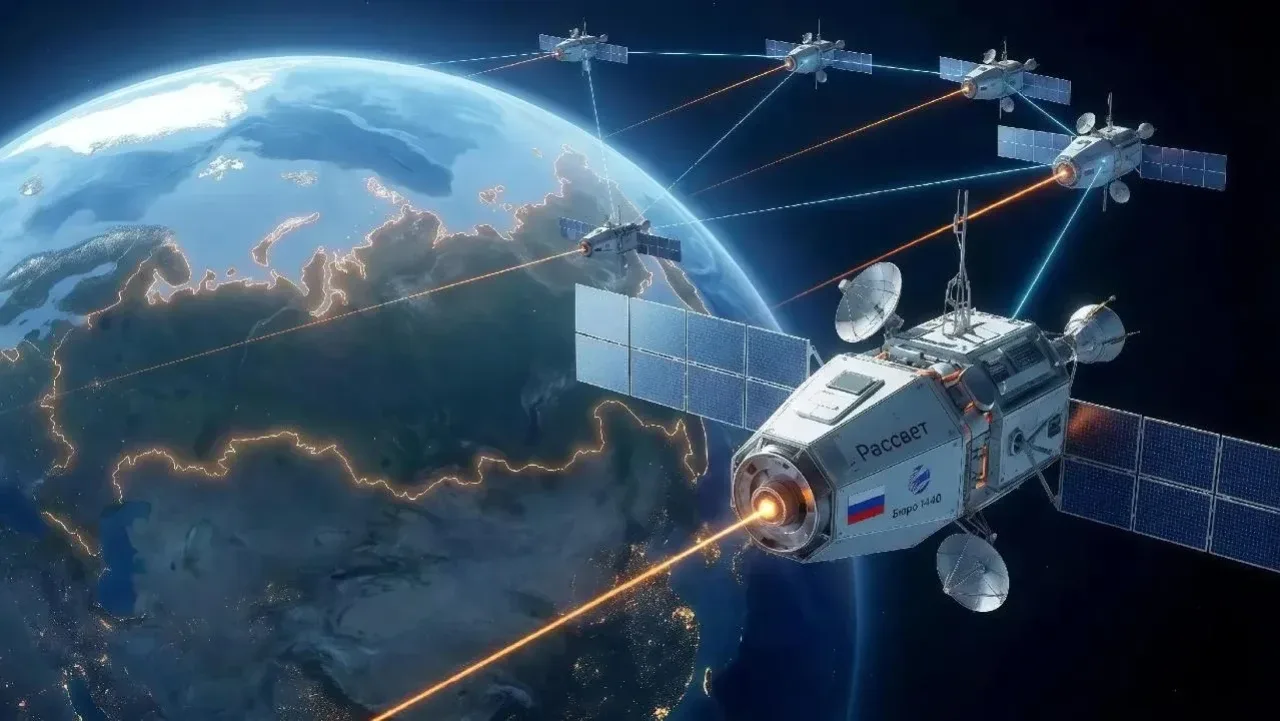
Russia's "Rassvet" satellite network, created as an alternative to Starlink, may be getting closer to establishing communications over Ukrainian territory. According to an analysis by the Ukrainian military publication "Militarniy", the launched spacecraft are creating communication "windows" that sometimes last for over an hour.
However, there is a crucial difference: this is not yet about an active, uninterrupted internet service, but rather expert calculations based on the satellites' flight paths and theoretical coverage.
Coverage over Ukraine is reported to occur twice a day
Ukrainian satellite communications expert Volodymyr Stepanes analyzed the orbital paths of the "Rassvet" spacecraft.
According to his assessment, the satellites can provide relatively stable coverage over Ukrainian territory at least twice a day. Each such period is said to last for more than an hour.
According to the expert, because the spacecraft move in several chains, certain areas may fall into their field of view approximately every 90 minutes.
Previously, an analysis observing only three experimental satellites estimated each communication window over Ukraine to be around 15–20 minutes. The addition of new spacecraft may have extended the theoretical coverage time.
However, active communication has not yet been confirmed
The flyover of a satellite above a specific area does not automatically mean that internet communication is working there.
For this to happen, the following are necessary:
Activation of all satellite communication systems;
Presence of a compatible subscriber device on the ground;
Operation of the network's management and gateway infrastructure;
Configuration of appropriate frequencies and software systems.
Official information from "Bureau 1440" stated that the second group of satellites was launched on July 19, and the spacecraft established contact with the control center. However, they will only move to their designated orbit and prepare for service after checks are completed.
Therefore, the notion that "several hours of communication are already provided" over Ukraine is currently better interpreted as an expert's orbital calculation rather than a proven fact.
What is the "Rassvet" system?
"Rassvet" is a low-Earth orbit broadband communication network being developed by the Russian company "Bureau 1440". In terms of its purpose, the project is similar to SpaceX's Starlink system.
Its satellites are designed to:
Utilize 5G NTN communication architecture;
Transmit data between spacecraft via laser;
Feature a plasma propulsion system;
Deliver high-speed data to specialized ground terminals.
On March 23, 2026, the first 16 serial spacecraft were launched into orbit. Later, public orbital tracking data circulated indicating that one of them failed to reach its designated altitude and re-entered the atmosphere.
On July 19, the second group was launched. This time, the company did not disclose how many spacecraft were put into orbit.
When might Russia achieve uninterrupted communication?
According to the official plans of "Bureau 1440", the commercial launch of the network is scheduled for 2027. To provide round-the-clock global communication, launching over 250 spacecraft into orbit is planned.
According to Volodymyr Stepanets' calculations, if the current launch pace is maintained, Russia could achieve continuous coverage over Ukraine by mid-2027.
However, this timeframe depends on a number of factors:
Production speed of new satellites;
Rocket launch capabilities;
Technical reliability of the spacecraft;
Readiness of ground terminals;
International sanctions and component supplies.
Therefore, mid-2027 is not a fixed date, but a forecast based on the current pace.
Why is this important for Ukraine?
Starlink has become a vital communication tool for frontline units, unmanned vehicles, and command systems in the Russia-Ukraine war. This experience has dramatically increased the military significance of low-Earth orbit satellite networks.
If "Rassvet" is fully deployed, it could provide Russia with the ability to:
Create mobile and backup communication channels;
Transmit data when regular terrestrial networks fail;
Connect military and civilian facilities in remote areas;
Expand capabilities for controlling certain unmanned systems.
However, orbital coverage alone does not mean all these tasks have been realized. Military use requires specialized terminals, protected software, and an entire management infrastructure.
It is too early to equate it with Starlink
"Rassvet" is often called "Russia's Starlink". While such a comparison is appropriate in terms of purpose, the systems are not equal in their current scale.
Starlink has thousands of active satellites, massive manufacturing capacity, and extensive ground infrastructure. "Rassvet" is still in its initial deployment phase, and its commercial service has not officially launched.
Therefore, it is premature to say that Russia has created a fully functioning Starlink alternative. However, the rapid development of the project makes it a technological and security factor that cannot be ignored.
Main Conclusion
According to the analysis by the Ukrainian expert, "Rassvet" satellites have begun forming a denser orbital coverage over Ukraine than before. Certain communication opportunities may last over an hour and repeat multiple times a day.
However, this does not yet mean that Russia has established a working satellite internet service on Ukrainian territory. The information relies on expert estimates based on orbital paths, and the operator has only confirmed that spacecraft deployment and testing work are ongoing.
Now the main question is — will Russia be able to launch the planned hundreds of spacecraft on time and turn "Rassvet" into a truly uninterrupted communication system? Leave your assumptions in the comments!



Comments 0
…