


Scientists Learn to Predict Mars Weather Using Artificial Intelligence
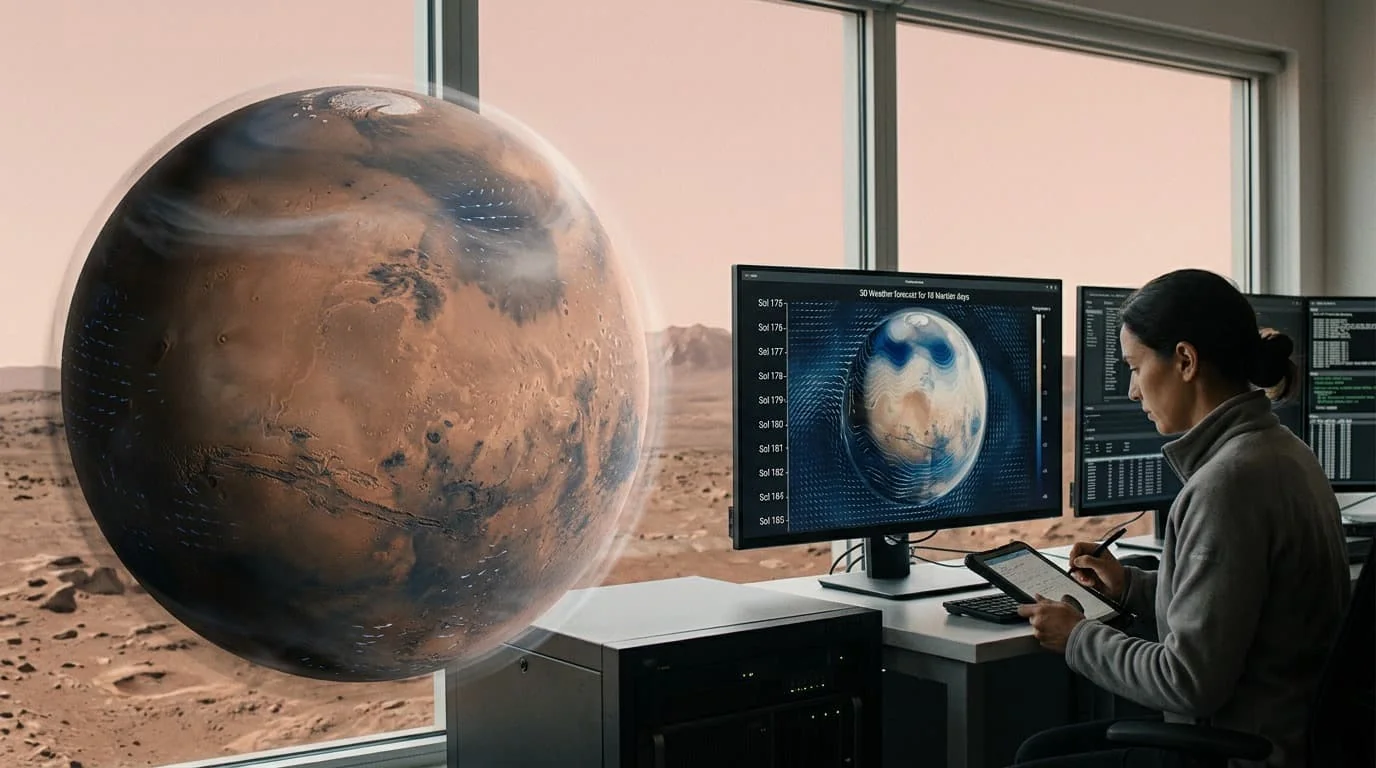
According to Ixbt.com, researchers successfully tested whether an artificial intelligence model designed to predict Earth’s atmosphere could be adapted to the challenging conditions of another planet—Mars. The new MarsCast system, based on GraphCast, a graph neural network model developed for Earth, made it possible to calculate Red Planet weather with unprecedented speed and accuracy. Ixbt.com reports .
Initially, although the model accurately reflected Mars’s current atmospheric state using knowledge acquired under Earth conditions, it soon lost its dynamics and failed to fully reproduce daily temperature variations. To address this problem, the scientists decided to retrain the model using data from the Mars Climate Database (MCD).
The MarsCast Model and How It Works
During the system’s improvement, temperature as well as horizontal and vertical winds were taken into account. Solar radiation at the upper boundary of the atmosphere was also added as the key factor determining planetary heating. Humidity was simplified and kept constant because, although actual relative humidity on Mars remains below 10 percent most of the time, it can briefly rise to saturation levels before dawn.After just 10 training epochs, MarsCast began reconstructing a reliable daily temperature cycle on Mars. After 300 epochs based on only 30 days of data, the model became significantly more stable and continued to improve. As a result, it accurately represented seasonal and vertical structures, as well as wind movement patterns, in 10-day forecasts.
Computational Speed and Future Plans
One of the biggest achievements of the new approach is its speed and efficiency. According to the data, MarsCast calculates a 10-day forecast with a 6-hour time step and 1° resolution in just 2 minutes using a single GPU. By comparison, a conventional physics-based model requires 1 CPU, takes 30 minutes for the same forecast, and operates at a lower resolution of 5°.The researchers note that Earth-based meteorological artificial intelligence models can partially reproduce the dynamics of other planets, but adaptation is essential because of major differences in atmospheric chemical composition, radiation balance, and thermal inertia. In the next stage, the authors plan to add dust transport and its effect on radiation, as well as test the system using data from orbiters and surface stations. In the future, such technologies could help plan crewed and robotic missions, including the early assessment of dust storm risks.


Comments 0
…