


Cable bacteria found to grow metal-organic wires
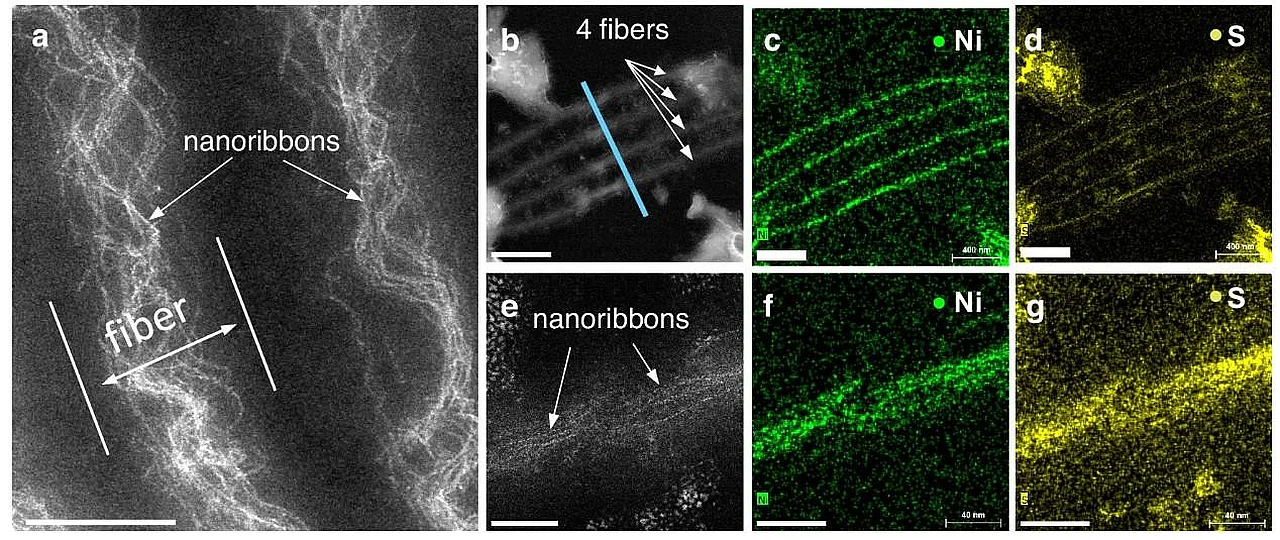
Scientists at the University of Antwerp have discovered that multicellular cable bacteria living in river and sea silt naturally grow a metal-organic framework—a material humans usually synthesize in laboratories. According to ixbt.com, such living systems were previously thought to lack this capability. This is reported by Ixbt.com reports .
For a decade, researchers have been amazed that these microorganisms can conduct electric current over distances thousands of times longer than their body size—spanning centimeters. The mechanism behind such long-range electron transport, which is atypical for biological systems, had remained a mystery.
In a new study, experts conducted atomic-level examinations and discovered that inside the bacteria, there are not simple proteins or iron-sulfur clusters, but a precisely ordered nickel-organic structure. These filamentous organisms live at the interface of oxic and anoxic zones, where cells in the deep layers capture electrons from hydrogen sulfide, and those on the surface release them to oxygen.
Unique conductivity and its secret
The electrical conductivity of these conductive fibers was previously proven to reach up to 500 S/cm. Using electron microscopy, X-ray spectroscopy, and computer modeling, scientists showed that the conductivity center is a complex called NiBiD.Each conductive fiber contains 11 nanoribbons with a thickness of 1.4 nanometers in its central channel, twisted like a multi-strand copper wire. A nickel atom is held by four sulfur atoms in an organic molecule, creating an overlap of electron clouds.
Prospects for practical application
Bacteria form these ordered nanoribbons through self-assembly at room temperature in an aqueous environment. This is highly energy-efficient, in contrast to the energy-intensive processes required for synthetic polymer production.Researchers state that the most realistic application could be flexible printed electronics, where conductive inks are applied in layers to create circuits and sensors.
The main obstacle to implementing the technology is the cost of scaling. Experts must first prove that the biomaterial can be produced in an economically viable way and that its properties are not inferior to current electronic inks.


Comments 0
…