


Closest black hole to Earth discovered in space
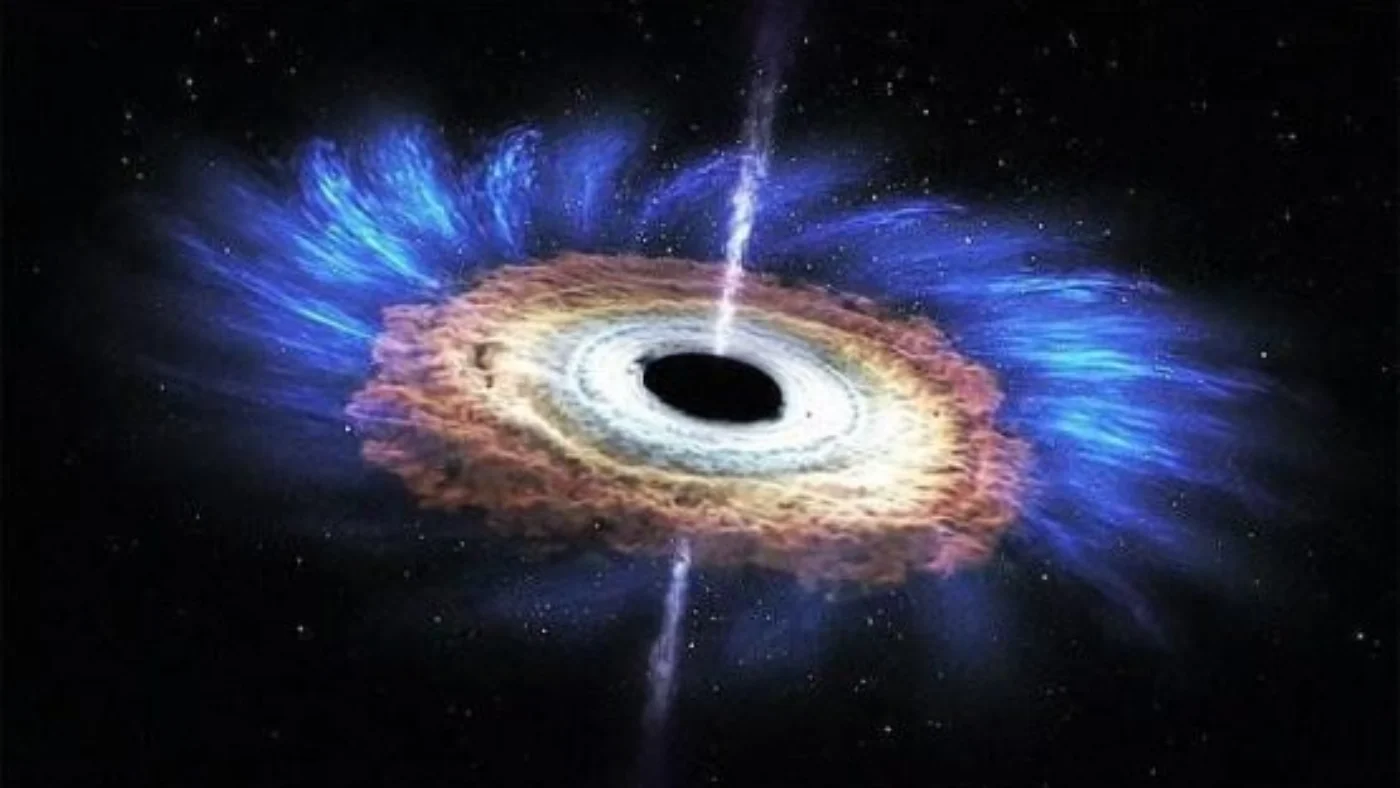
The James Webb Space Telescope (JWST) has identified a supermassive black hole. Scientists believe this discovery could fundamentally change existing theories about the formation of the Universe. This was reported by the University of Cambridge's 'Universe Today' journal.
It is reported that an international team of researchers led by the University of Cambridge discovered a massive black hole with a mass approximately 50 million times that of the Sun. It likely appeared even before the stars in its host galaxy. This mysterious object, named QSO1 or Abell2744-QSO1, was found using the James Webb telescope.
Experts note that this finding challenges traditional views on how black holes form. Previously, scientists believed that massive stars formed first, then collapsed into black holes, and grew over time by consuming matter.
However, new data shows that QSO1 had a massive size at a time when stars had barely formed in its galaxy. Analyses showed that the gas around the object consists mainly of hydrogen and helium, with almost no heavy elements that are typically produced after stellar activity.
Scientists managed to measure the object's mass through the gravitational lensing effect of the Abell 2744 galaxy cluster, known as 'Pandora's Cluster.' This effect amplified the light coming from distant objects, allowing for precise observation.
According to further analysis, the majority of the system's mass is concentrated in the central black hole rather than in stars. Researchers estimate that the black hole accounts for nearly two-thirds of the total system mass.
The authors suggest that this object may have formed from 'heavy seeds' that appeared after the Big Bang or resulted from the direct collapse of massive gas clouds.
Interestingly, the JWST telescope has also identified hundreds of similar objects, now called 'little red dots.' This implies that such systems may have been widespread in the early Universe.


Comments 0
…