


Voyager probes encounter a 50,000-degree 'plasma wall' — what surprised scientists?
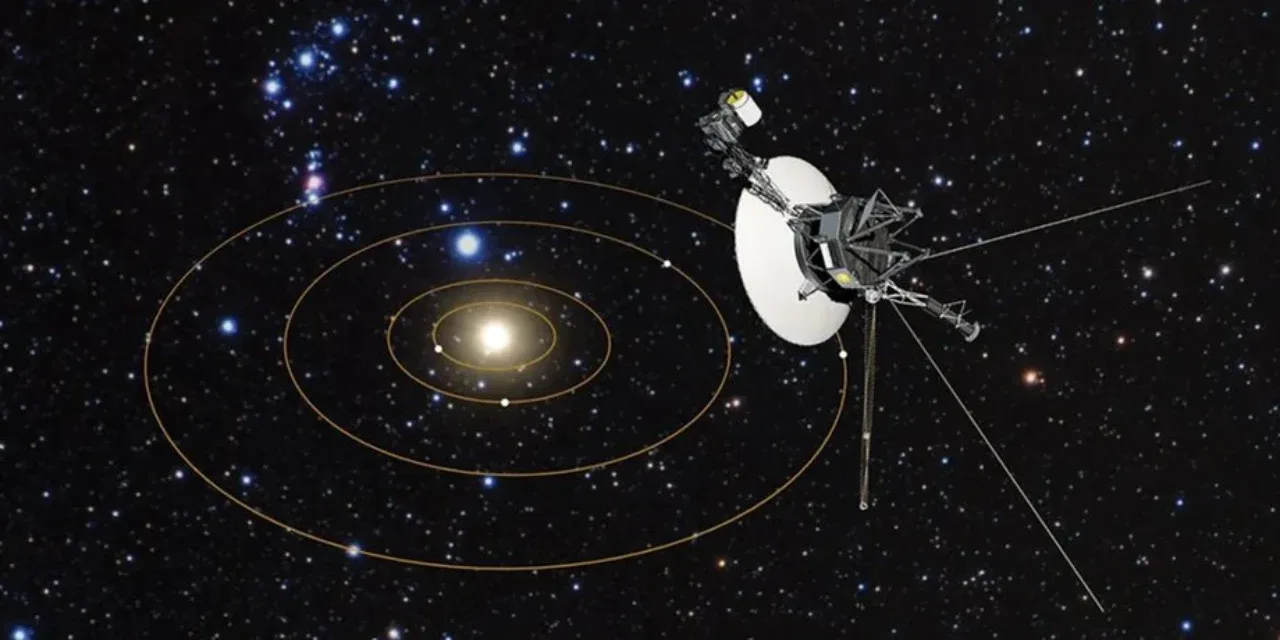
Launched nearly half a century ago, NASA's legendary Voyager 1 and Voyager 2 spacecraft have recorded an unexpected phenomenon at the outer reaches of the solar system. According to the influential iflscience.com scientific portal, the research probes encountered an incredible temperature at the threshold of interstellar space, twice as high as expected — between 30,000 and 50,000 Kelvin (almost the same on the Celsius scale).
Collision of the heliopause and interstellar space
Complex processes are taking place at the boundary where the solar wind and the interstellar medium collide:
What is a 'plasma wall'?: It is not a solid barrier, but the transition region — the heliopause — where the flow of charged particles emitted by the Sun (the heliosphere) meets the interstellar medium;
Much hotter than expected: Theoretical calculations suggested that the temperature beyond the boundary would be around 15,000 to 30,000 Kelvin. However, the 30,000–50,000 degrees recorded by Voyager 2 instruments completely updated scientists' hypotheses;
Transition zone and sharp changes: At the threshold of the heliopause, there is a unique buffer zone with a width of 1.5 astronomical units (larger than the distance between the Earth and the Sun). There, the plasma flow slows down, the temperature rises, and its density changes drastically in less than a day.
Why didn't the probes burn up at 50,000 degrees? A physics puzzle
The fact that the space probes did not break down or melt at such extreme temperatures is explained by the laws of fundamental physics:
Temperature vs. heat: In the conditions of open space, high temperature does not mean standard heat transfer, but rather the exceptionally high kinetic energy of individual particles;
Particle sparsity: Because interstellar plasma is extremely sparse and diffuse, the number of particles there is not nearly enough to transfer real heat to the probe's body;
Unobstructed flight: It is precisely because of this vast emptiness that the Voyager probes passed through this 'fiery barrier' without any damage and continued their journey.
Half-century mission: A step toward new discoveries
These historic spacecraft are still transmitting important scientific signals from regions unknown to humanity:
Historic milestone: Voyager 1 crossed this boundary in 2012, and Voyager 2 in 2018, becoming the first human-made objects to reach interstellar space;
Unexpected magnetic field: Voyager 2 discovered that the direction of the magnetic field in interstellar space is almost the same as in the inner zone dominated by the Sun, which has become another mystery for experts in the field;
Continuous data: Even today, the probes continue to send invaluable scientific data to Earth regarding interstellar plasma density and the parameters of the open galactic environment.
Don't you think that the fact that such devices, built in the 1970s and operating for nearly half a century, are still transmitting data from the depths of space is the pinnacle of human engineering? What other surprising secrets await us outside the solar system? Leave your thoughts in the comments!



Comments 0
…