


Why does a honeybee die after stinging? There is a fascinating mechanism behind its sting...
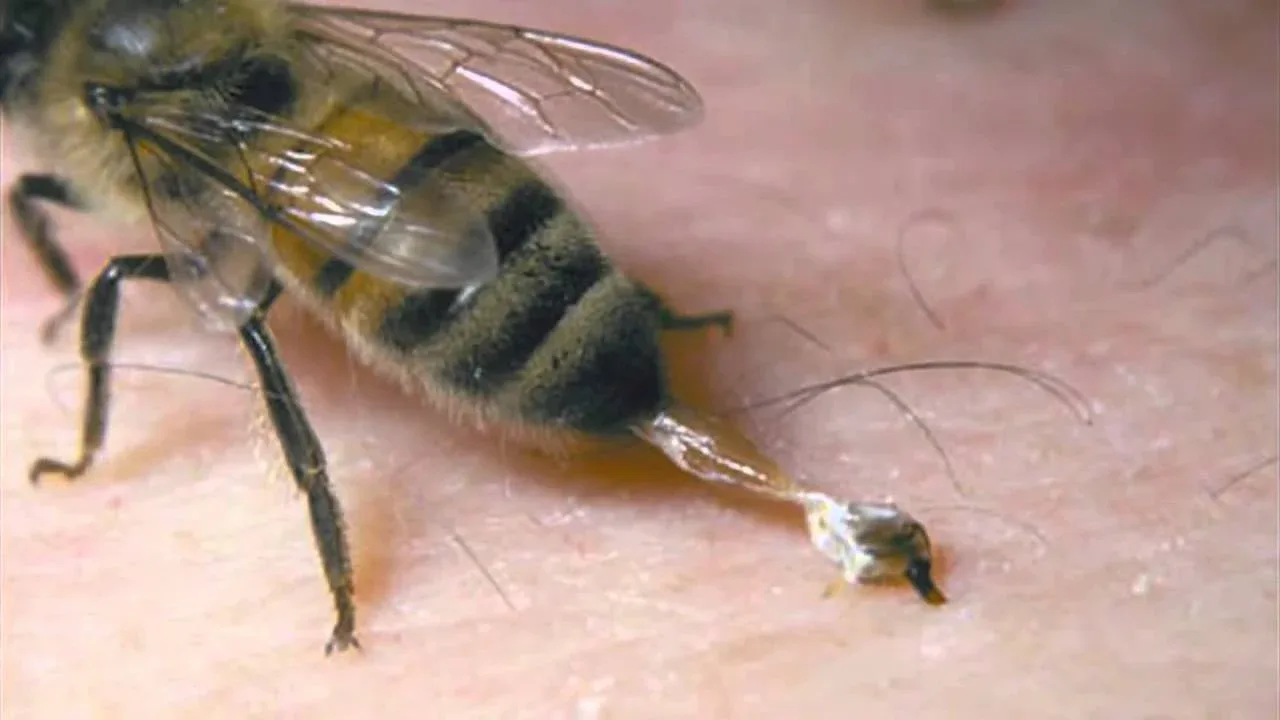
A honeybee stings. A few minutes later, it dies. Why has such a strange mechanism formed in nature? In fact, the death of a bee is not related to running out of venom, but rather to severe damage that occurs in its body during the stinging process.
Many people have a simple understanding that "a bee dies because it stings." But a much more complex biological process lies behind this event.
Most interestingly, a bee does not always die after stinging. This mainly depends on whom it has stung.
What "secret" is inside a bee's stinger?
At the rear part of the bee's body, there is a special stinger connected to a venom gland.
Unlike the stingers of many other insects, it has tiny barbs. These barbs cause the stinger to get firmly hooked into the victim's skin.
When a bee stings a human, the stinger may remain stuck inside the skin.
And the bee tries to fly away.
This is where the most unusual process in nature begins.
Why can't the bee pull its stinger back?
Because human skin is relatively thick and elastic, it is impossible to easily detach the bee's stinger.
As the bee tries to fly away, the stinger does not separate from the skin, and it may tear off along with a portion of the tissues in the bee's abdomen.
As a result, severe damage occurs in the bee's body.
That is, the bee dies not because its venom runs out, but because a vital part of its body is damaged during the sting.
However, this does not happen with all creatures
There is an important aspect here.
The barbs on a bee's stinger hook well into the skin of humans or other mammals.
However, the bodies of other insects are structured differently.
Therefore, when a bee stings certain insects, it can retract its stinger and survive.
Thus, the idea that "if a bee stings once, it will definitely die" is not entirely correct.
This situation is mainly associated with worker bees stinging mammals like humans.
The most amazing aspect — the bee does not release all its venom instantly
Many people think that once a bee removes its stinger from the skin, the venom-delivery process stops immediately.
In fact, even after the stinger has detached from the skin, its venom apparatus can continue to function for some time.
Therefore, it is important to remove the stinger from the skin as quickly as possible.
However, one should avoid squeezing and crushing it during this process. In practice, methods such as carefully scraping the stinger off are used.
Why did nature create such a mechanism?
At first glance, this is a huge "sacrifice" for the bee.
After all, once it stings an enemy, it may perish itself.
However, from the perspective of nature, this mechanism serves to protect the colony.
The most important thing for a bee is not the life of a single worker bee, but the survival of the entire family.
The sacrificing bee manages to protect its colony. Meanwhile, the stinger and part of the venom apparatus remain in the enemy's body, continuing to exert the effect of the venom.
In this sense, the loss of a single bee serves as the "price" for the safety of the entire hive.
This is not "suicide" for bees
When a bee stings a human, its goal is not to kill itself.
It is trying to eliminate a threat and protect itself and its colony.
Its death is an anatomical consequence of the stinging mechanism.
Thus, it is correct to understand this phenomenon in nature not as a conscious decision of self-sacrifice, but as a defense mechanism formed during the course of evolution.
Why don't male bees sting humans?
There is another interesting fact.
Not all bees in the hive have the same duties.
Worker bees are female bees, and they perform tasks such as cleaning the hive, gathering food, caring for larvae, and protecting the colony when danger arises.
Male bees have a different role and usually do not have a stinger.
Therefore, the bee that can sting a human and leave its stinger behind is mainly a female worker bee.
Why does a bee need such an "expensive" defense method?
Because the hive is not just a simple shelter for bees.
It contains honey, wax, larvae, and the future of the entire colony.
When danger arises for a single bee, it protects not just its own life, but the entire hive.
Therefore, the defense mechanism in bees turned out to be more effective from the standpoint of colony safety rather than individual survival.
The most important conclusion
The death of a bee after stinging is one of the strangest yet evolutionarily logical mechanisms in nature.
What kills it is not the venom. The main reason is that the stinger gets stuck in the skin of a mammal, and when the bee tries to break away, part of its body is damaged.
At the same time, this rule does not apply to all situations: when a bee stings other insects, it can retract its stinger and survive.
That is the most fascinating part of nature: behind a few seconds of an action that looks like a simple "sting" to a human, anatomy, the poisoning mechanism, and millions of years of evolutionary adaptation are hidden.
And perhaps the most interesting truth about the bee is this:
it does not sting to kill itself — it stings to protect its colony. Death is a tragic consequence resulting from that defense mechanism.



Comments 0
…