Should Telegram messenger be banned in Uzbekistan as well?
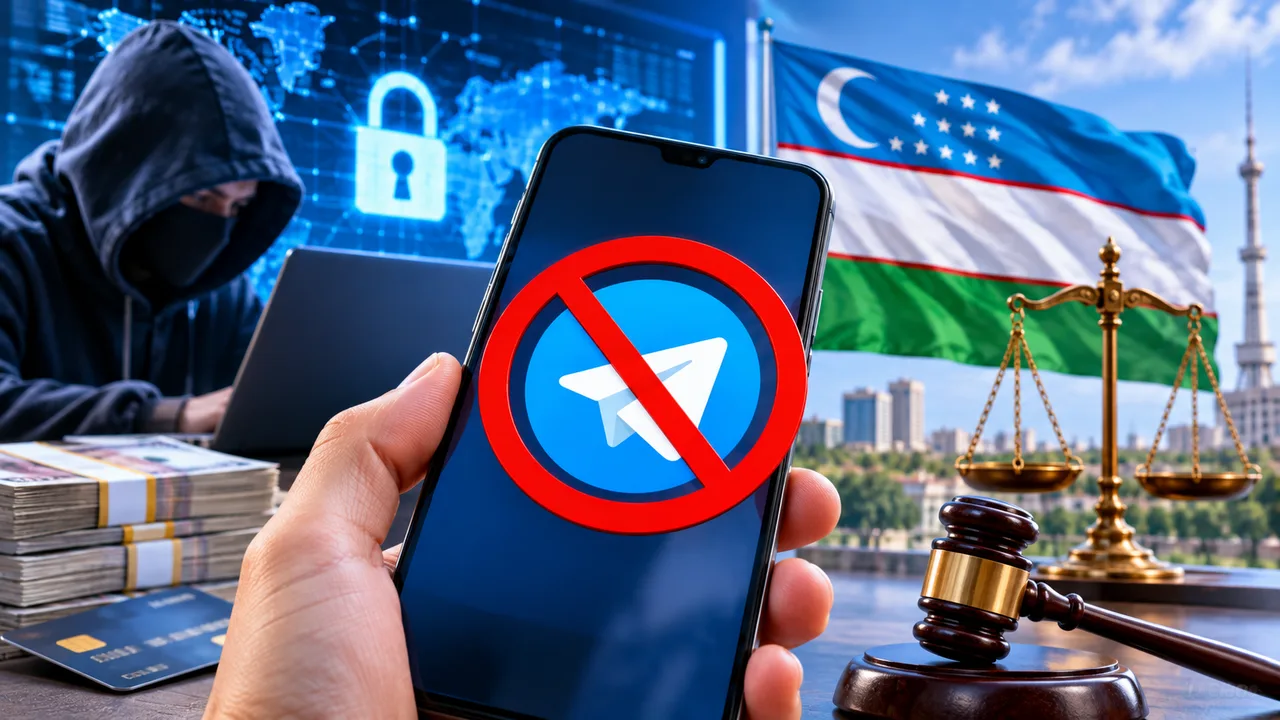
On November 16, 2026, Jordan and Iraq made the drastic decision to block the Telegram messenger. This news has brought an important question to the forefront in Uzbekistan: should our country also ban Telegram to combat fraud that threatens citizens' money, personal data, and security?
The issue is not being raised without reason. According to the Central Bank of Uzbekistan, in the first nine months of 2026, scammers compromised citizens' Telegram accounts in 2,808 instances. The financial damage resulting from these incidents amounted to 21.9 billion soums.
However, do these figures mean the messenger should be banned entirely? Or does the solution to the problem lie elsewhere?
How many people have fallen victim to scammers via Telegram?
Cybercrime and internet-based fraud are becoming a serious problem in Uzbekistan. In particular, incidents involving the takeover of Telegram accounts, fake voting contests, requests for money in the name of acquaintances, and deceiving citizens through suspicious links and malicious files are becoming frequent.
The Central Bank analyzed complaints received by the Ministry of Internal Affairs' "Cardblock" platform between January 1 and October 1, 2026.
The results are noteworthy:
Type of fraud | Recorded cases | Damage caused |
|---|---|---|
Telegram account takeovers | 2,808 | 21.9 billion soums |
Installation of malicious files | 18,830 | 79.3 billion soums |
Following instructions given over the phone | 611 | 27.7 billion soums |
Fake trading platforms | 1,044 | 15.1 billion soums |
Deception with promises of multiplying money | 1,086 | 14 billion soums |
Prepayment for online purchases | 3,571 | 10.5 billion soums |
In total, the financial damage caused to citizens based on the analyzed complaints reached 278.3 billion soums. As a result of emergency measures, 113.1 billion soums were successfully blocked.
It is important to understand a key distinction here: not all of the 278.3 billion soums relates to fraud committed via Telegram. The damage from the 2,808 separately recorded cases involving Telegram account takeovers amounted to 21.9 billion soums.
Nevertheless, this figure alone shows that the issue of digital security must be approached seriously.
Why did Jordan and Iraq ban Telegram?
On November 16, 2026, the Jordanian government announced it would block Telegram within the country. Authorities justified the decision by citing the need to strengthen digital security, prevent cybercrime, threats, and extortion, as well as combat the spread of extremist materials.
Iraq also announced restrictions on the messenger's operations on the same day. The country's Media and Communications Commission accused Telegram's administration of failing to comply with local legal requirements and failing to take necessary measures to remove illegal content.
Iraqi officials stated that the company had been given a 30-day period to bring its operations into compliance with legal requirements.
The decision in Jordan was made against the backdrop of heightened security measures following a bloody attack on a church in the south of the country. However, there is no official confirmation that the attack was organized specifically via Telegram.
Thus, the decisions of the two countries are based not on the same reason, but on different situations related to national security, illegal content, and the responsibility of platforms.
Should Uzbekistan follow suit?
The arguments of those in favor of a total ban on Telegram are understandable. In their view, if the platform is used to deceive people, steal money, distribute personal data, and facilitate criminal activity, the state must take drastic measures to prevent such risks.
The main arguments for this approach are as follows:
Financial security of citizens. Scammers are appropriating people's funds through fake contests, investment offers, and requests for money in the name of acquaintances.
Protection of personal data. When accounts are compromised, personal correspondence, phone numbers, and other information are also put at risk.
Combating illegal content. Fraud, extortion, threats, and harmful materials can be spread through certain channels and groups.
Platform responsibility. Cooperation from the messenger's administration is essential in identifying and blocking accounts and channels that violate user rights.
However, those against a ban also have serious arguments.
Will closing Telegram solve the problem?
In Uzbekistan, Telegram serves a much broader purpose than just a simple messaging tool. It is used to distribute news, send educational materials, facilitate communication between entrepreneurs and customers, process small business orders, and allow various organizations to connect with their audience.
Therefore, a complete block of the messenger could affect the daily lives of millions of users.
Furthermore, Telegram is not the sole source of fraud. The Central Bank's own statistics record separate instances involving malicious files, phone calls, fake trading platforms, and online purchases.
Even if Telegram were banned, criminals could continue their activities through other messengers, social networks, phone calls, or fake websites.
Technically, blocking does not eliminate all risks either. Some users will attempt to bypass restrictions using tools like VPNs. This does not mean the root of the fraud has been eradicated.
Most importantly, a criminal cannot be equated with an ordinary user. The rights and interests of millions of people using the platform legally must also be taken into account.
What measures could be effective instead of a ban?
Instead of completely shutting down Telegram, strengthening specific and targeted measures against fraud could be a more effective approach.
1. Rapid blocking of fraudulent accounts and channels
It is necessary to establish a mechanism for rapid cooperation between law enforcement agencies, cybersecurity experts, and the Telegram administration. The process of investigating and restricting accounts involved in fraud should not be delayed.
2. Strengthening the protection of banking and payment systems
Scammers often use bank cards and electronic payments to obtain a victim's money. Therefore, it is important to improve mechanisms for detecting suspicious operations, quickly stopping dangerous transactions, and recovering funds.
3. Increasing the digital literacy of the population
Citizens need to be educated on what fraud schemes are hidden behind fake voting contests, suspicious links, malicious APK files, and promises of multiplying money.
4. Popularizing the protection of Telegram accounts
Enabling two-step verification, not sharing access codes with anyone, not opening unknown links, and not downloading suspicious files should become a simple rule for every user.
5. Setting clear responsibilities for platforms
Messengers should have clear requirements to protect users within the framework of the law, review complaints regarding materials related to criminal activity, and cooperate with authorized agencies.
What should every user know to protect themselves from scammers?
The Central Bank recommends that citizens follow a series of simple but important security rules:
Do not install unknown APK files received via Telegram or other messengers.
Do not give anyone your bank card details or confirmation codes received via SMS.
Enable two-step verification on Telegram.
Do not trust offers that promise quick and easy money.
Check the reliability of a seller before making an online purchase.
If you notice that a stranger has accessed your account, immediately check its security settings.
If you fall victim to fraud, contact your bank or payment organization immediately, as well as law enforcement agencies.
The main question: Should Telegram be banned?
The decisions of Jordan and Iraq show that every country has the right to evaluate the operations of digital platforms from the perspective of national security and legislation. However, a measure applied in one country is not automatically the right solution for another.
There is no doubt that fraud committed via Telegram is a serious problem in Uzbekistan. 21.9 billion soums in damages and thousands of compromised accounts demonstrate that serious measures are needed in this regard.
In your opinion, does the solution to the problem consist solely of closing the messenger? Or is it also important to identify scammers, block their money transfers, protect victims, increase digital literacy, and strengthen the responsibility of platforms?
Perhaps the most correct path for Uzbekistan is to completely ban Telegram. Or perhaps it is necessary to fight against crimes committed through the platform in a firm, targeted, and effective manner.
Society must be protected from scammers, but in this process, the opportunities for legal users to access information, communicate, and engage in entrepreneurship must also be preserved. Perhaps for this, Uzbekistan needs to create its own national messenger.
In your opinion, what other firm measures should be taken to protect citizens from such cyber-fraud? Leave your thoughts in the comments!

No ads with a subscription
Zamin Premium — 4 900 UZS a month


Related news


Comments0
…