


Secret of the Solar System's Past: Stellar Approach May Have Altered the Oort Cloud
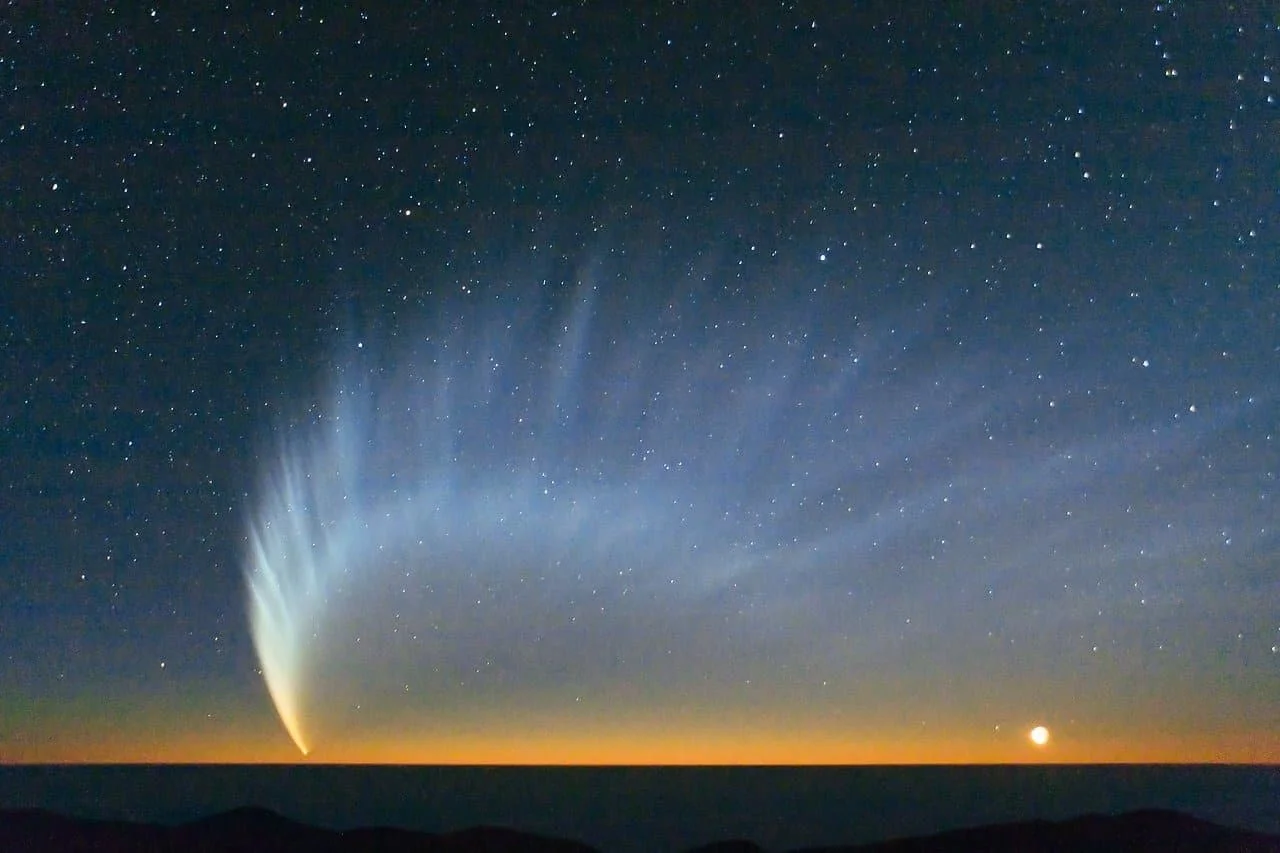
A new study based on data from the European Space Agency's (ESA) Gaia mission has revealed a major gravitational event that occurred in the outer reaches of the Solar System. Scientists state that approximately 2.5 million years ago, the passage of the star HD 7977 near the Solar System may have completely altered the dynamics of the Oort cloud, which is considered a reservoir of frozen bodies. This is reported by Ixbt.com news reports.
Typically, the movement of long-period comets was thought to be influenced by the gravitational waves (galactic tides) of the Milky Way galaxy. However, analysis of comet orbits showed that their paths into the inner Solar System are more irregular and random than expected. This suggests some kind of strong external influence.
The impact of the star HD 7977 on the comet shower
According to mathematical models, the star HD 7977 may have passed between 6,000 and 10,000 astronomical units from the Sun. Such a close approach allowed the star's gravitational field to displace objects in the Oort cloud. As a result, some of these objects were directed toward the inner Solar System, creating a "comet shower" spanning millions of years.Researchers studied the orbits of 112 comets observed since 1989 and found that their movement aligns more closely with the stellar influence model. If this theory is confirmed, the abundance of comets we observe today could be the final echo of that ancient encounter.
This discovery also forces a reconsideration of our assumptions about the total number of objects in the Oort cloud. If the current comet flow was artificially enhanced by stellar influence, the actual density of objects in outer space may be twice as low as previously thought.
Future observations and uncertainties
It is worth noting that the model is not yet perfect. Scientists note discrepancies between the measured comet orbits and the calculations. This could be caused by non-gravitational factors, such as gas and dust streams emanating from comet nuclei. Additionally, data on the exact trajectory of the star HD 7977 needs further refinement.In the near future, data from the Vera C. Rubin Observatory and the Gaia mission will help test this hypothesis. Studying such anomalies in the outer reaches of the Solar System is important not only for astronomy but also for understanding the past climatic and biological changes on Earth.


Comments 0
…