


Air Taxi Flies in Astana: What Happens Next?
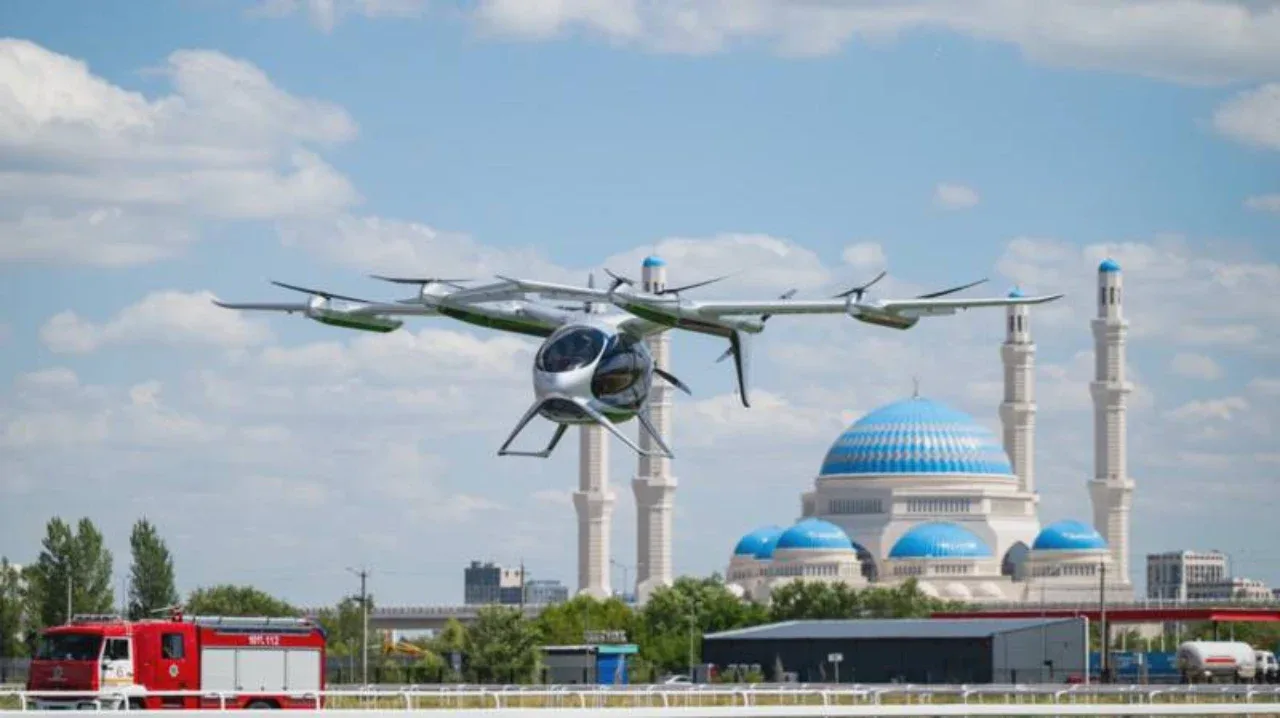
An electric passenger air taxi has performed a demonstration flight in the skies above the capital of Kazakhstan for the first time. Designed for one pilot and five passengers, the vehicle has a range of up to 200 kilometers — though this does not yet mean regular air traffic has begun over the streets of Astana.
Legislation alone is not enough to turn this new mode of transport into an everyday service. The country faces major tasks such as certification, safety, building vertiports, and creating a digital air traffic management system.
Where did the capital's first flight take place?
The demonstration flight was organized on July 24 at the Kazanat racetrack in Astana, as part of the program of the international tournament "Future Games — 2026".
The event was organized in cooperation with Kazakhstan's Alatau Advance Air Group Ltd. and Chinese manufacturer AutoFlight. The AutoFlight Prosperity electric vertical take-off and landing (eVTOL) aircraft took to the skies.
The flight in Astana marked the first air taxi demonstration held in the capital of Kazakhstan.
In accordance with safety requirements, there were no passengers on board the aircraft during the test. Organizers explained this as standard practice used to evaluate the flight characteristics of the new aircraft and the reliability of its systems.
What are the capabilities of the air taxi?
The showcased AutoFlight Prosperity features a six-seat cabin:
one pilot;
five passengers;
maximum speed — up to 200 km/h;
range on a single charge — up to 200 kilometers;
number of electric motors — 13.
The aircraft does not need a traditional runway: it takes off vertically and, upon reaching a specified altitude, moves forward like an airplane. The manufacturer and organizers emphasize that it operates at a much lower noise level compared to traditional aircraft and produces zero direct carbon emissions during flight.
These features could make it possible in the future to use air taxis for short intercity trips, tourist routes, urgent cargo delivery, medical assistance, and emergency situations.
How did the project reach this stage in 1.5 years?
According to AAAG Head Sergey Hegay, the team has traveled the path from studying international experience to building infrastructure and organizing real demonstration flights within a year and a half.
He noted that the air taxi itself is only part of the new system. To launch full urban air mobility, the following are required:
vertiports for air taxis to land;
digital flight management;
air traffic coordination systems;
maintenance centers;
certification and safety standards;
training for pilots, engineers, and operators.
"This is a new high-tech industry that unites air operators, digital platforms, maintenance, aircraft assembly, spare parts manufacturing, and software," said Sergey Hegay.
Thus, the project is not limited to launching a single futuristic vehicle. The plan envisions forming an entirely new transport and technology ecosystem.
Kazakhstan Adopts Law for Air Taxis
Kazakhstan President Kassym-Jomart Tokayev signed a law regulating advanced transport technologies on June 24, 2026.
The document defines for the first time:
the legal status of eVTOL aircraft;
operating procedures for vertiports;
concepts of urban and regional air mobility;
certification of manufacturers and operators;
digital management of unmanned air traffic;
cybersecurity requirements.
The new legal framework creates the foundation for moving technology from experimental demonstrations to the commercial market. However, each vehicle and operator must still undergo individual certification, and flight routes must be adapted to safety requirements.
This is not the first test in Kazakhstan
The country's first air taxi demonstration flight took place on May 19 in the city of Alatau. Kazakhstan's first fully operational vertiport and the UAM Center Eurasia urban air mobility center are being built there.
The flight in Astana was the next step in showcasing the technology to the general public in the country's capital. AAAG and AutoFlight have also signed a memorandum for the delivery of another 50 V2000 and V5000 series eVTOL aircraft.
When will it be possible to fly in an air taxi?
No exact date for the launch of commercial air taxi services in Kazakhstan has been announced yet. The demonstration flight proved the technology works, but several more stages must be passed for passenger transport:
local certification of the aircraft;
construction of a network of vertiports;
establishment of safe flight corridors;
development of weather and emergency procedures;
training of pilots and technical personnel;
determination of service pricing and insurance mechanisms.
Therefore, it is more accurate to view the flight in the skies of Astana not as a ready transport service, but as the first public demonstration of a future system.
Smartphones once seemed like science fiction. Now it is time to fly above traffic jams — as long as legislation, safety, and infrastructure keep pace with the speed of technology.



Comments 0
…