


Falcon 9 rocket’s second stage crashed into the Moon’s surface
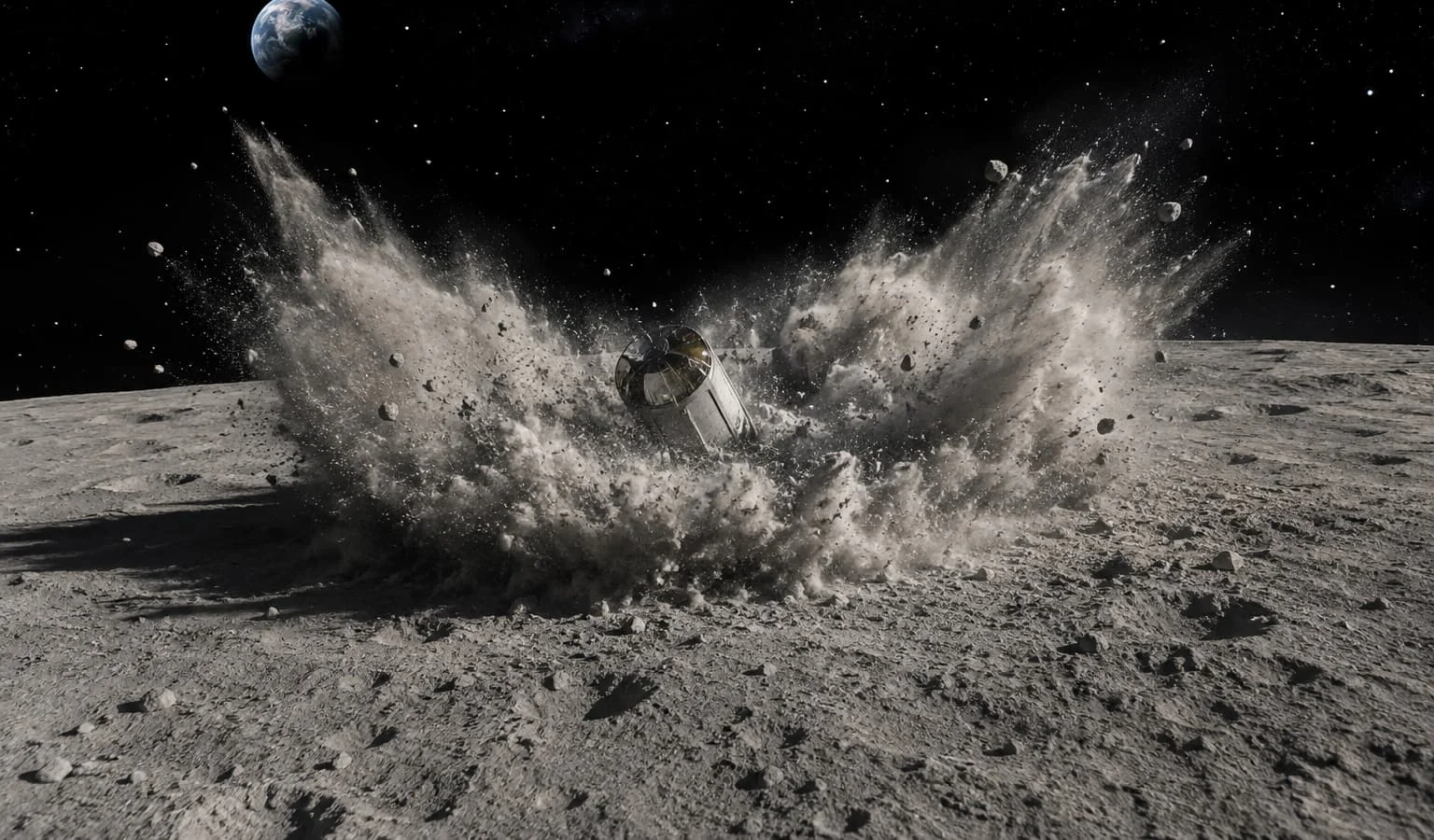
The second stage of SpaceX’s Falcon 9 rocket, which had been drifting uncontrolled in space for more than a year and a half, crashed into the Moon’s surface. According to ixbt.com, the collision occurred around noon on August 5, Tashkent time, and was recorded as another significant event highlighting the impact of space debris on celestial bodies. Ixbt.com reports.
The rocket stage was initially launched into space on January 15, 2025. At the time, it successfully completed a mission to deliver the United States’ Blue Ghost Mission 1 and Japan’s Hakuto-R Resilience spacecraft to the Moon. However, after placing the payload into its intended orbit, the rocket no longer had enough fuel to return to Earth or perform a controlled deorbit.
An uncontrolled journey through space and its end
After its fuel was completely exhausted, the rocket’s upper stage remained in deep space and gradually entered a trajectory crossing the Moon’s orbit. According to SpaceX representative Julianna Shayman, the object’s subsequent path slowly changed under the influence of solar activity and gravitational forces in space. Experts emphasize that once its fuel reserves were depleted, there was no way to alter its trajectory.According to calculations, the collision occurred in the area of the Einstein crater on the western edge of the Moon’s visible side. The impact speed of the rocket remnant, weighing nearly four tons, was approximately 8,700 kilometers per hour. The energy produced by the combination of such enormous speed and mass is estimated to have been equivalent to an explosion involving about three tons of TNT.
Scientific significance and future research
Preliminary assessments indicate that a new artificial crater, 27 meters in diameter and up to six meters deep, formed at the impact site. NASA experts firmly stated that the event posed no danger to Earth. At the same time, the new crater and the rocks ejected by the impact could become rare research material for scientists.The scientific community plans to use the debris to study the formation processes of the Moon’s surface in greater depth. The data may also help assess potential risks in advance for future crewed space expeditions and the construction of long-term lunar bases.


Comments 0
…