


Astronomers capture the first image of a growing protoplanet
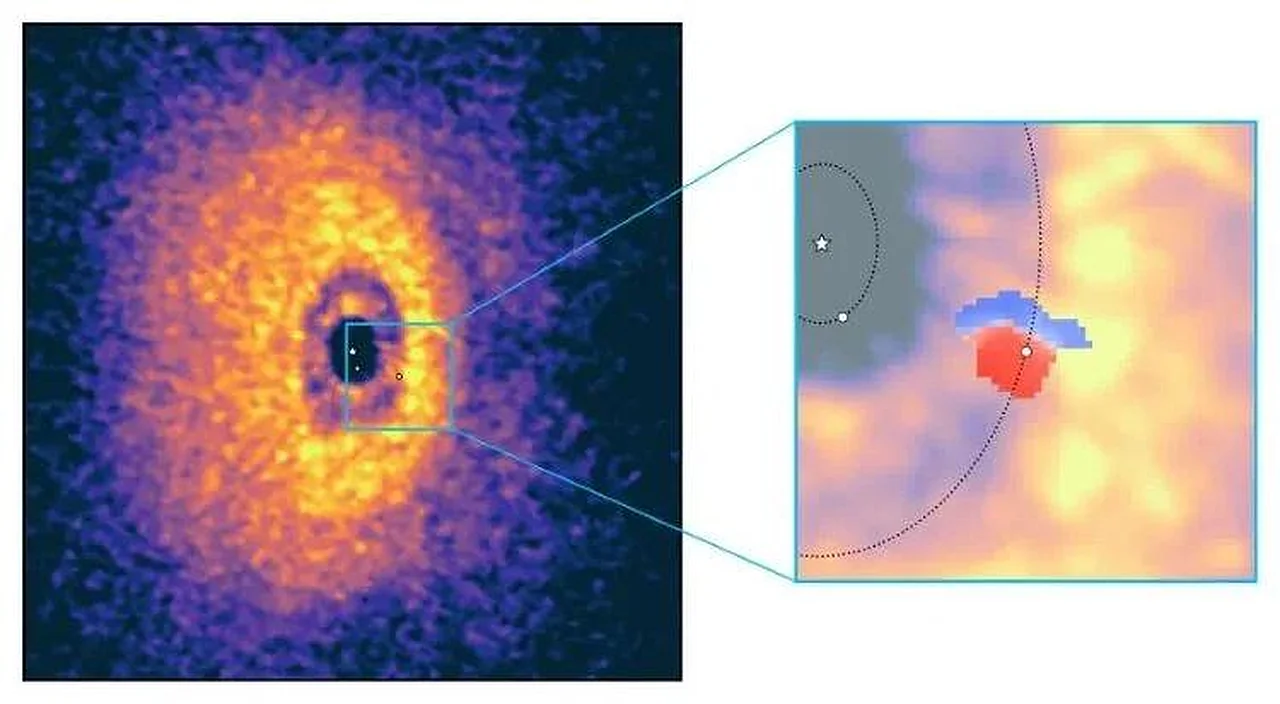
An international team of astronomers has, for the first time in history, managed to capture a direct image of a growing protoplanet accumulating gas and dust around it. The study, published in The Astrophysical Journal Letters, allows for the practical observation of processes that have long been studied theoretically, marking a significant milestone in planetary science. This was reported by Ixbt.com reports .
According to ixbt.com, this object, named WISPIT 2b, is located 430 light-years from Earth. Its mass is approximately 5 times that of Jupiter, and it orbits its host star at a distance of 57 astronomical units, nearly twice the distance of Neptune's orbit. This unique image was captured using the ALMA (Atacama Large Millimeter/submillimeter Array) radio telescope complex located in the Atacama Desert in Chile.
Until now, the process of planet formation was depicted only through theoretical models and computer simulations. According to general scientific theory, a massive cloud of gas and dust collapses to form a rotating disk, within which small solid bodies collide and grow. As a result, terrestrial planets form closer to the star, while gas giants form further away. However, observing this process directly had not been possible until now.
Structures in the protoplanetary disk and their mysteries
Miriam Benisti, director of the Max Planck Institute for Astronomy in Germany and one of the study's leaders, explained the observed processes: "We can clearly see how both planets are shaping their environment. While WISPIT 2c has created a gap, WISPIT 2b has carved out a trench. Around WISPIT 2b, we have identified gas vortices that were predicted in simulations of disk-planet interaction but had never been observed before."In scientific terms, the concepts of a gap and a trench in a protoplanetary disk are distinct. A gap refers to a region almost completely cleared of material—such a zone was created by the companion WISPIT 2c, which has a mass of 8 to 12 Jupiters, at an orbit of 15 astronomical units. A trench is a region of lower density where enough material remains for the protoplanet to continue growing.
The era of high-tech observations
The ALMA complex achieved such high resolution by combining data from 66 individual antennas into a single, massive interferometer. This complex architecture allowed for the detailed examination of features beyond the reach of a single instrument, specifically the structure of gas flows around the object. Using the Doppler visualization method, the gas movement in the image was represented in red and blue.It is worth noting that WISPIT 2b was discovered in August 2025, while its companion, WISPIT 2c, was identified in March 2026. This image, which directly demonstrates the accretion process—one of the central puzzles in planet formation, showing how small particles merge into massive bodies—serves as a valuable source of data for testing theoretical models in practice.


Comments 0
…