


Persistent hot spot discovered on Betelgeuse star after 7 years
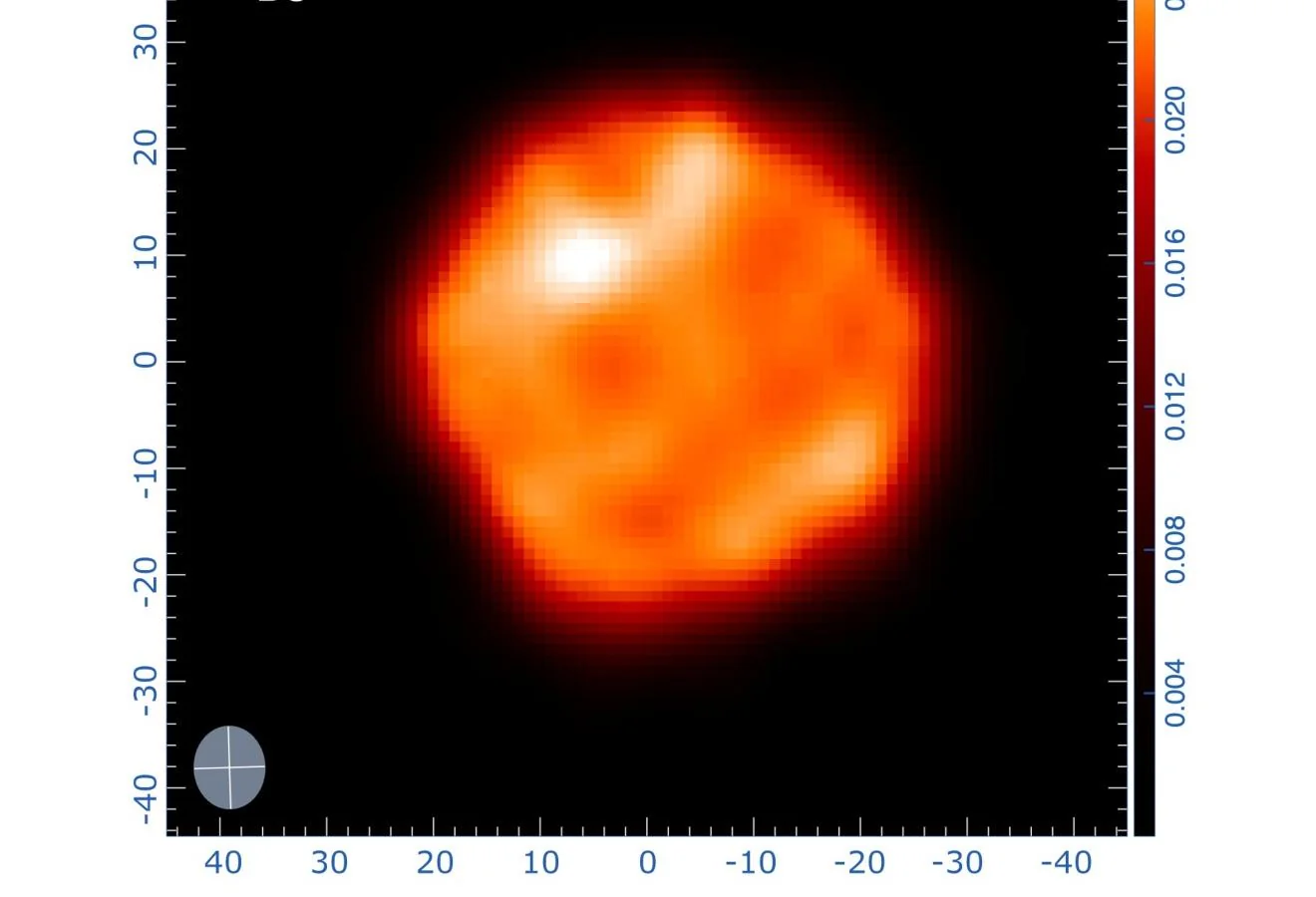
Astronomers using the ALMA radio telescope array have identified unusually persistent features on the surface of the red giant Betelgeuse. Studying this massive star, located approximately 724 light-years from Earth, revealed that its atmosphere is not uniform and exhibits variations in its radius. These scientific observations provide deeper insight into the internal processes of one of the most mysterious stars in space. This was reported by Ixbt.com reports .
The mystery of the unusual hot region
According to ixbt.com, the study was conducted in the millimeter range in August 2023. The average photospheric temperature of Betelgeuse is approximately 2300 Kelvin. However, a region 800 Kelvin hotter than the surrounding surface was found in its northeastern part. The location and brightness of this discovery were found to be almost identical to a hot spot recorded by scientists in 2015.Usually, mixing processes in the atmosphere of a red supergiant change the surface in a very short time. Therefore, the fact that this hot spot has not disappeared for at least 7 years is an important discovery for science. This indicates the existence of exceptionally long-lived stable structures on the star's surface.
Stellar radius and convection processes
The newly obtained images showed that the atmosphere of the red supergiant is clearly non-uniform. In particular, experts recorded specific "bulges" and wave-like variations of up to ±6 percent along the visible radius sector of the star. The shape of these structures was also found to have changed compared to the 2015 observations.Astronomers believe that such observed characteristics are directly related to strong convection processes. Hot gas streams rising from the depths of Betelgeuse create shock waves in the atmosphere. These processes also create conditions for the formation of various molecules such as carbon monoxide and silicon monoxide.
Supernova and future evolution
These complex processes may also be related to the star's mass loss, as the red supergiant is gradually ejecting its outer layers into the surrounding space. Betelgeuse, which is significantly larger than the Sun in mass and volume, will eventually end its evolution with a supernova explosion.It is not yet clear when this massive explosion will occur. However, studying the non-uniform surface of the star and the changes in its atmosphere helps to better understand the complex processes that occur before the final stage of the life of massive stars.


Comments 0
…