


Astronomers capture the latest and most detailed image of the star Betelgeuse
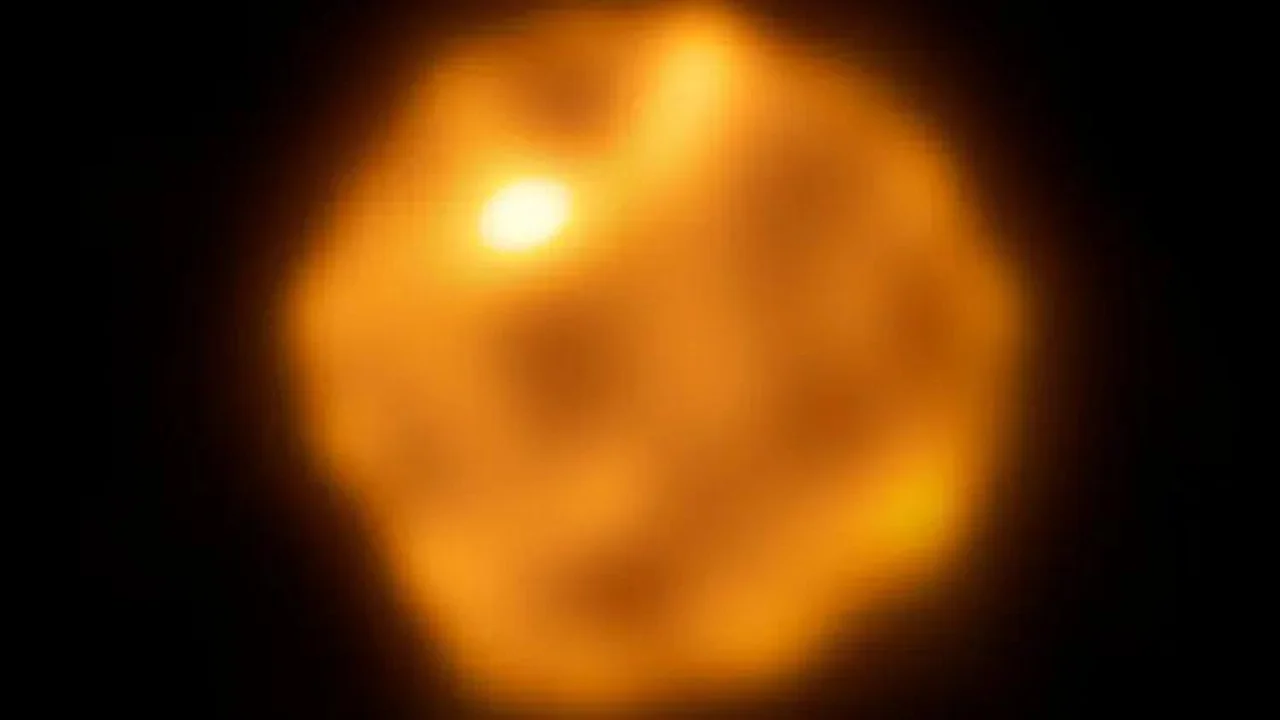
An international team of astronomers has obtained the most detailed images to date of Betelgeuse, one of the red supergiants closest to Earth. The mysteries of this celestial body, which is approximately 800 times larger than the Sun and expected to explode as a supernova at the end of its evolution, are of great importance to science. This is reported by Ixbt.com reports .
According to ixbt.com, the observations were carried out using the ALMA radio interferometer. With this massive instrument, scientists determined that the star's submillimeter photosphere has an uneven, almost "corrugated" structure, and also contains several reddish regions and a bright area that has persisted for an unexpectedly long time. Betelgeuse is located approximately 600 light-years from Earth.
Specific features of the star's atmosphere
New observations conducted in 2023 showed that the radius of Betelgeuse's submillimeter photosphere is approximately 1.1–1.3 times the star's radius, with an average temperature around 2300 K. However, this structure is not spherical: deviations in the visible radius reach about 6 percent. Weaker radiation is observed at distances up to 2.5 times the star's radius.Researchers found at least two hotter regions in the northeast and southwest parts of the stellar disk. The brightest of these was found to be approximately 800 K hotter than the surrounding gas. Experts attribute these structures to powerful convection processes within Betelgeuse. Massive volumes of hot gas rise from the star's interior, potentially triggering shock waves in the outer layers.
Long-term structures and future observations
Comparing the newly obtained data with observations from 2015 revealed a major surprise. The bright region in the northeast part of the disk has remained practically in the same place and maintained the same level of intensity. This indicates that this structure has existed for at least seven years, which is significantly longer than what current models for large convective features predict.It is known that Betelgeuse drew the attention of astronomers a few years ago following a sharp drop in brightness known as the "Great Dimming." Although the visible changes sparked speculation that a supernova explosion was imminent, current data do not allow for a precise prediction of such an event. Scientists plan to continue observations using ALMA to determine the stability of the hot regions and their connection to mass loss.


Comments 0
…