


Astronomers Discover Rare Radio Galaxy with Four Generations of Jets
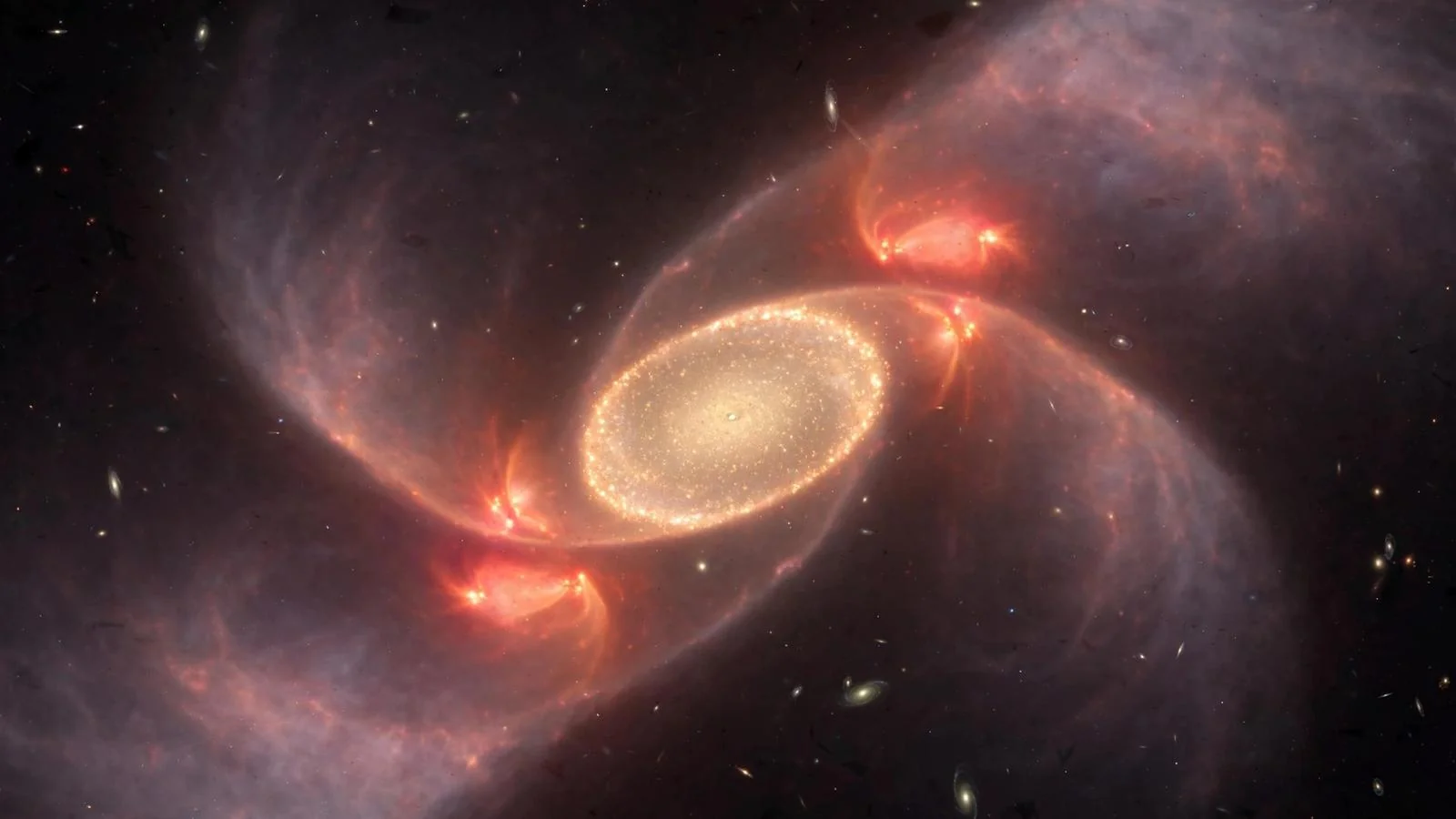
Astronomers have identified the first radio galaxy in the universe where a supermassive black hole has undergone four distinct periods of activity. According to ixbt.com, this unique object, designated J023721.13−010528.5, is located at the center of a galaxy cluster and spans a total length of approximately 3.9 million light-years. This is reported by Ixbt.com .
This massive S-shaped radio structure is of great importance to both Earth and modern astrophysics. Scientists estimate that at the center of the galaxy lies a supermassive black hole approximately 2.28 billion times the mass of the Sun. The cyclic activity of such massive objects is a key factor in understanding the evolution of the universe.
The mystery of quadruple activity
The sign of repeated activity was uncovered based on data recorded at various frequencies using the uGMRT, MeerKAT, and VLA radio telescopes. Four pairs of compact, high-radio-brightness regions were identified symmetrically on both sides of the central galaxy.The age of the radiating plasma was put forward as the primary evidence. The radio spectrum steepens as it moves away from the core emission, indicating that the electrons are aging. Specifically, the radiative age ranges from 4.5 million years at the S1 region closest to the core to 20.5 million years at the outermost N4 region.
S-shaped form and its dynamics
This sequence refutes the assumption that all components are random plasma clumps within a single jet. The system has been interpreted as a quadruple-double radio galaxy (QDRG) with four consecutive episodes of activity.The study showed that the jets did not maintain the same orientation each time. Compared to the inner N1–S1 pair, the orientation of subsequent pairs shifted counter-clockwise by 7°, 16°, and 24°. It is this gradual rotation of the axis that created the characteristic S-shape.
The authors attribute this geometry to the precession of the central black hole. The observed correlation between age and distance in the system suggests a decrease in jet power or a shortening of the duration of individual active phases.


Comments 0
…