


Humanoid robots successfully perform complex surgery for the first time
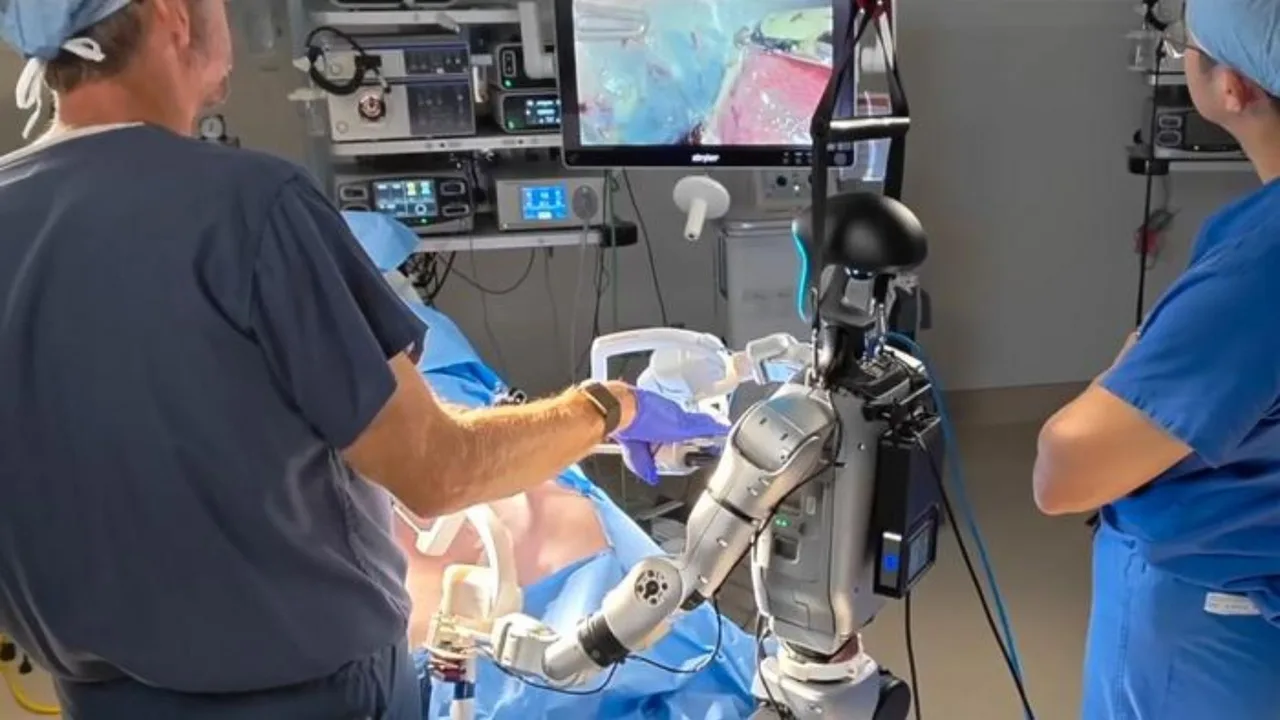
A major scientific breakthrough has been achieved in the field of medicine. For the first time, two humanoid robots successfully performed a gallbladder removal surgery on a living subject. Scientists emphasize that this result is one of the most critical milestones on the path to starting clinical trials on humans in the near future.
These innovative surgeries were conducted on pigs by engineers and surgeons at the University of California, San Diego. The results of the study were published on July 8 in the prestigious Nature journal.
The first surgery in the study was performed by one humanoid robot under the supervision and assistance of an experienced surgeon. In the second operation, two humanoid robots collaborated to independently complete the gallbladder removal procedure. According to the university, these successful experiments are considered one of the most important steps before testing the technology on humans.
Dr. Ryan Broderick, interim director of the Center for the Future of Surgery at the University of California, stated that this experiment proved in practice that robots can work effectively in surgery.
“From a proof-of-concept perspective, everything worked as expected,” he said in an interview with ABC.
Experts note that these humanoid robots differ in several ways from the traditional robotic surgical systems currently used in many hospitals. They have a human-like structure, equipped with a head and arms. Most importantly, they occupy very little space in the operating room. Researchers have even nicknamed the robots “Surgie” (surgical robot).
Dr. Ryan Broderick emphasizes that one of the main advantages of the new robots is their compactness.
“The space constraints often encountered in traditional robotic surgeries are almost non-existent here. The robot sits next to the patient as a human-like assistant and fits perfectly into the environment we are accustomed to in laparoscopic surgeries,” he said.
Scientists believe that this compact design will allow humanoid robots to be used effectively in various conditions in the future. For example, such robots could perform surgeries in remote areas far from large medical centers, in small operating rooms, on naval ships, or in rural medical facilities.
Dr. Shangley Liu, a colorectal surgeon at the University of California, noted that this technology opens up opportunities to further expand the reach of medical services.
“It is not hard to imagine using this device on a ship, in a remote village, or in small operating rooms far from large cities. This will significantly expand access to medical services,” she said.
Researchers say this technology could also help partially solve the problem of medical staff shortages in hospitals in the future. Robots can assist surgeons and medical teams, enabling them to perform more operations.
Professor Michael Yip of the University of California believes the experiment proved that humanoid robots are capable of performing real surgeries.
“I think we have demonstrated that humanoid robots can perform real surgical procedures in the operating room. In the future, such technologies could serve to save human lives,” said the professor.
Experts consider this result a major turning point in the progress of robotic medicine. If subsequent studies are also successful, the first clinical trials involving humanoid robots on humans may not be far off.


Comments 0
…