


Uzbekistan won 70 medals: how much reward will athletes receive?
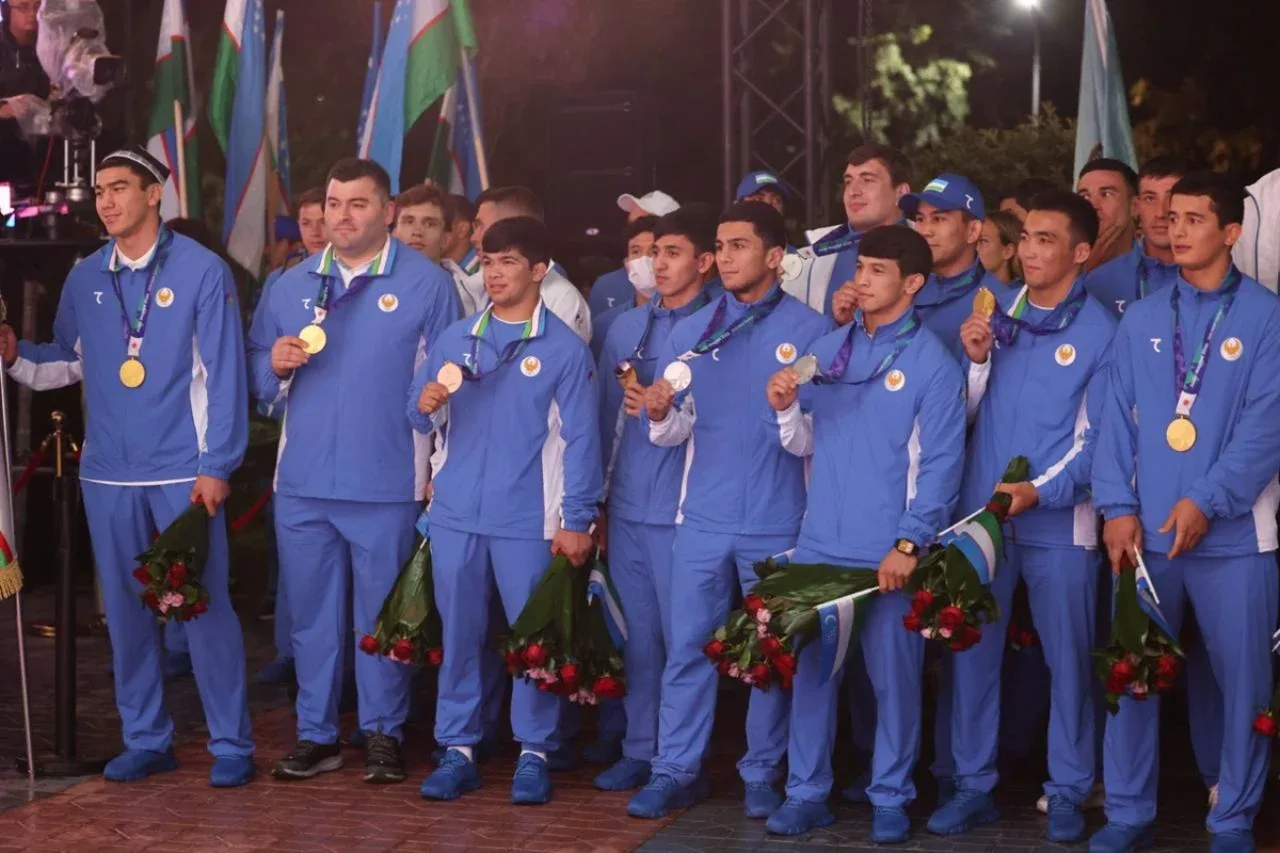
The sports delegation of Uzbekistan concluded the Aichi–Nagoya–2026 Asian Games held in Japan with 70 medals. The national team's tally includes 21 gold, 25 silver, and 24 bronze medals. This result enabled Uzbekistan to take fifth place in Asia in terms of medal count.
Notably, while the competitions were in full swing, cash prizes for medalists of the Asian and Para Asian Games, as well as their coaches, were increased.
Therefore, against the backdrop of the 70 medals won in Aichi–Nagoya, another question arises: how much money might be paid to Uzbek athletes and coaches under the new reward rates?
$25 thousand for a gold medal
In accordance with the Presidential Decree No. PQ-347 dated September 21, cash prizes for winners and medalists of the Asian and Para Asian Games were increased.
According to the new procedure, the following rewards are established for athletes:
gold medal — $25 thousand;
silver medal — $12.5 thousand;
bronze medal — $6,250.
A separate incentive system is also provided for coaches:
for a gold medal — $10 thousand;
for a silver medal — $5 thousand;
for a bronze medal — $2,500.
The decree entered into force on September 23.
Thus, athletes who won medals in Aichi–Nagoya are expected to be rewarded based on the new rates that came into effect after the competitions began.
How much does it tentatively amount to for 21 gold medals?
Assuming that for each of the 21 gold medals in Uzbekistan's tally, there is tentatively one athlete and one coach, a total of $35 thousand corresponds to a single gold medal.
For 21 gold medals:
21 × 35,000 = $735,000.
Consequently, in tentative terms, athletes and coaches are entitled to $735 thousand for the gold medals.
Here, the athletes' reward amounts to $525 thousand, and the coaches' share is $210 thousand.
For 25 silver medals — $437.5 thousand
For a silver medal, $12.5 thousand is designated for the athlete and $5 thousand for the coach.
Thus, the tentative total reward for one silver medal is:
12,500 + 5,000 = $17,500.
Considering that Uzbekistan won 25 silver medals:
25 × 17,500 = $437,500.
Accordingly, the tentative amount for silver medals totals $437.5 thousand.
How much for 24 bronze medals?
For a bronze medal, it is established that $6,250 is paid to the athlete and $2,500 to the coach.
For one bronze medal:
6,250 + 2,500 = $8,750.
And for 24 bronze medals:
24 × 8,750 = $210,000.
Thus, the tentative calculation for bronze medals amounts to $210 thousand.
Total of 1 million 382.5 thousand dollars
Now let's summarize the calculation for all three medal types:
Medal | Quantity | Tentative amount for athlete + coach |
|---|---|---|
Gold | 21 | $735,000 |
Silver | 25 | $437,500 |
Bronze | 24 | $210,000 |
Total | 70 | $1,382,500 |
Furthermore, based on the tentative approach that each medal belongs to one athlete and one coach, a total of 1 million 382.5 thousand dollars for 70 medals emerges.
However, it is not correct to accept this figure as the exact final reward to be paid to the Uzbek delegation.
Why might the actual amount be different?
The reason is that not all medals in Aichi–Nagoya were won in individual events.
In some sports, multiple athletes participate in a team for a single medal. In pairs and team competitions as well, a single medal may belong to several athletes.
Additionally, the procedure for rewarding coaches does not mean that the same amount for a single coach is automatically calculated for every single medal.
Therefore, the calculation of 1.3825 million dollars is merely a tentative arithmetic calculation based on the number of medals and the established new rates.
The actual payment amount may vary depending on the sport, the number of medal holders, and the rewarding procedures.
With what result did Uzbekistan conclude Aichi–Nagoya?
Nevertheless, 70 medals in themselves proved to be a significant achievement for the Uzbek delegation.
National athletes won 21 gold, 25 silver, and 24 bronze medals at the Asian Games in Japan.
Most importantly, Uzbekistan secured fifth place in the overall team standings.
This result once again demonstrated the competitiveness of Uzbek sports on the Asian continent, not only in terms of the number of medals but also in the fight for top placements.
Meanwhile, the new reward rates have also significantly enhanced the financial incentive side of this achievement.
The 70 medals that will remain in the history of Aichi–Nagoya–2026 will now be significant not only for the athletes' victories but also for the new rewards established for them. However, when determining the final payment amount, whether the medals were won in singles, pairs, or team lineups will certainly be taken into account.



Comments 0
…