


Tesla FSD Fails Testing: Autopilot Still Cannot Replace Humans
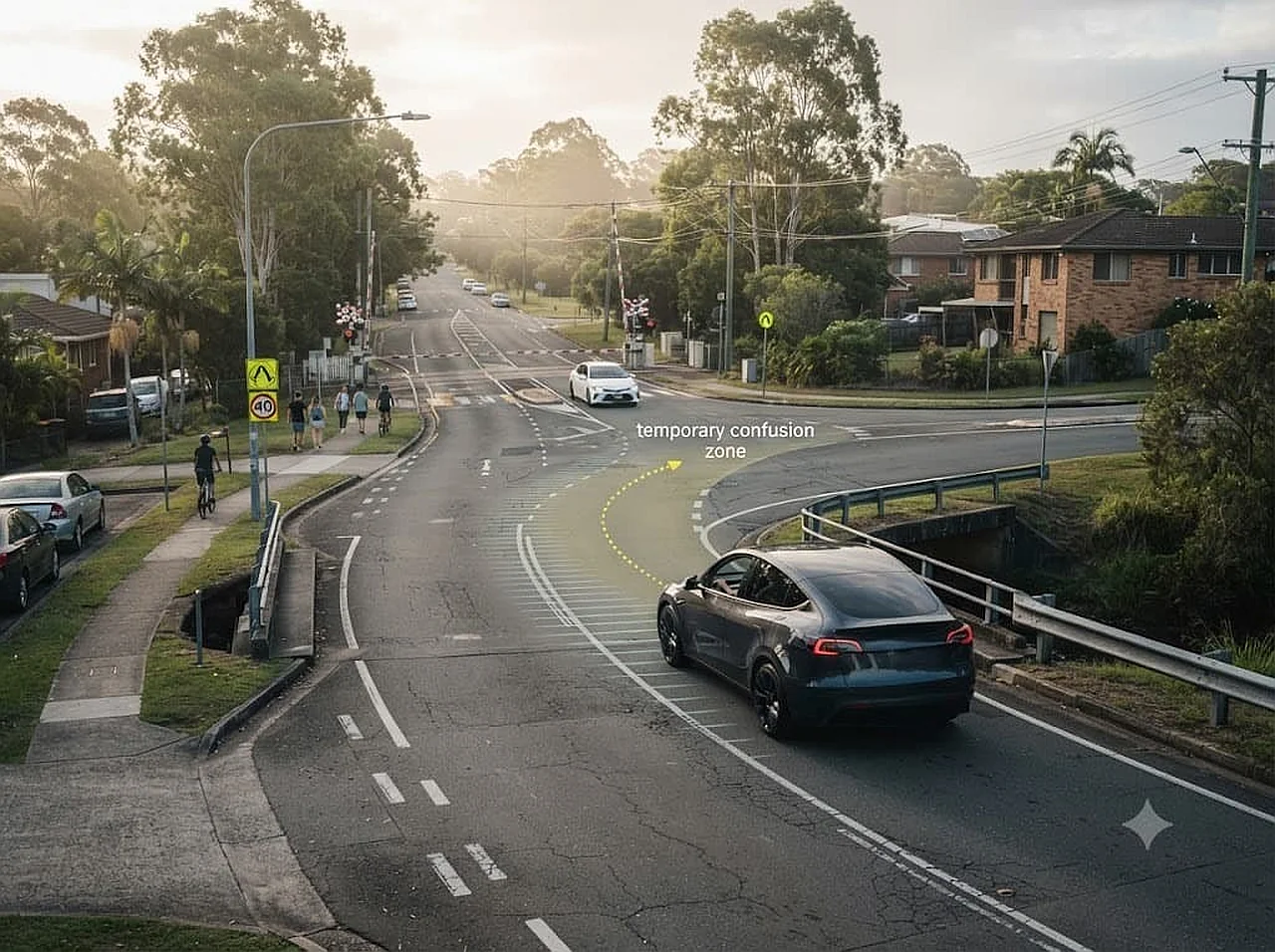
Despite the rapid development of autonomous driving technologies, modern AI systems still make serious errors in ordinary road conditions. Large-scale research conducted in Australia has shown that Tesla's Full Self-Driving (FSD) system has not yet reached a level of safe operation without human intervention. This situation suggests that the "ChatGPT moment" for self-driving cars, predicted by NVIDIA CEO Jensen Huang, is still some way off. This is reported by Ixbt.com reports .
During tests lasting over 100 days on Queensland roads, a Tesla Model Y electric vehicle caused over 500 critical situations. According to ixbt.com, researchers created a special open archive called White Box Autonomy to record every failure and erratic system behavior. Interestingly, while the system sometimes acts more precisely than professional drivers, it makes unexpected errors in simple situations.
Unexpected errors and system vulnerabilities
Tests revealed that the Tesla FSD system sometimes misinterprets even well-marked road lines. For example, when crossing small bridges, the car could not determine the trajectory and began to "snake." Also, in speed-restricted zones, particularly near schools, the system was wrong in 90 percent of cases. Even when school was out and restrictions were not in effect, the car unreasonably slowed down, hindering other drivers.From a safety perspective, the most dangerous situations were observed at railway crossings. In one instance, the Tesla followed a car in front and almost stopped exactly on the tracks. The driver had to engage the emergency braking system to rectify the situation. Such cases demonstrate that autonomous systems still cannot fully analyze the environment.
Human factor and complex intersections
Researchers emphasize that the most difficult task for autonomous systems is engaging in informal communication with other drivers. In situations like yielding or merging, algorithms often hesitate. The system made more errors in the following scenarios:- Navigating complex roundabouts;
- Passing between cars parked densely on the side of the road;
- Misclassifying scooter riders as pedestrians;
- Inability to see road signs in poor weather conditions.
In conclusion, autonomous driving systems are very useful as auxiliary functions, but handing over the steering wheel completely is currently dangerous. Companies continue to improve software, but achieving full autonomy will require several more years and millions of kilometers of testing.


Comments 0
…