


The Secret of Hawking Radiation: Scientists Discover a New Mechanism for Black Hole Evaporation
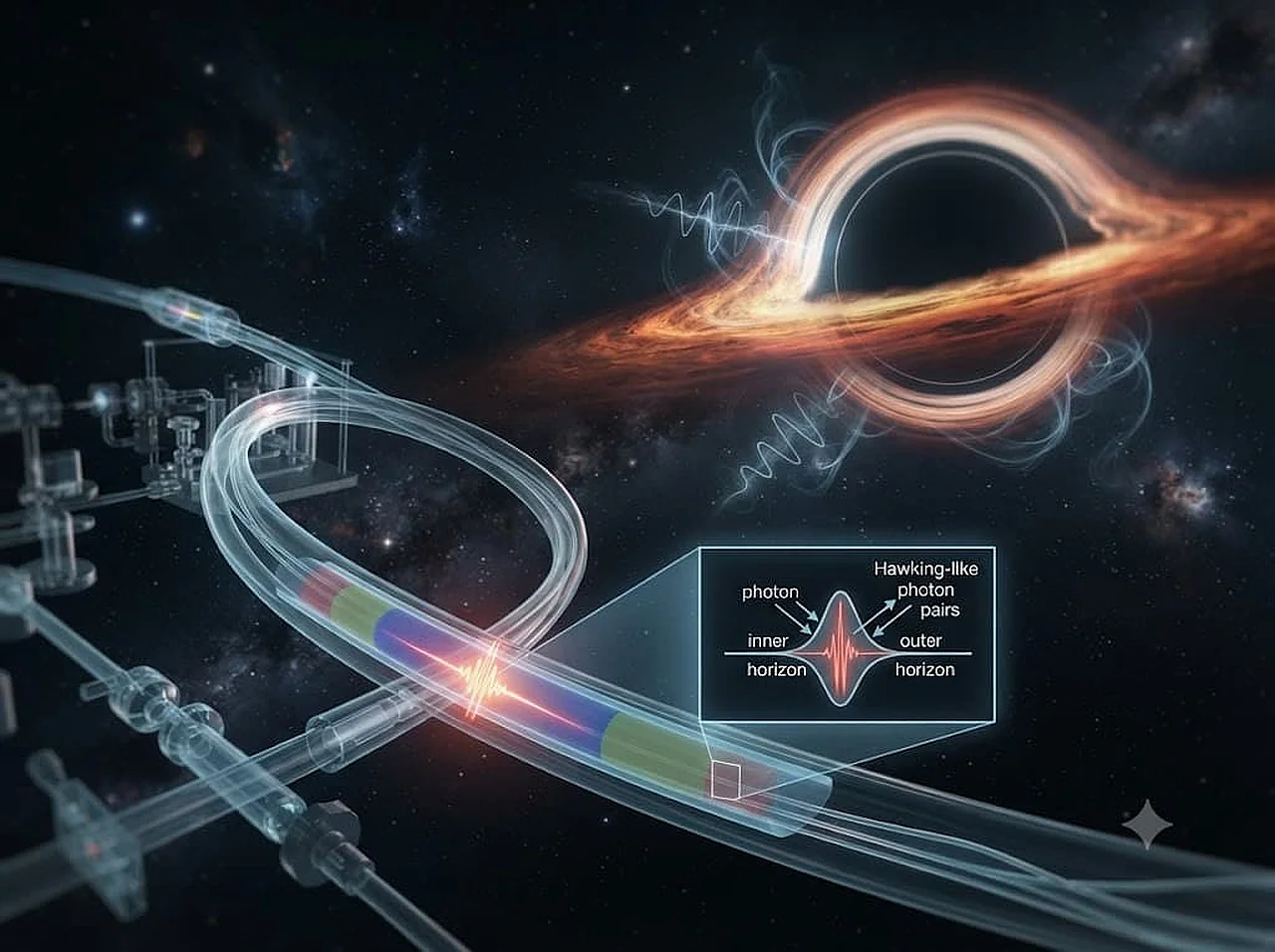
A major breakthrough has occurred in the study of Hawking radiation, one of the most complex and debated theories in modern physics. An international team of scientists from Germany, Mexico, and Israel has presented an unexpected and significantly simpler model explaining the energy emission mechanism of black holes. This discovery could open a new era in understanding the evolution of the most mysterious objects in the universe. This is reported by Ixbt.com .
According to the theory proposed by Stephen Hawking in 1974, black holes are not absolute "swallowers." Due to quantum effects, they emit very weak thermal radiation and lose mass over time, eventually evaporating. However, in real cosmic conditions, this radiation is impossible to detect because it is lost among cosmic background noise. For this reason, researchers are focusing on creating optical analogs of black holes in laboratory settings.
A "black hole" in the laboratory
Physicists from Paderborn University (Germany) and the Weizmann Institute (Israel) used a special optical system based on nonlinear waveguides. This device allowed them to model the event horizon of a black hole—the boundary from which nothing, not even light, can escape. During the experiments, scientists discovered that the process of Hawking radiation emergence is much simpler than previously assumed.Previous theories described this radiation as a chain of several complex quantum processes. The new study shows that a feedback mechanism between the radiation and the system itself plays a key role. Lead researcher Lorenzo M. Procopio notes that this new model not only simplifies the theory but also helps to more accurately understand how radiation occurs in real gravitational systems.
Another important aspect of the study is that Hawking radiation is not just a passive process. Experiments proved that the radiation actively influences the system that creates it. This very feedback mechanism is considered the key factor confirming that black holes can lose mass and eventually disappear completely.
The intersection of quantum physics and relativity
The significance of this discovery is not limited to black holes. Hawking radiation is one of the few points where two fundamental but contradictory theories—general relativity and quantum mechanics—can be reconciled. Scientists have yet to create a unified theory of "quantum gravity" for the universe, and laboratory experiments are the most promising step in this direction.For science enthusiasts, this news means that studying the laws of fundamental physics is now being carried out not only through giant telescopes but also with the help of compact laboratory equipment. Such research will serve to find answers to questions about the origin of the universe and its ultimate fate in the future.
According to Ixbt.com, the results of this scientific work have sparked great interest in the world of physics. If the laboratory results are confirmed by astrophysical observations, this will be the final proof of the greatest idea of Stephen Hawking, which could have been worthy of a Nobel Prize after his death.


Comments 0
…