


Thermal Imaging Revolution: New Transistor Device Increases Accuracy by 15 Times
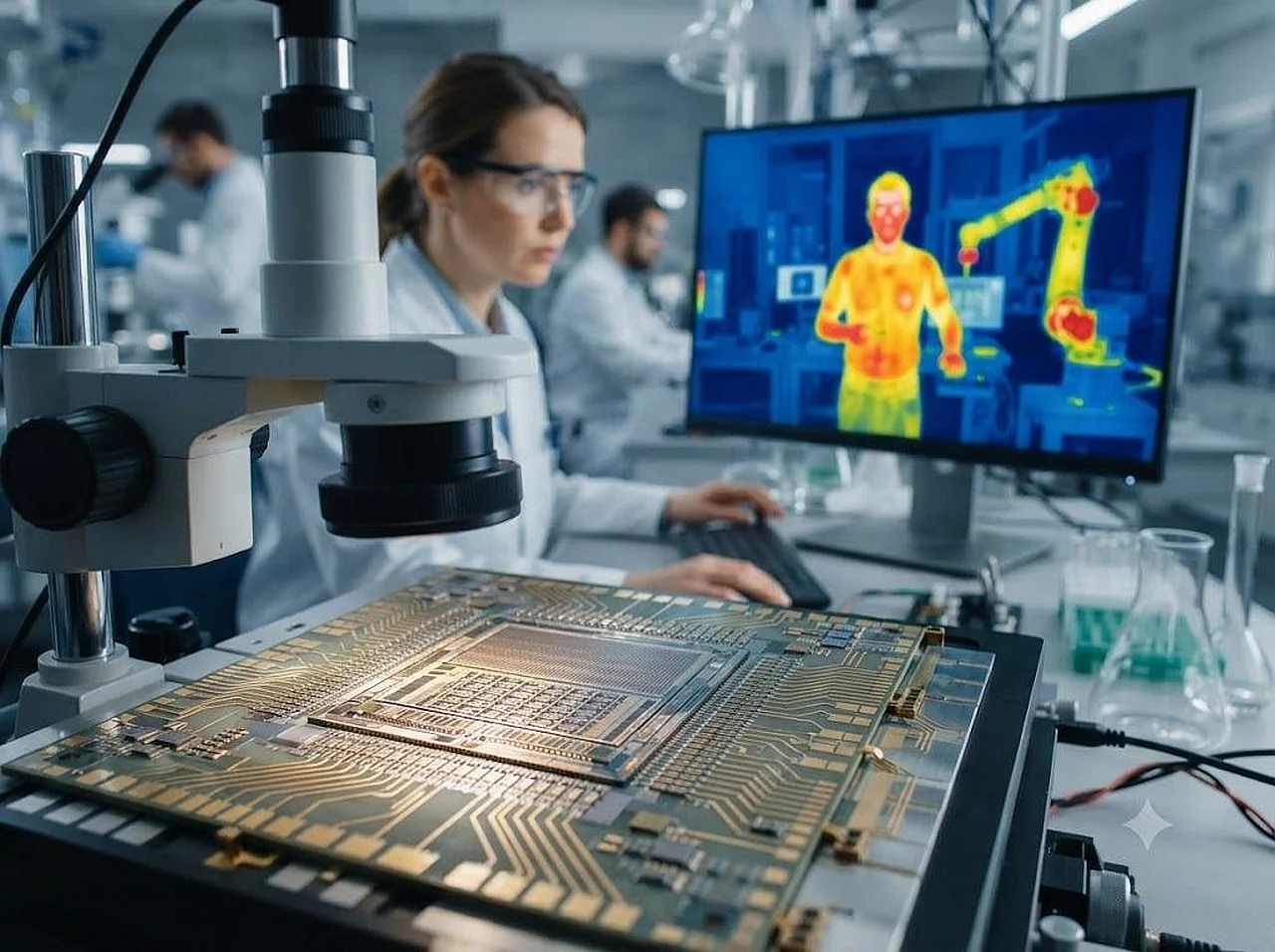
In the world of modern technology, the importance of night vision devices and thermal sensors is growing daily. By developing a new type of compact transistor, scientists have managed to dramatically increase the sensitivity of traditional thermal imagers. This discovery is expected to usher in a new era not only in the military sector but also in robotics and autonomous vehicle navigation. This is reported by Ixbt.com reports .
The results of this work, carried out by a research group led by Professor Fengnian Xia, were published in the prestigious journal Nature Sensors. The researchers used a two-contact NPN-transistor to expand the capabilities of existing thermal sensors. This electronic component has the property of amplifying signals in electrical circuits, fundamentally improving the sensors' reaction to temperature changes.
Overcoming Technological Barriers
Currently, thermal imagers operate mainly on two principles. The highest-precision systems use photon detectors, but they are very expensive and require special cooling systems to operate. Therefore, they are mainly used in specialized military equipment. The second type is microbolometers, which are cheaper and used in portable devices, including fire safety systems. However, their sensitivity was much lower than that of photon detectors.The root of the problem was the low Temperature Coefficient of Resistance (TCR) of the materials. This indicator determines how much the electrical resistance of a substance changes when its temperature changes. The higher the TCR, the faster and more accurately the sensor can detect even the smallest heat changes. According to Ixbt.com, this indicator was limited in traditional materials such as vanadium oxide and amorphous silicon.
New Approach and Results
Instead of searching for new materials, scientists chose to add a transistor to the existing design. Lead author Jiazhen Chen explains that the transistor creates feedback between charge carriers. This artificially amplifies the temperature dependence of resistance and allows for programming the sensor sensitivity.As a result of this modification, the temperature coefficient increased from 10 percent to 150 percent per Kelvin. This means that the accuracy of thermal imagers has increased by nearly 15 times. Most importantly, such a high result was achieved without complex and expensive cooling systems, which will reduce the cost of devices and allow for their mass adoption.
The project authors plan to create full-scale devices based on this technology in the future. The next stage involves porting the sensors to a silicon platform, which is widely used in modern microchip manufacturing. This opens up the possibility of integrating new types of thermal imagers into smartphones and other consumer gadgets.


Comments 0
…