


New Generation Nuclear Battery Created in China with a 5730-Year Lifespan
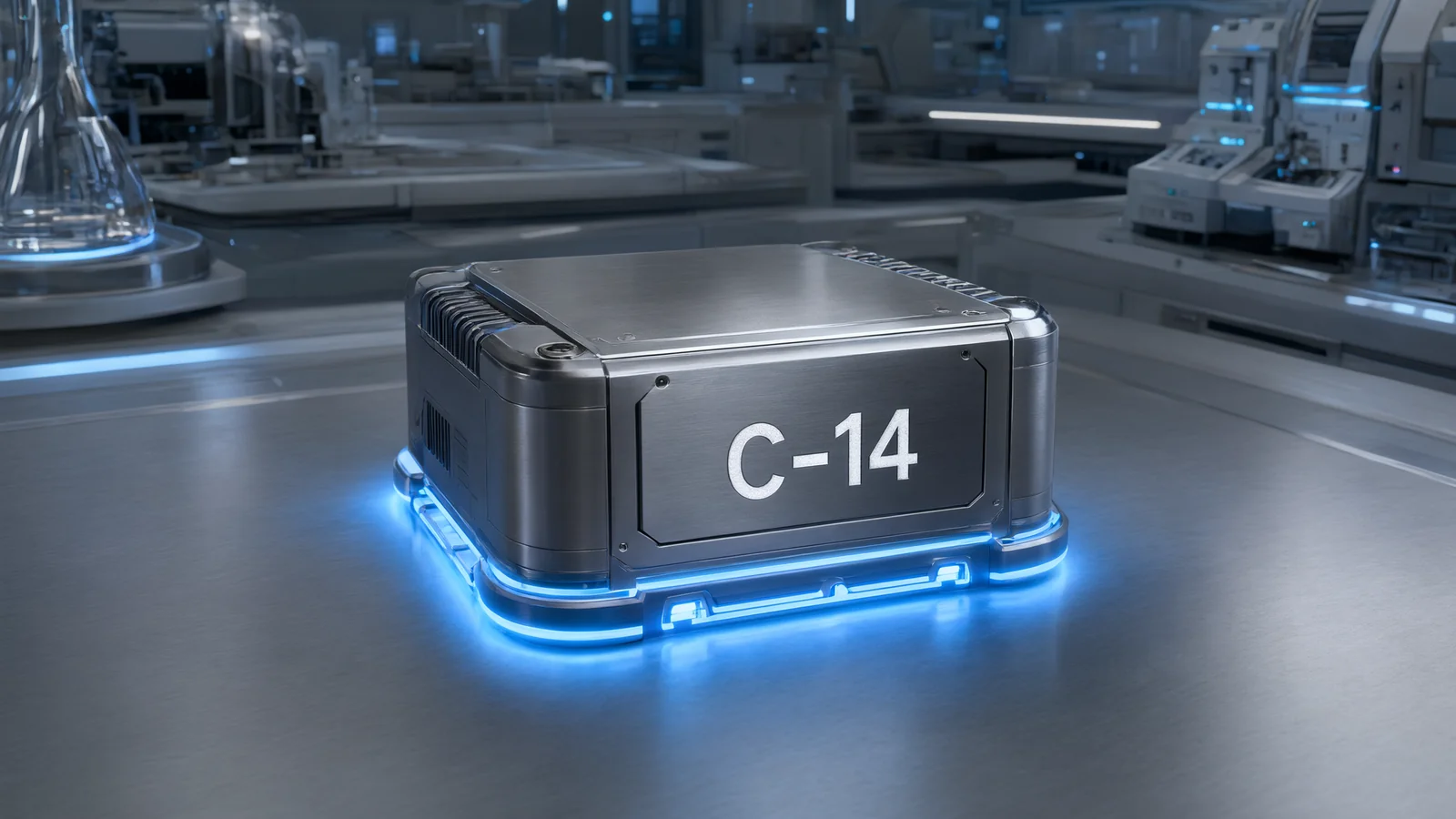
Chinese scientists have unveiled a new generation of compact nuclear batteries based on the carbon-14 isotope, expected to trigger a major shift in the energy sector. This device has a service life of several thousand years and could revolutionize fields where long-term maintenance is impossible. This is reported by Ixbt.com reports .
Developed by researchers at Northwest Normal University in collaboration with Gansu Zhulong Technology, this system is named Qianjiyuan Tianshu. According to ixbt.com, the new development is more powerful and compact than the team's previous projects and is distinguished by being created entirely on China's own technological base.
Operating Principle and Advantages of the Technology
The battery's operation is based on the radioactive carbon-14 isotope and a silicon carbide (SiC) semiconductor. Unlike traditional radioisotope generators, this technology does not convert heat into electricity. Instead, beta radiation energy is transformed directly into electric current. Developers compare this process to solar panels: only here, instead of light photons, electrons generated from carbon-14 decay create a constant current in the semiconductor layer.The device's technical specifications confirm its uniqueness. The battery volume is only 16.8 cubic centimeters. It provides a voltage of 2.06 V and a current of 0.713 mkA, delivering a maximum power of 1.13 mkW. Although this is not enough to power smartphones, it is ideal for specialized sensors that need to operate continuously for decades.
Application Areas and Prospects
The half-life of the carbon-14 isotope is approximately 5730 years. This means such energy sources have the potential to operate stably for several centuries. Scientists plan to apply this technology in the following areas:- Spacecraft and satellites;
- Autonomous sensors and scientific research equipment;
- Medical implants (e.g., pacemakers);
- Industrial monitoring systems;
- Devices in remote areas where maintenance is impossible.
Experts believe that such batteries could become the primary power source for future "smart" systems that operate without human intervention and for long-term scientific missions. This allows for energy independence and a drastic reduction in maintenance costs.


Comments 0
…