


AstroRad Special Radiation-Protection Vest Tested
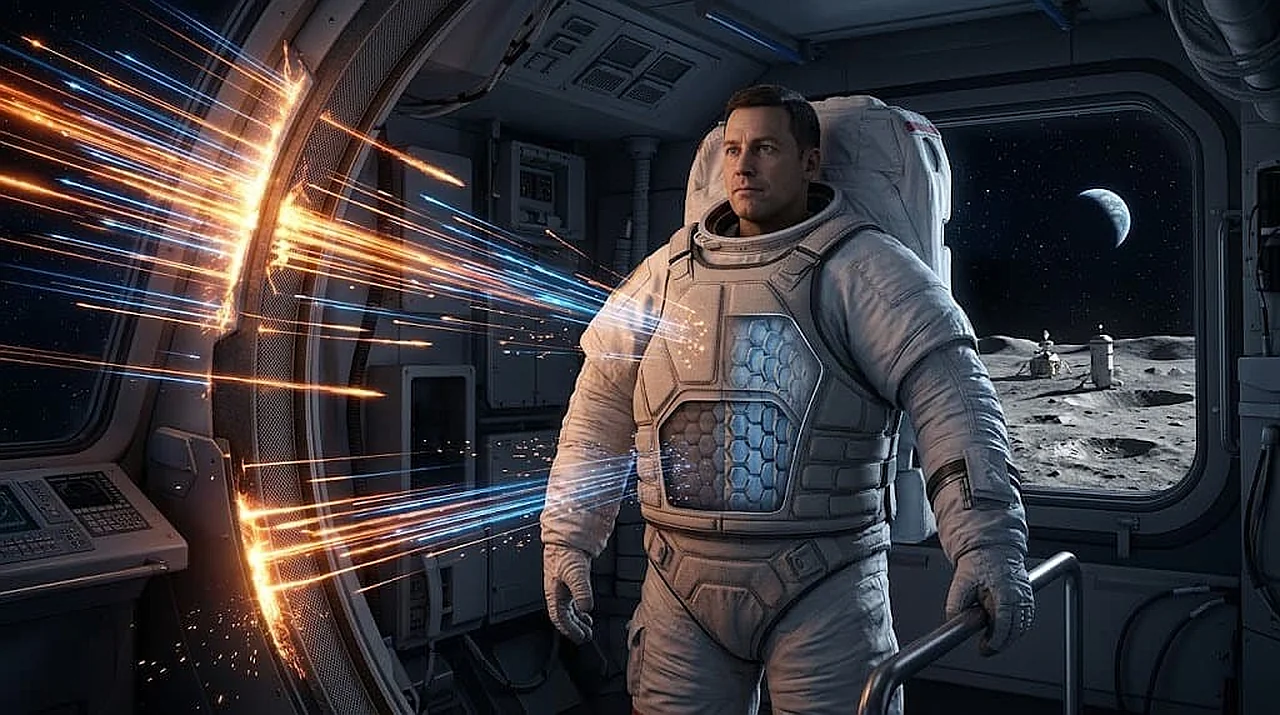
One of the main hazards of long-duration space flights beyond Earth's magnetosphere is ionizing radiation. In particular, solar proton events can unexpectedly cause a sharp increase in the radiation dose received by astronauts. ixbt.com reports that an international team of scientists has assessed for the first time the effectiveness of AstroRad, a wearable radiation-protection device designed for long-duration space flights. Ixbt.com reports .
Developed by StemRad and Lockheed Martin, the vest is designed to protect the human organs most sensitive to radiation instead of covering the entire spacecraft hull with heavy materials. The main component of the design is high-density polyethylene containing hydrogen. To make the material flexible, specialists divided it into hexagonal segments of various sizes. The test version weighed approximately 26 kilograms.
Space Tests and Mathematical Modeling
The protective device was tested during the uncrewed Artemis I mission carried out in 2022. Two anthropomorphic “phantoms” simulating human tissue, Helga and Zohar, were placed in the Orion spacecraft cabin. One was fitted with an AstroRad vest, while the other was left unprotected. Since no major solar event occurred during the flight, the scientists relied on data collected as the spacecraft passed through the Van Allen radiation belts and created a specialized radiation model using the Monte Carlo method.According to the calculations, in a scenario involving the powerful solar storm of August 1972, AstroRad managed to reduce the effective radiation dose by up to 60% (from 222.3 mZv to 87.5 mZv). However, during the more intense solar event of October 1989, which had a harder energy spectrum, the protection level was 38.5%, because high-energy particles penetrate deeper into the material. Nevertheless, the vest helped keep exposure below the safety limits established by NASA.
Practical Benefits and Prospects
The vest's effect was particularly evident in specific organs of the human body. In the 1972 scenario, the radiation dose was reduced by 75% for the chest, 66% for the stomach, 65% for the colon, and 61% for the lungs. At the same time, the brain received virtually no benefit from the protection—the reduction was only 3%. This fully aligns with the vest's concept, which focuses primarily on vital organs most vulnerable to radiation damage.AstroRad is not intended to protect against constant galactic cosmic radiation; it is considered an emergency measure to be used only during dangerous hours of a solar storm. Unlike dedicated radiation shelters aboard spacecraft, the vest allows astronauts to move around the vehicle's working areas and continue their duties. Engineers have now managed to reduce the vest's mass to 16 kilograms and are working to make it even lighter.


Comments 0
…