


Common bleach doubles salt battery capacity
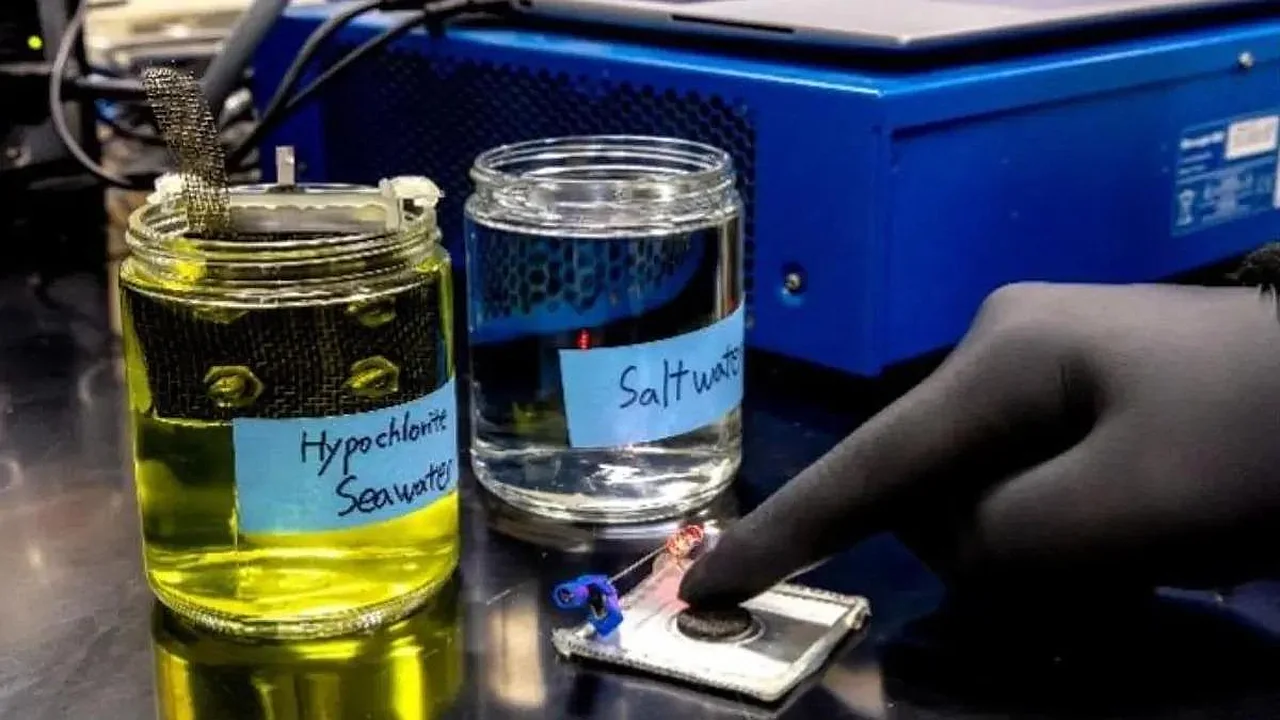
Scientists at the Oak Ridge National Laboratory (ORNL) of the U.S. Department of Energy have managed to completely change the approach to creating salt-water batteries. During the research, an unexpected side reaction became the main advantage of the new generation of power sources, bringing their performance to the level of lithium-ion batteries. This was reported by Ixbt.com reports .
According to ixbt.com, postdoc Vuseok Go discovered during his research that sodium hypochlorite — a common household bleach — is formed before the slow oxygen reaction at the battery cathode. Having noticed that this compound provides higher voltage to the system, the scientists conducted an experiment.
Adding just 5 percent bleach to the system fundamentally changed the entire process. After that, the redox reaction shifted to a hypochlorite/chloride pair occurring entirely in the liquid phase. This process ensured continuous ion circulation during charging and discharging.
Key advantages of the technology
Thanks to this innovative approach, the problematic liquid-gas phase transition in traditional batteries was completely eliminated. As a result, the need for expensive catalysts disappeared, the internal resistance of the battery decreased sharply, and its peak capacity increased more than twofold.Although salt batteries are heavier and bulkier than lithium-ion analogs, they are not suitable for smartphones or electric vehicles. However, for stationary grid storage systems where weight is not a factor, these technologies are a real find.
Safety and future directions
The internal liquid cooling system based on salt electrolyte completely eliminates the risk of catastrophic fire typical of lithium-ion batteries. It is known that in standard lithium-ion batteries, a huge amount of energy is spent on mandatory cooling to prevent fires.Currently, the startup Coulomb Technology is actively working on commercializing this technology. It is planned to use this development to provide backup power for large data centers and electrical grid base stations.
In addition, the possibility of using this technology on container ships in the oceans is being considered. Since ships are surrounded by this exact type of environment, it provides the most favorable conditions for the operation of the new type of batteries.


Comments 0
…