


Planet Earth Has Become a Giant Detector Searching for Dark Matter
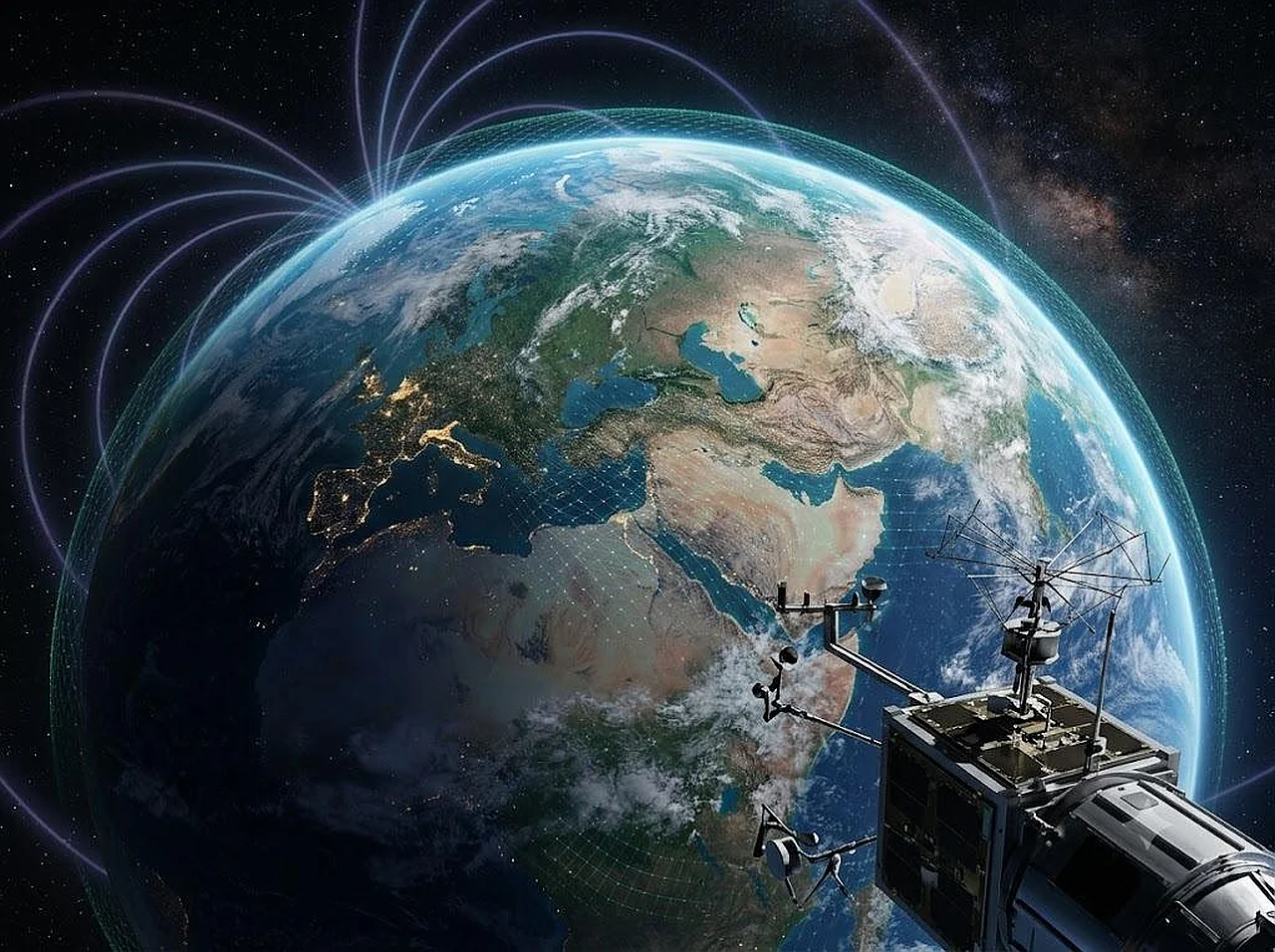
An international team of physicists used Earth itself as a giant detector for dark matter particles. According to a study published in the journal Progress of Theoretical and Experimental Physics, they analyzed magnetic field measurements collected over more than a decade by the Eskdalemuir Observatory in Scotland. The scientists identified 65 stable signals that could not be explained by ordinary noise and established the most stringent direct limit on axion properties to date. Ixbt.com reports that this
Axions are hypothetical, ultralight particles that barely interact with ordinary matter and can pass through it unhindered. If they exist, they could account for approximately 85% of the universe’s invisible mass, which cannot be detected by instruments but reveals itself through gravity. According to theory, as axions pass through Earth, they should interact with the planet’s global magnetic field and generate low-frequency electromagnetic waves.
A New Method and Rigorous Analysis
According to ixbt.com, instead of building expensive new equipment, the researchers relied on existing data from the Eskdalemuir Observatory in southern Scotland. From September 2012 to November 2022, the facility recorded magnetic field fluctuations at a frequency of 100 times per second. The enormous dataset was divided into 9909 eight-hour segments, and each was searched for persistent peaks at a constant frequency characteristic of axions.More than 800 candidates were found during the initial screening. The researchers then checked whether each signal was present not only throughout the overall period but also in every observation, reducing the number to 375. In the next stage, suspicious fixed-frequency signals produced by electronic systems were removed, leaving 65 signals. However, their authenticity cannot be confirmed using data from a single location alone, because such a signal must be recorded simultaneously by magnetometers at different points around the planet.
Scientific Results and Prospects
In regions where no reliable signals were found, the authors calculated the upper limit for the strength of axion–photon interactions. For a mass of approximately 3×10^-14 electronvolts, this value proved to be the most stringent result among all direct measurements in this range. It was found to be 100 times more precise than the result of Europe’s CAST experiment.The main advantage of this approach is that it does not rely on complex assumptions about distant galaxy clusters, but only on repeatable conditions on Earth. The observations are further enhanced by the Schumann resonance effect, global electromagnetic oscillations between Earth’s surface and the ionosphere. In the next stage, the scientists plan to verify these 65 candidates using data from other observatories around the world.


Comments 0
…