


Bomber and Stealth Fighter in Frame: What Signal Did China Send?
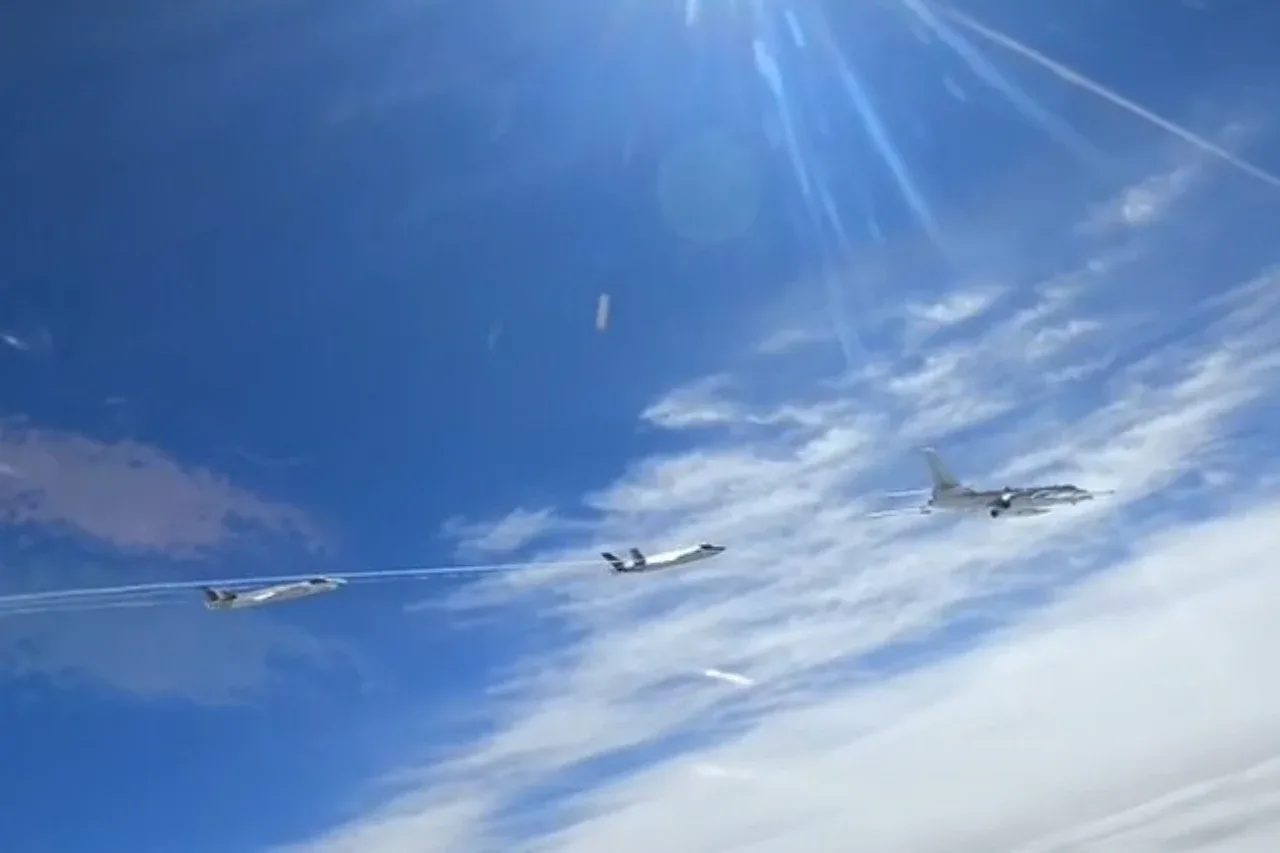
A new video broadcast by Chinese state television has intensified discussion about the country’s strategic aviation capabilities. The footage shows an H-6N bomber carrying a large missile under its fuselage and flying alongside two J-20 stealth fighters.
The footage focuses on a coordinated strike scenario against a large naval force. However, the key clarification is that no missile was launched in the video, and its type has not been officially disclosed by the Chinese military. Experts have likened the weapon to the JL-1 air-launched ballistic missile, but the long-distance footage does not allow a definitive conclusion.
What exactly was shown in the video?
The footage appeared in the final episode of Victory, a documentary project about cooperation between branches of the People’s Liberation Army of China.
According to the scenario, a large naval group moving at high speed in China’s southeastern direction is detected. Airborne drones track information about the target, after which the data is transmitted to various strike platforms.
The following assets were shown operating as a single system:
Asset | Possible role in the scenario |
|---|---|
H-6N bomber | Carrying a large long-range missile |
Two J-20 fighters | Protecting the bomber from airborne threats |
Unmanned aircraft | Reconnaissance and tracking the target’s movement |
Warships | Communications, surveillance and strike platform |
Ballistic missiles | Coordinated strike against large naval targets |
According to the Global Times, the video also shows a Type 052D destroyer launching a YJ-20 missile and two DF-21D anti-ship ballistic missiles being prepared.
This was not an actual nuclear strike
It would be incorrect to interpret the video as “China launched a nuclear missile” or “conducted a nuclear attack exercise.”
The released footage does not show:
a missile launch;
a nuclear warhead;
an explosion or impact on a target;
the use of actual combat ammunition
None of these were shown.
For now, this is not about the use of nuclear weapons, but rather the first public depiction of an aviation platform that could carry such a weapon in a possible combat formation.
The Global Times also did not definitively identify the missile as the JL-1. The publication noted that its appearance resembles the JL-1 displayed in 2025, but that the footage quality is insufficient for precise identification.
When did the JL-1 first appear?
The JL-1—Chinese for “Jinglei,” meaning “Thunder Strike”—is a long-range air-launched ballistic missile.
It was first officially presented to the public at a military parade in Beijing on September 3, 2025. The missile was displayed alongside the JL-3 submarine-launched missile system and the DF-31BJ, DF-61 and DF-5C intercontinental missiles.
Chinese official publications described that parade as the first event at which the country’s land-, sea- and air-based strategic nuclear capabilities were publicly displayed at the same time.
At that time, the JL-1 was shown on a separate platform, while H-6N bombers flew over the parade without missiles. The new video is different because a large weapon resembling the JL-1 was shown under an H-6N, accompanied by J-20s, for the first time in an official production.
Why are two J-20s escorting the H-6N?
Although the H-6N is a long-range bomber adapted for strategic missions, it does not have stealth technology. This could make it a relatively easy target for modern fighters and long-range air-defense systems.
The J-20, by contrast, is a fifth-generation fighter designed to reduce its radar signature. In the video’s scenario, the aircraft move ahead of the bomber and may perform the following tasks:
keeping enemy fighters at a distance;
detecting airborne threats;
creating a safer flight corridor for the H-6N;
protecting the bomber’s return after missile launch
These may be their assigned roles.
A military expert interviewed by the Global Times also said that the J-20s could provide a “protective umbrella” for the H-6N at medium and long ranges. However, there is still no basis for treating the two aircraft shown in the video as a permanent or standard combat formation.
Does the missile carry a nuclear or conventional warhead?
This is the question at the center of the most intense debate.
The JL-1 was displayed among China’s strategic nuclear forces at the 2025 parade. Independent military analysts also assess it as an air-launched ballistic missile intended for the H-6N and capable of carrying a nuclear weapon.
However, it has not yet been officially confirmed that the missile shown in the new video is specifically the JL-1. It could be another type of air-launched ballistic missile, including one equipped with a conventional warhead.
Moreover, the fact that the video focuses on a strike against a naval group does not prove that the missile is necessarily intended for use against moving ships. The documentary footage may have edited different weapons together within a single combat scenario.
What is China’s “nuclear triad”?
A nuclear triad is the ability to deliver nuclear weapons using three types of platforms:
Land-based ballistic missiles.
Missiles launched from submarines.
Weapons carried by strategic aviation.
The main purpose of such a system is to preserve the ability to launch a retaliatory strike even if one delivery route is disabled.
China’s land-based missile forces were established much earlier. Its submarine-based component has been developed through the JL-2 and JL-3 systems. The H-6N and JL-1 represent the open acknowledgment of the air component.
The distinctive feature of an air platform is that it can be moved to another airfield during a crisis, change its flight path or be recalled before launching a missile. At the same time, a complex system consisting of a bomber, tanker aircraft and fighters may remain vulnerable to an adversary’s attack.
Has China’s official nuclear policy changed?
Beijing continues to state officially that it maintains a policy of not using nuclear weapons first.
In a report submitted by China’s Foreign Ministry in April 2026 on the Treaty on the Non-Proliferation of Nuclear Weapons, the country reiterated that its nuclear strategy is defensive and that China will not be the first to use nuclear weapons under any circumstances.
The Defense Ministry also stated in June 2026 that nuclear forces would be maintained at the minimum level necessary for national security and that China would not participate in an arms race.
Therefore, there is currently no basis for presenting the new video as evidence of a change in official nuclear doctrine. It may be more accurately viewed as a demonstration of existing capabilities and a tool of strategic signaling.
Why was this footage released now?
The Chinese military has not provided an official answer. However, the video’s content suggests three possible signals.
The first signal is a shift from platforms to a system.
While the 2025 parade showed individual missiles and aircraft, the new footage depicts bombers, stealth fighters, drones and warships operating within a unified information and strike network.
The second signal is an emphasis on the maritime direction.
The scenario is built around detecting and tracking a large surface group and striking it with various platforms. This indicates that the Chinese military considers joint operations in distant maritime areas important.
The third signal is strategic display.
Although the missile’s exact capabilities were not disclosed, showing it alongside J-20s may send rivals a political signal that China is learning to employ strategic aviation not as a standalone platform but within a broader protection and information system. This is an analytical conclusion based on the footage’s composition.
Which questions remain unanswered?
Although the footage has generated considerable interest, key technical details remain classified:
whether the missile is actually the JL-1;
its precise range;
whether conventional and nuclear variants exist;
how many missiles and H-6Ns have entered service;
what state of readiness the weapon is kept in;
whether the episode shows a real exercise or a specially staged scene;
when and where the flight took place.
Open-source analyses contain no confirmed information about the JL-1’s warhead, engine, stockpile or alert status.
From parade display to combat scenario
The significance of the new footage is not that the missile appeared for the first time. It had already been presented at the 2025 parade.
The most important change is that the weapon is now shown mounted on a bomber, protected by stealth fighters and integrated into a joint operation involving drones and warships.
Nevertheless, this does not mean that a nuclear missile was launched or that China has adopted a new military doctrine. For now, the most cautious and accurate conclusion is this: Beijing has entered a new stage of openly displaying its strategic aviation capabilities, while the system’s real technical and combat parameters remain secret.
In your view, is this video merely military propaganda or a serious strategic signal aimed at regional rivals? Share your opinion in the comments and forward the article to your contacts on Telegram or other social networks!



Comments 0
…