


China Growing Rice in Space: A Key Step for Moon and Mars Missions
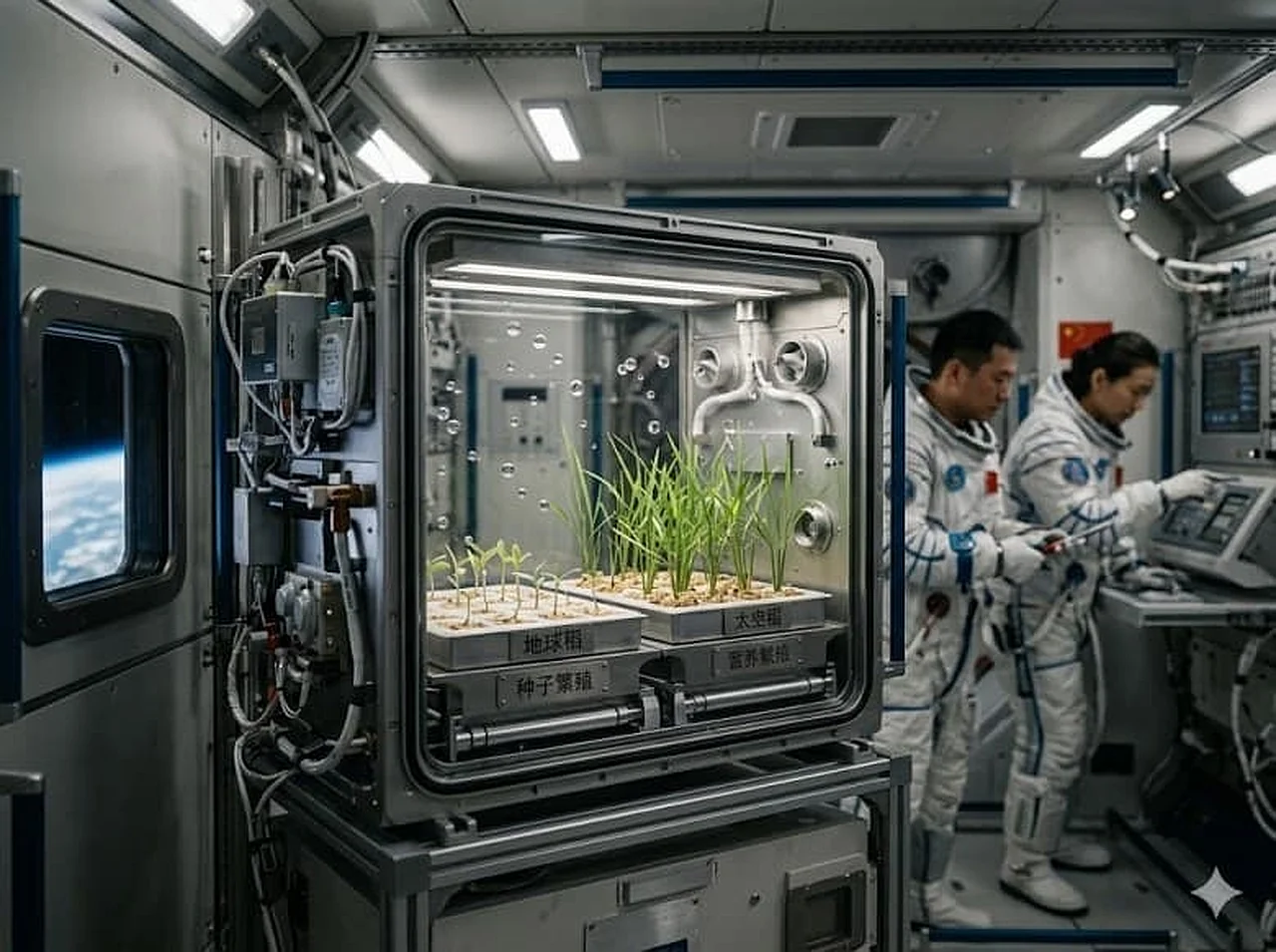
The crew of the "Shenzhou-23" mission operating on China's "Tiangong" orbital station is conducting a unique experiment in growing rice under microgravity conditions. This research is a strategic step toward creating autonomous food sources for humanity's future missions to deep space, specifically the Moon and Mars. This is reported by Ixbt.com news reports.
According to China Science Daily, the experiment is being carried out inside a compact module roughly the size of a microwave oven. Currently, the seeds have successfully germinated and the first shoots have formed. The scientists' primary goal is to study the genetic stability and recovery capacity of plants in zero gravity.
Technical Challenges of Space Farming
All life forms on Earth evolved under constant gravity, meaning plant metabolism and genetic systems are adapted specifically to terrestrial conditions. In zero gravity, water droplets do not flow downward but remain suspended in the air. This can lead to over-saturation of the plants. Additionally, special bio-glues and fixation systems are used to keep the soil and seeds in place.Research lead Zheng Huiqiong noted that plants behave strangely in space. For example, instead of growing upward as usual, they lie flat along the surface. Furthermore, the pollination process is complicated in zero gravity because pollen does not naturally fall. Therefore, scientists are currently focusing on self-pollinating rice varieties.
Foundation for Future Missions
The following key aspects are being studied within this project:- The possibility of completing the full plant life cycle (seed-to-seed) in space;
- The effect of microgravity on flowering and yield timing;
- The viability of subsequent generations derived from seeds grown in space;
- Adapting dwarf and fast-ripening varieties for limited space conditions.
Specialists from the Chinese Academy of Sciences successfully completed a full cycle of rice cultivation in the "Wentian" module in 2022. The seeds obtained then were returned to Earth and tested over several generations. The current experiment serves to further refine this process and create a permanent food production system on the space station.
Such research in space biology is expected not only to provide astronauts with new products but also to open new genetic possibilities for agriculture on Earth. If scientists achieve stable yields in zero gravity, long-term human habitation on other planets will become a reality.


Comments 0
…