


Japanese Scientists Find Way to Convert Ordinary Sunlight into Ultraviolet Radiation
Japanese scientists have developed a new solid material capable of converting ordinary visible light into high-energy ultraviolet (UV) radiation. Created by researchers at Kyushu University, this technology eliminates the need for toxic solvents and represents a revolutionary step in the field of photon upconversion. This discovery, published in the journal Nature Communications, is expected to find wide application in the future, from air purification to 3D printing technologies. This is reported by Ixbt.com news says.
Ultraviolet radiation possesses significantly higher energy than visible light, making it critical for curing polymer resins, disinfection, and various photochemical processes. However, only about 6% of the sunlight reaching the Earth's surface is ultraviolet, and only a small fraction of that can be practically utilized. Therefore, technology to artificially convert ordinary sunlight into UV rays has been one of the priority directions of modern science.
Quantum Physics and Photon Fusion
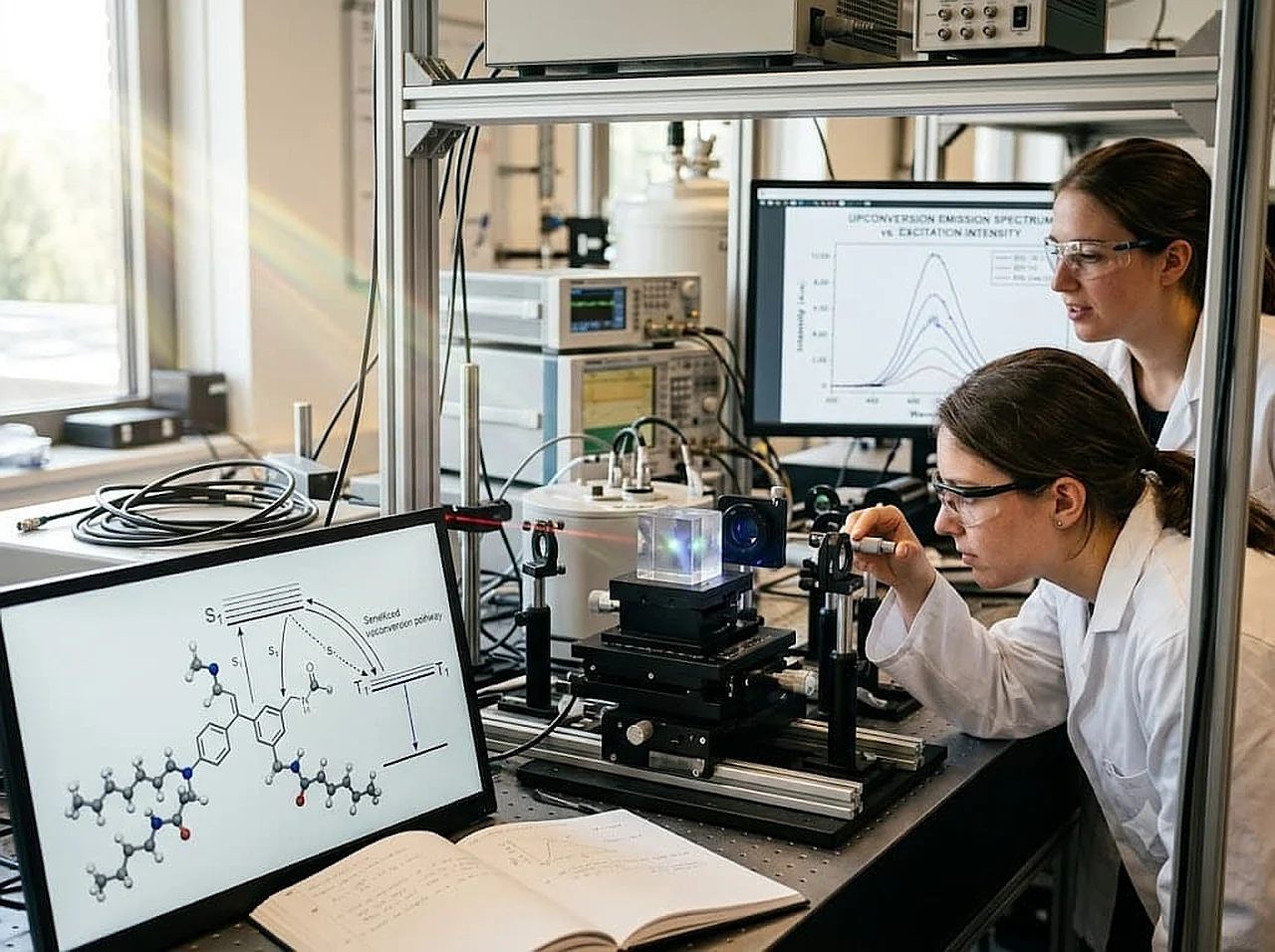
The basis of the new technology relies on the phenomenon of photon upconversion. According to the laws of quantum physics, several low-energy photons can combine to form a single high-energy photon. As explained by Associate Professor Yoichi Sasaki of Kyushu University, this process can be compared to two cups of warm water merging to become one cup of boiling water. Researchers used a special molecular mechanism to achieve this complex process.The process is based on a mechanism called "triplet-triplet annihilation." Initially, a light-absorbing molecule enters an excited state and transfers this energy to a neighboring molecule. When two such excited molecules collide, their energies combine, resulting in the emission of a single ultraviolet photon. While such systems previously worked effectively only in liquids, this result has now been achieved in solids.
Abandoning Liquid Solvents
Previously, photon upconversion systems primarily required toxic and volatile liquid solvents. Attempts to transfer them to solid materials had failed: because the molecules were located too close to each other, the energy would quench before the collision could occur. Japanese scientists solved this problem using an organic semiconductor called dihydroindenes (DHI).By attaching special alkyl chains to the DHI molecules, scientists succeeded in precisely controlling the distance between molecules. This ensured sufficient proximity for energy transfer without allowing the energy to be lost prematurely. The resulting material demonstrated an efficiency of 1.9%, meaning two UV photons are formed for every hundred absorbed light photons.
The authors of the study emphasize that this figure is a very high result for solid materials operating under ordinary sunlight. Many existing systems cannot achieve such efficiency even under strong artificial light. Due to the simple chemical structure of the new material and low production costs, a patent application has already been filed.
This discovery was the culmination of Professor Nobuo Kimizuka's 14-year scientific career. The scientist retired 11 days after completing his paper. In his view, this technology will open a new era in increasing the efficiency of solar energy utilization and establishing environmentally friendly chemical processes.


Comments 0
…