


How the Growth of Data Centers Affects Electricity Prices
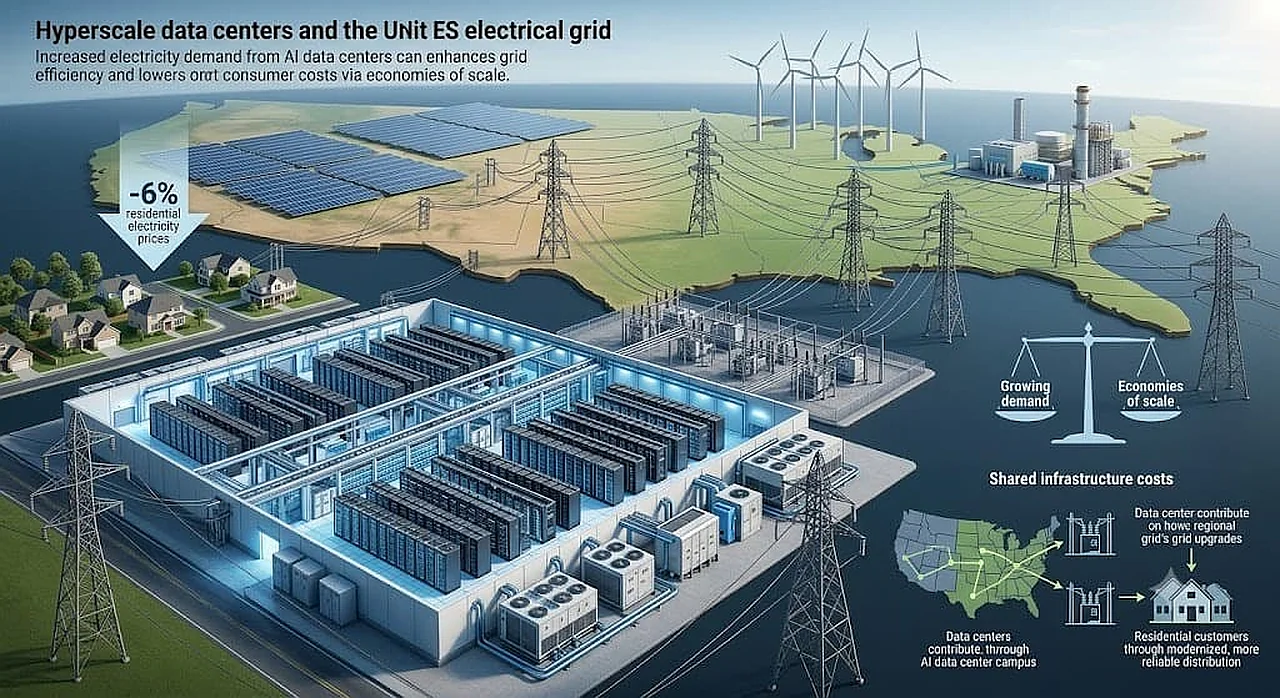
The rapid development of AI technologies has accelerated the construction of massive data centers worldwide. Many experts feared that the emergence of such large consumers would lead to electricity shortages and increased tariffs for the population. However, a new study conducted in the USA has completely changed these views. This is reported by Ixbt.com news reports.
Researchers from the Electric Power Research Institute (EPRI) and Watershed analyzed data from 2015–2024 and found that the expansion of data centers did not lead to an increase in electricity prices for the population, but rather contributed to their decrease. According to ixbt.com, this process is linked to "economies of scale" in the economy.
A peculiar feature of the energy system is that the bulk of costs is spent not on generating electricity, but on maintaining infrastructure—power plants, high-voltage lines, and distribution networks. When large and stable consumers like data centers appear, these fixed costs are distributed over a larger volume of consumption. As a result, the average cost per kilowatt-hour of energy decreases.
Economic Efficiency and Tariff Reduction
According to the research results, every 10 percent increase in data center capacity led to a decrease in retail tariffs for households by approximately 0.4 percent. For example, between 2019 and 2024, in some regions of the USA, tariffs were 6 percent lower than expected due to the development of digital infrastructure. This means significant economic relief for the population.Scientists used highly complex economic methods to prove their conclusions. They analyzed the US federal highway project developed in 1947. It turned out that historical roads determined the location of fiber-optic communication lines today, which in turn influenced where data centers were built. This correlation allowed researchers to clearly prove that the price decrease occurred specifically due to technological hubs.
Furthermore, tech giants are investing in new and cheaper energy sources for their needs, specifically solar and wind power plants. This increases the efficiency of the entire energy system and reduces the need for old and expensive generators.
Future Risks and Constraints
Nevertheless, the authors of the study warn that this positive trend may be temporary. Currently, a number of problems are emerging in the energy sector:- Shortage of voltage transformers;
- Long queues for the delivery of gas turbines;
- Rising prices for renewable energy equipment.
In Uzbekistan, digitalization and the establishment of data centers are also accelerating. The US experience shows that properly planned infrastructure and the attraction of large consumers can be beneficial for ordinary consumers in the long run.


Comments 0
…