


The Milky Way is larger than we thought: astronomers make a new discovery
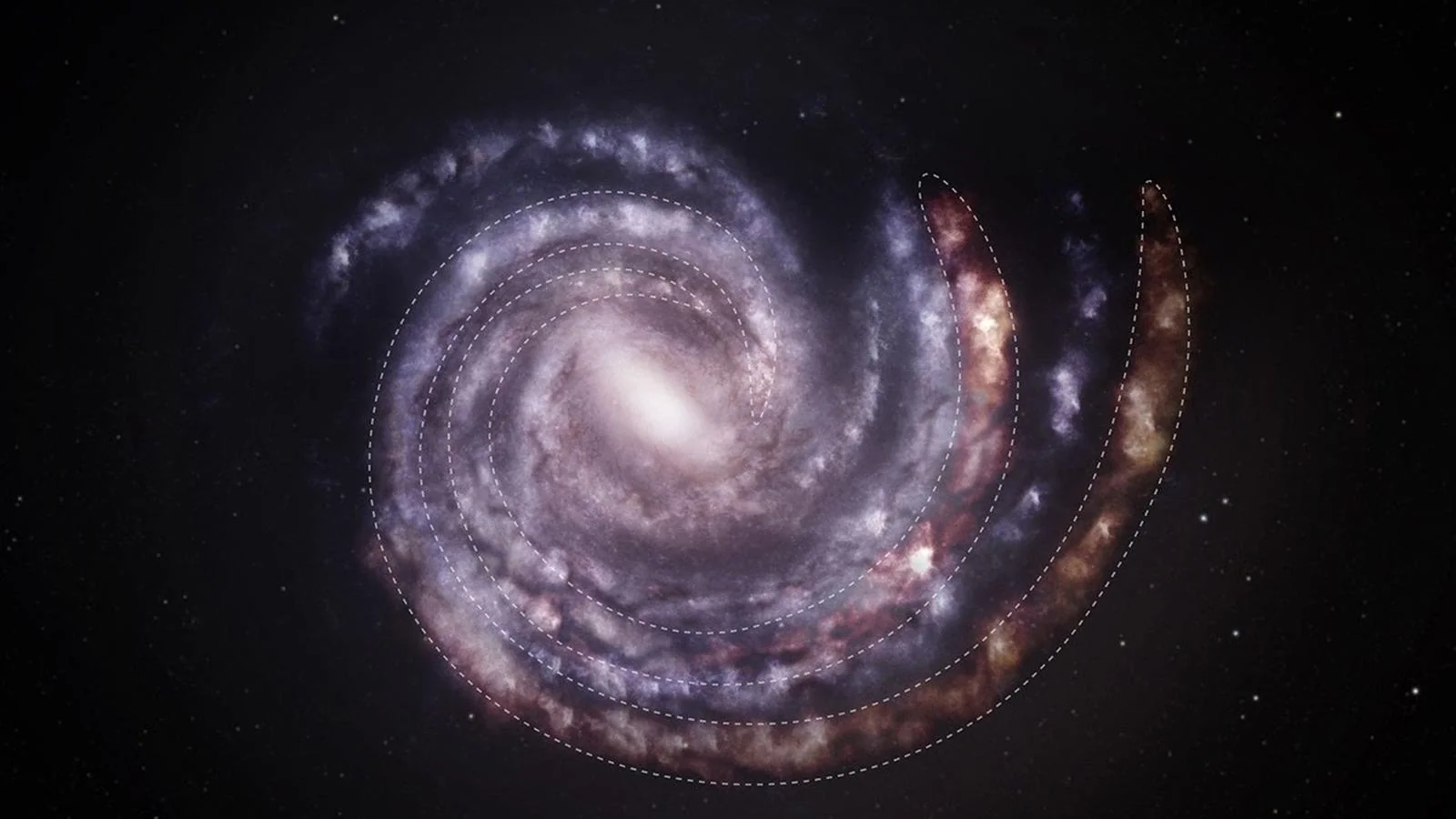
Astronomers studying the mysteries of the universe have reached an unexpected conclusion about the structure of the Milky Way galaxy in which we live. New studies show that the outer spiral arms of our galaxy extend 10 percent further than previously estimated. This discovery may force a revision of existing models of the universe. This is reported by Ixbt.com reports .
According to ixbt.com, scientists achieved this result by studying the unique X-ray "echoes" coming from powerful cosmic explosions. Data obtained with the help of NASA's Chandra X-ray Observatory and the European XMM-Newton satellite allowed for more accurate measurement of the distance to interstellar dust clouds within the spiral arms.
The complexity of studying the galaxy from within
The biggest challenge in studying the Milky Way is that the Solar System is located exactly inside the disk of this galaxy. Because we are viewing our "home" from the inside, determining its exact shape and dimensions is more difficult than observing alien galaxies millions of light-years away. Therefore, astronomers rely on data in various ranges, not only optical but also radio, infrared, and X-ray radiation.A team led by Beatrice Vaiai, a researcher at the Italian National Institute for Astrophysics (INAF-IASF Milano), analyzed X-ray rings formed when gamma-ray bursts reflect off cosmic dust clouds. Such bursts occur as a result of massive stars exploding as supernovae or the collision of neutron stars. The size of the rings changes depending on how far the dust cloud is from the observer.
"This is a very accurate method based on pure geometry to measure the distance to spiral arms," says Beatrice Vaiai. Scientists analyzed three major gamma-ray bursts in the Perseus and Scutum-Centaurus spiral arms and found that in two of them, the distance is 10 percent greater than previous calculations. It was also revealed that the diameter of the outermost dust cloud is approximately 3,500 light-years.
New maps and future plans
Co-author of the study Ilaria Fornasiero noted that these measurements apply not only to individual dust clusters but to the thickness of the entire spiral arm. This could lead to a recalculation of the total mass of the Milky Way, as the mass of the galaxy directly affects the shape and width of its spiral structures.Although this method is revolutionary for studying the galaxy "from within," its capabilities are somewhat limited. Bright gamma-ray bursts visible through the plane of the Milky Way occur very rarely. According to scientists, only a handful of such events have been recorded in the last 25 years. In the future, astronomers aim to analyze more bursts to create a more perfect map of our galaxy.


Comments 0
…