


Revolutionary Discovery in Space: First Rocky Exoplanet Capable of Supporting Life Found
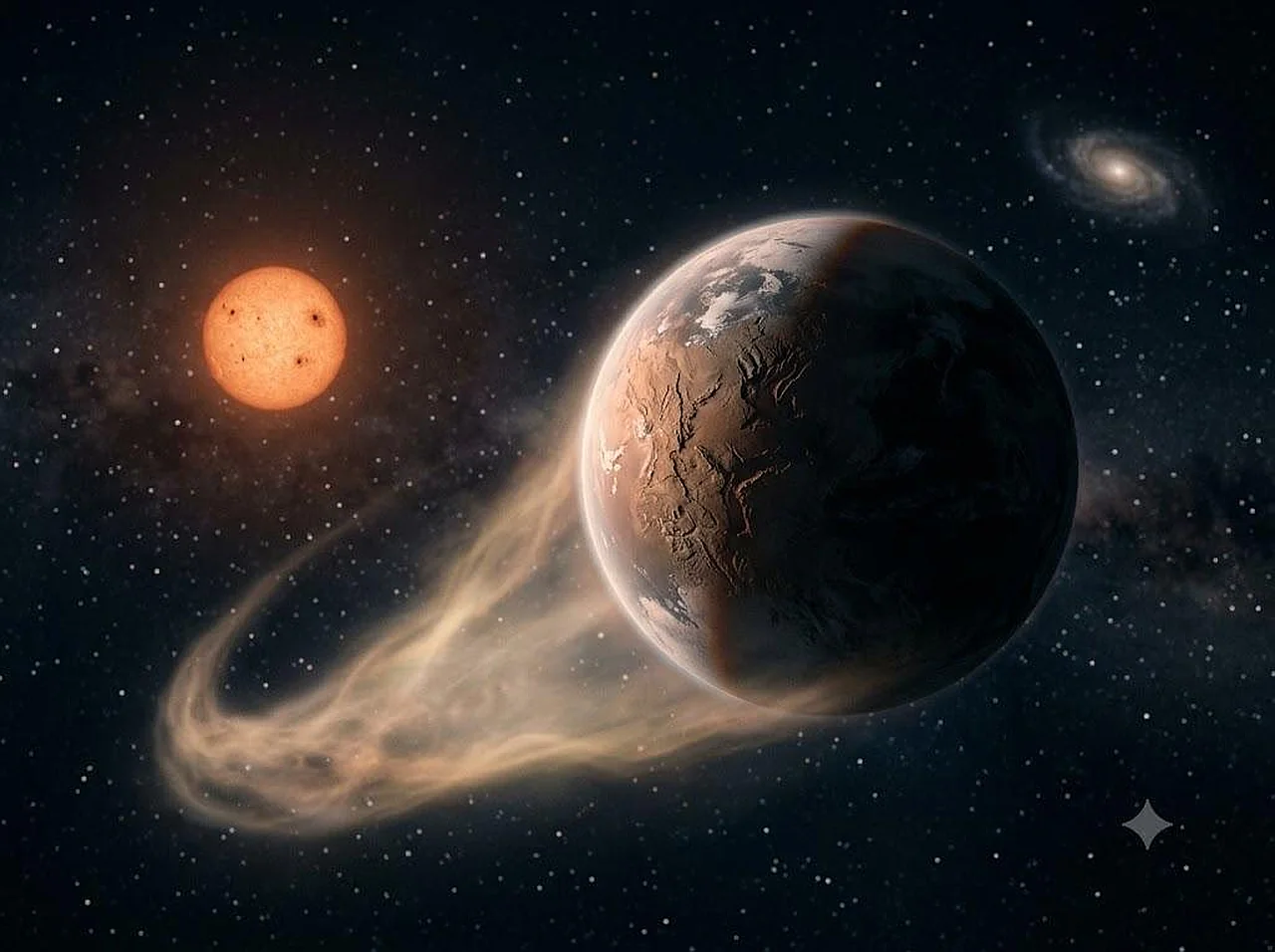
An international team of astronomers has for the first time in the history of space exploration identified an atmosphere on a rocky exoplanet located in its star's "habitable zone." This "super-Earth," known as LHS 1140b, which has a structure similar to Earth, is located 48 light-years away from the Solar System. Until now, Earth was the only rocky celestial body known to possess a gas envelope. This is reported by Ixbt.com .
The planet LHS 1140b orbits an ancient red dwarf star that is over 3 billion years old. An atmospheric evolution model developed by the study's lead author, Collin Cherubim, had predicted the existence of a helium envelope on such planets. Spectroscopic observations conducted using the Magellan "Clay" optical telescope confirmed this theory in practice and revealed the presence of a massive gas envelope around the planet.
Unique characteristics of the super-Earth and the helium shield
LHS 1140b is impressive in its dimensions: its radius is 1.73 times larger than Earth's, and its mass is 5.6 times greater. These parameters mean that gravity on the planet is nearly twice as strong as on Earth. The planet is tidally locked to its star, meaning it has permanent day and night hemispheres. A year on this planet lasts only 24.7 days.Scientists have determined that the planet's upper atmospheric layers are devoid of hydrogen and consist mainly of helium. Under the influence of intense radiation, light hydrogen escaped into space, but the helium layer remained. This "helium shield" creates conditions for heavier elements—carbon, nitrogen, and oxygen—to accumulate in the lower layers of the planet. According to ixbt.com, the temperature on the planet is around -47 degrees, which contributes to the condensation of water vapor and the retention of the atmosphere.
Potential for life and future research
The most interesting aspect is that LHS 1140b could potentially retain between 9 and 19 percent of its mass in the form of water. For now, scientists cannot definitively answer whether the planet's surface is rocky or entirely covered by an ocean. However, the probability of water vapor and oxygen, which are essential for life, accumulating in the lower layers of the atmosphere is rated very highly.This discovery also confirmed the "cosmic shoreline" theory. According to this theory, a planet's ability to retain its atmosphere depends on how much radiation it receives from its star. For example, the planet LHS 1140c in the same system lost its atmosphere entirely because it is too close to its star and receives 5 times more radiation.
Combining the new data with archives from the James Webb and Hubble space telescopes will usher in a new era in studying other worlds where life might exist. The LHS 1140b system has now become one of the primary targets for searching for signs of life outside the Solar System.


Comments 0
…