


Flat optical fibers made of pure glass are a thousand times more sensitive than traditional cables
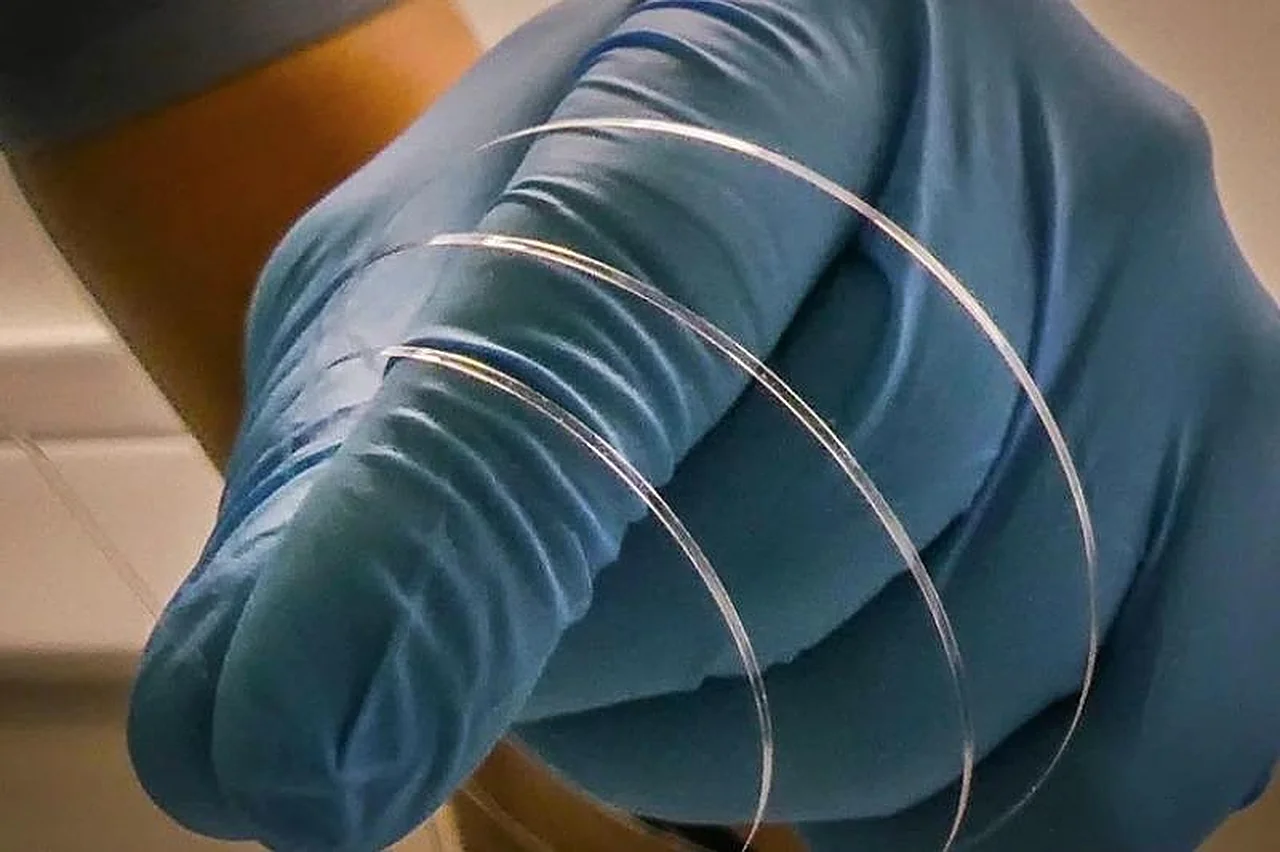
A team of researchers from the KTH Royal Institute of Technology in Sweden and the University of Southampton in the UK has created a flat, ribbon-like HARFF (High Aspect Ratio Flat Fiber) optical fiber that shows a thousand times higher sensitivity to physical influences than traditional cylindrical fibers. According to ixbt.com, the scientists have practically proven the feasibility of this unusual material, managing to draw more than 120 meters of fiber from a single preform. This is reported by news source.
New geometry and engineering approach
The main secret of this invention lies in its unique geometry. Instead of simply flattening conventional round fibers, experts shaped the preform from the start into a flat ribbon with an aspect ratio of up to 20:1. As a result, the placement of internal channels, air gaps, and waveguides became independent variables. This allows engineers to precisely design where the glass will bend and where it will resist.To create a pressure sensor, the researchers formed two elongated air channels. During deformation, asymmetric stress occurs in them, changing the birefringence of the glass. Two identical fiber Bragg gratings form an optical resonator, and the interference pattern shifts in proportion to the pressure.
Tests showed that at a pressure of 0.40 MPa, the sensitivity reaches 31.6 rad/MPa. This is three orders of magnitude higher than similar round fibers. At the same time, the cross-sensitivity to temperature was less than 1% of the pressure reading.
Temperature measurement capabilities
To provide a temperature measurement function, the internal channel of the HARFF was filled with a tin alloy, which has a coefficient of thermal expansion 46 times higher than that of silica. When heated, strong mechanical stress is generated in the glass, which again leads to a change in the birefringence index.KTH researcher Pavel Manvstov notes that this development is not just a differently shaped fiber, but opens up an entirely new space for designing fiber-optic technologies. For now, HARFF remains a laboratory prototype, with optical losses of approximately 0.16 dB per meter.
In the future, experts plan to improve shape control, reduce losses, and successfully integrate these innovative fibers into drone wings, large bridges, industrial structures, and batteries.


Comments 0
…