


Astronomers observe neutron star consuming matter for the first time
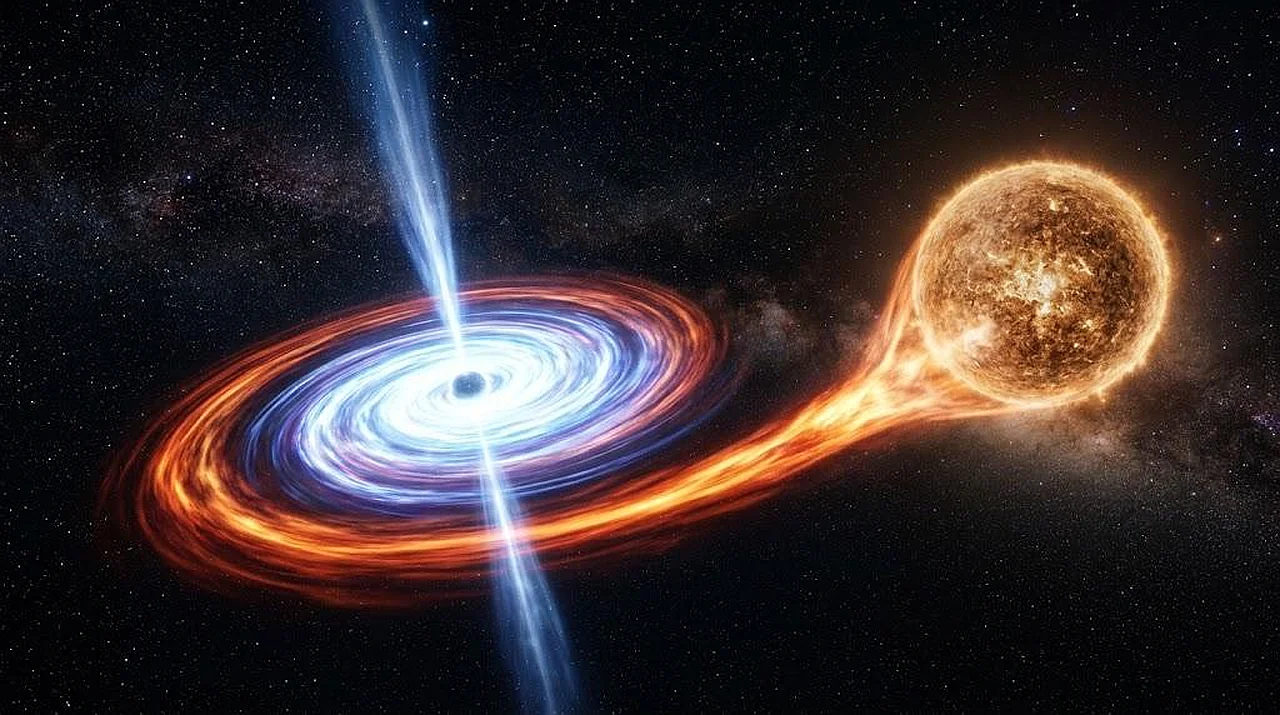
For the first time in history, scientists have managed to observe in detail the movement of matter falling onto the surface of a neutron star, or pulsar. According to research published in the journal Science Advances, data obtained using a Japanese space observatory showed that matter reaches the star in several ways and at certain times forms a spiral disk around it. This is reported by Ixbt.com reports .
According to the IXBT.com publication, the GX 301-2 X-ray binary system, located in the Crux constellation approximately 9,900 light-years from Earth, was chosen as the observation object. This system consists of a neutron star-pulsar with extremely strong gravity and a massive star, and their interaction allows for the study of important astrophysical processes.
The pulsar continuously pulls matter from its companion star. The captured gas accelerates to enormous speeds, heats up to extreme temperatures, and begins to shine brightly in the X-ray spectrum. This process, known as accretion, is the main reason for the powerful X-ray flares in such systems.
Discovery with new technologies
Although scientists understood the general process until now, they had not been able to directly see how matter moves in the immediate vicinity of a neutron star. The Japanese XRISM X-ray space observatory, launched into space in 2023, fundamentally changed the situation.The high-precision X-ray spectroscopy of this modern observatory made it possible to determine the speed and direction of the hot plasma based on its radiation characteristics. Observations showed that for most of the time, matter falls toward the pulsar in the form of a calm, turbulent flow directed almost straight.
However, shortly before and immediately after the maximum approach of the two objects, the situation changes dramatically. During such periods, the captured matter begins to rotate, forming a temporary spiral structure around the pulsar — a structure resembling an accretion disk.
Understanding the physics of extreme conditions
The results obtained fully confirmed theoretical assumptions that disk structures consisting of captured gas can appear around a pulsar from time to time. This helps to better understand the nature of powerful X-ray flares and the physics of accretion under conditions of extremely strong gravity.Neutron stars remain one of the best natural laboratories for studying matter under conditions of immense density, strong magnetic fields, and gravity that cannot be replicated artificially on Earth.


Comments 0
…