


Significant discovery related to giant squid with pizza-sized eyes
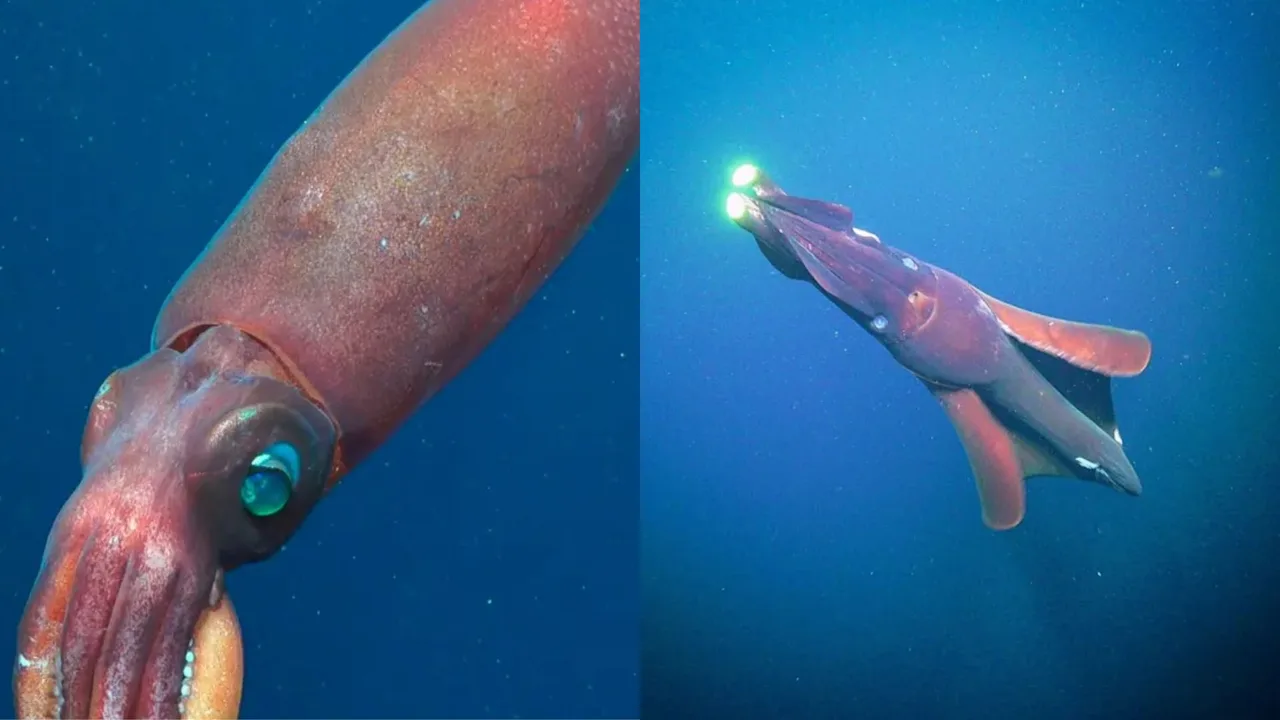
Australian scientists have identified significant traces of one of the most mysterious creatures living on the ocean floor — the giant squid. This discovery is considered the first of its kind recorded off the coast of Western Australia in the last quarter-century. The research results Environmental DNA were published in the scientific journal.
The authors of the study note that finding traces of this rare creature is a significant event in marine biology. According to Dr. Georgia Nester, a researcher at the Minderoo OceanOmics Centre at the University of Western Australia, the discovery of evidence related to the giant squid sparks great interest and wonder among people.
It is reported that the giant squid is one of the most mysterious sea creatures on our planet. It can reach a length of up to 43 feet (nearly 13 meters), which is longer than a school bus. Its eyes are the size of a large pizza, making them the largest among all living creatures on Earth.
Nevertheless, despite its massive size, it is very difficult to encounter this creature in its natural habitat. This is because the giant squid lives in the so-called "twilight zone" of the ocean, at a depth of about 600 meters, and leads a very cautious and elusive life. Therefore, it is rarely captured on camera.
This time, scientists did not encounter the creature itself, but rather traces of environmental DNA (eDNA) left in the seawater. This method allows for the identification of animals through biological material preserved in the water. Experts emphasize that this method is of great importance in studying many mysterious species living on the ocean floor.
Dr. Lisa Kirkendale, Head of the Department of Aquatic Zoology and Curator of Mollusks at the Western Australian Museum, praised the result, noting that this is the first time a giant squid has been detected via eDNA technology off the coast of Western Australia, and it is the northernmost record of this species in the eastern Indian Ocean.
The research Schmidt Ocean Institutewas carried out on board the research vessel Falkor . During the expedition, scientists collected and analyzed more than a thousand water samples.
As a result, biological traces of 226 species were identified. Among them are large marine animals such as Cuvier's beaked whales and dwarf sperm whales, as well as a number of species never before recorded in Western Australian waters.
In particular, rare creatures such as the sleeper shark, the headless fish, and the slender-bodied predatory deep-sea fish were identified. Scientists do not rule out that some samples may even be completely new species to science.
“We still know very little about the biodiversity of the ocean floor. We are only just beginning to understand its true scale,” said Dr. Georgia Nester.
Interestingly, the giant squid was first filmed alive only in 2004. Since then, it has been captured in its natural habitat very few times. Previously, mostly specimens that had washed ashore or died were encountered.
Scientists also mentioned another important fact. The giant squid is not the largest invertebrate in the world. This title belongs to the colossal squid, which can weigh over 500 kilograms.
In 2025, a young specimen of this colossal squid was filmed in its natural habitat for the first time near the South Sandwich Islands. Kat Bolstad, a researcher at Auckland University of Technology in New Zealand, confirmed these images and described it as one of the most exciting observations in marine biology.


Comments 0
…