


Rare shark that can live up to 500 years found on the Irish coast
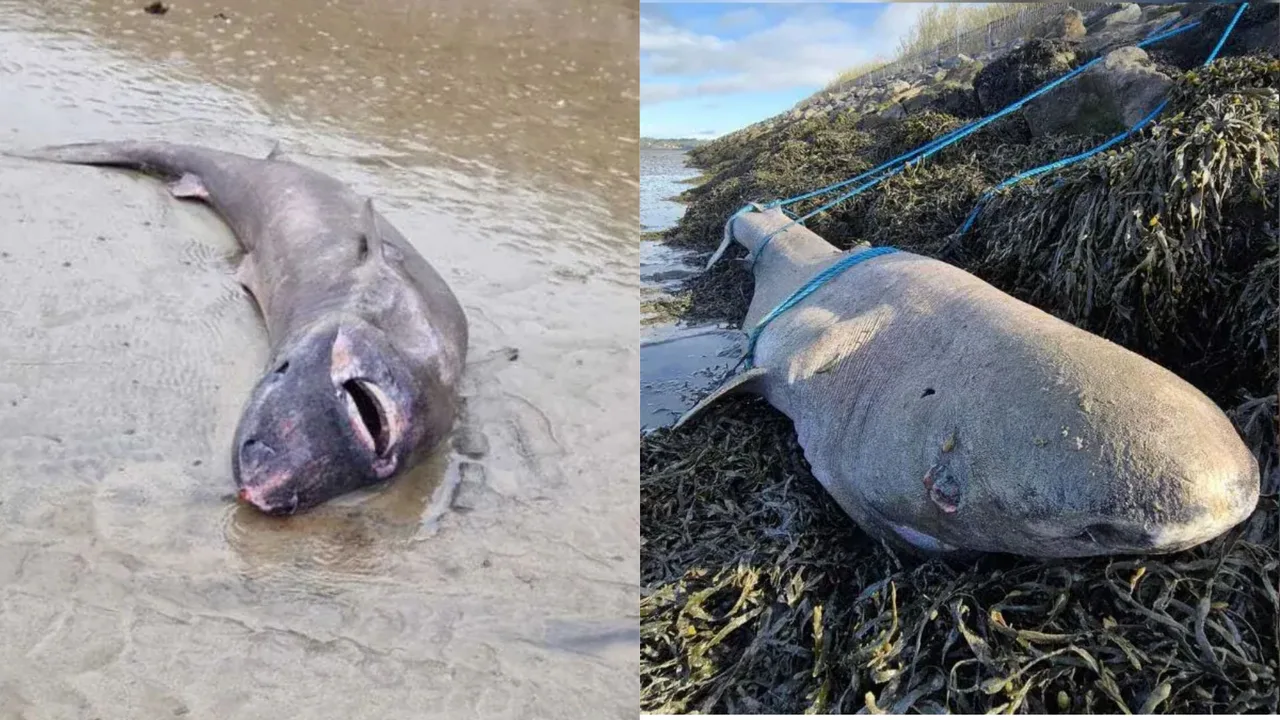
A rare discovery that surprised citizens walking along the Irish coast has been recorded. On the country's shore, the carcass of an ancient creature, considered one of the longest-living in the world, was found: Greenland shark. Expertsnote that this large marine predator is capable of living up to 500 years, and this is the first time in the country's history that this species has washed up on the Irish coast.
It is reported that Hammad Chaudhry and James Winters O'Donnell encountered the carcass of a massive, terrifying-looking sea creature while walking along the coast of Finnisklin (County Sligo). According to Jam Press, they initially thought it was just a giant shark. Later, the discovery was reported to the Irish Whale & Dolphin Group organization.
After examination, experts confirmed that the carcass indeed belonged to a Greenland shark. They described the incident as a "very rare and scientifically fascinating stranding." The specimen was later taken to the Natural History Museum for further analysis.
Scientists believe this shark was approximately 150 years old . Based on its well-developed sexual characteristics, experts estimate that the animal was nearly mature before it washed ashore. However, this age is considered relatively "young" for the species, as Greenland sharks can live for several centuries.
Irish Whale & Dolphin Group representative stated:
"The Greenland shark is considered the longest-living vertebrate in the world. Its lifespan spans several centuries. The oldest scientifically recorded specimen lived for more than half a millennium."
The Greenland shark is considered one of the largest sharks in the world. Its length can exceed 20 feet (6 meters) . This is roughly equivalent to the length of a large truck.
Experts note that although this incident is unfortunate, the stranded specimen allows scientists to gather more information about this mysterious marine creature. Because Greenland sharks usually live in the icy waters of the Arctic and North Atlantic Oceans at depths of 7,000 feet (nearly 2,100 meters) , it is very difficult to observe them in their natural habitat.
This species is distinguished by its heavy and robust body structure, short rounded head, and small eyes. Florida Museum reports that the Greenland shark hunts various fish, including char, wolffish, smaller sharks, and sometimes seals and porpoises.
Nevertheless, experts emphasize that this shark poses no threat to humans. The main reason is that its habitat is located in waters too cold for humans to swim in.
Experts also note that Greenland shark meat is toxic when fresh, but can be consumed after being fermented underground using a special method and then dried.
The rare find is expected to become another important scientific resource for researchers. This case may serve to deepen the study of the lifestyle and biology of the Greenland shark, one of the longest-living vertebrates in the world.


Comments 0
…