


50 Million Dollar Tyrannosaurus: “Gash” Breaks Record
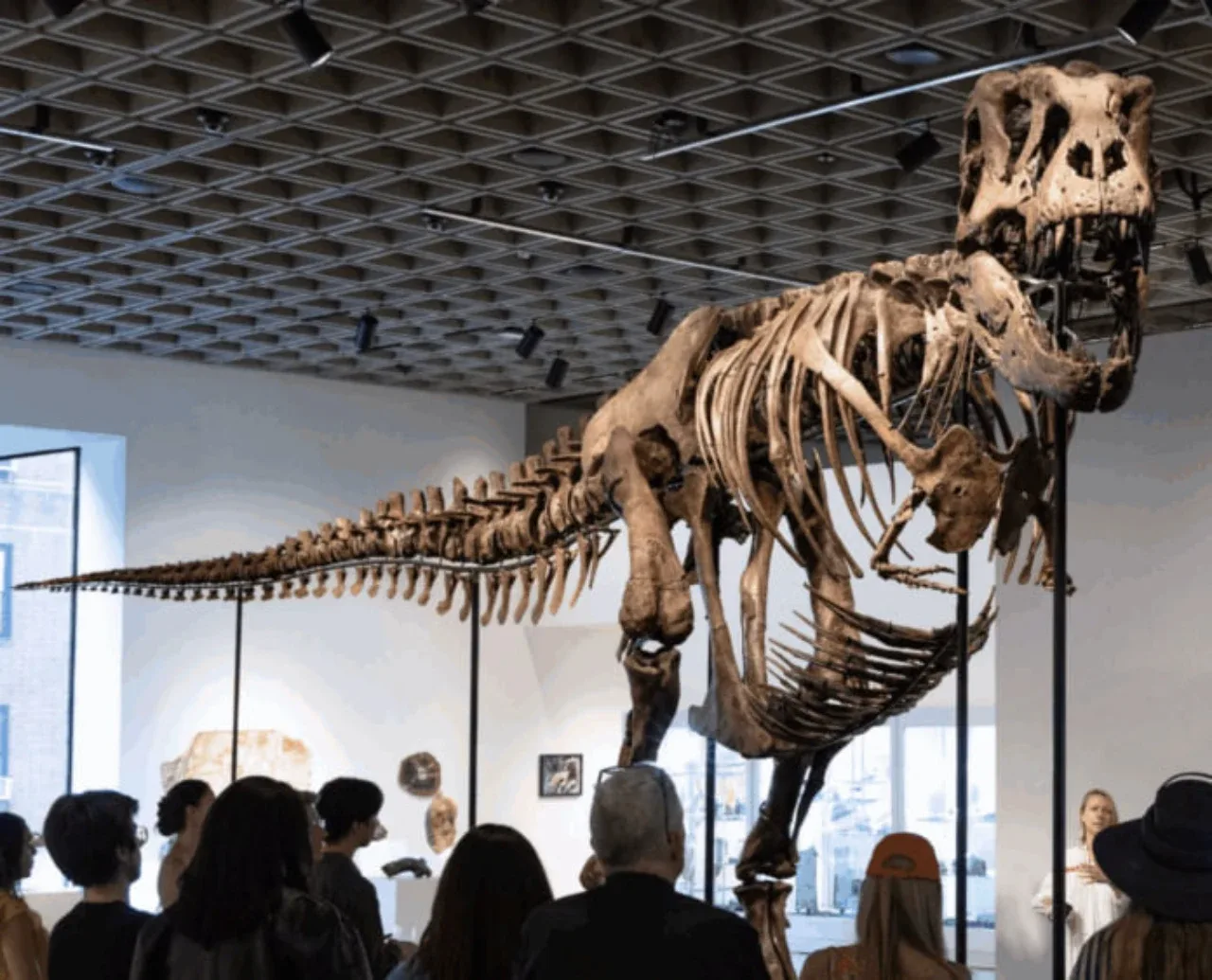
Photo: Sotheby's/Facebook
A Tyrannosaurus rex skeleton that lived approximately 67 million years ago has sold for $50.1 million at a Sotheby's auction. This fossil, nicknamed “Gash,” has now gone down in history as the most expensive dinosaur skeleton ever sold at auction.
Initially expected to fetch 20–30 million, the price skyrocketed
Before the Sotheby's auction, “Gash” was estimated to be worth around $20–30 million. However, bidding was intense, and the final price reached $50.1 million.
This result set a new record in the fossil market. Now, “Gash” is not only a large and well-preserved Tyrannosaurus rex, but also the most expensive dinosaur skeleton ever sold at auction worldwide.
The “Apex” record surpassed
The previous record belonged to a Stegosaurus skeleton nicknamed “Apex,” which sold for $44.6 million at a Sotheby's auction in 2024.
“Gash” has surpassed this figure, once again demonstrating how high prices in the paleontological fossil market have climbed.
Fossil | Species | Sale Price |
|---|---|---|
Gash | Tyrannosaurus rex | $50.1 million |
Apex | Stegosaurus | $44.6 million |
Stan | Tyrannosaurus rex | $32 million |
Why is “Gash” so expensive?
According to the lot description, “Gash” is considered one of the largest Tyrannosaurs. It stands nearly 4 meters tall and is about 12 meters long.
The skeleton consists of 183 bone elements. Most interestingly, it retains rare belly ribs—gastralia: 30 out of 32 are present.
Such details significantly increase the fossil's value for scientists and collectors, as while T-rex skeletons are found, those preserved to this degree are very rare.
The skull is also very well preserved
Another important aspect of “Gash” is its skull. Reports indicate that the skull is approximately 82 percent preserved and contains all six tooth rows.
Overall, the skeleton is about 61 percent preserved by bone count and 75–80 percent by weight.
These figures are very high for a large predator that lived 67 million years ago like the T-rex. Simply put, “Gash” is a find that would leave people in awe if displayed in a museum.
Where was it found?
The “Gash” skeleton was found on a private ranch in South Dakota, USA. Excavations lasted from 2021 to 2023.
The dinosaur's nickname was given in honor of the ranch owner.
South Dakota is considered one of the most important regions for finding large dinosaur fossils like the T-rex. The geological layers here have preserved traces of life from millions of years ago.
A question for scientists: will it end up in a museum?
When such fossils are sold, a major debate always arises: will the skeleton remain in a private collection, or will it be accessible to the public and scientists in a museum?
According to AP, paleontologists hope the new owner will place “Gash” on public display for scientific and educational purposes.
Because such finds are not just expensive exhibits; through them, scientists can learn more about the structure, growth, movement, hunting style, and evolution of dinosaurs.
Why is the fossil market so hot?
In recent years, dinosaur skeletons have been selling for huge sums, much like works of art, rare cars, and expensive collectibles.
There are several factors involved:
• Dinosaurs like the Tyrannosaurus rex are very popular in pop culture;
• Well-preserved skeletons are rare;
• Wealthy collectors are becoming interested in natural history objects;
• Competition at auctions is driving prices up sharply;
• Each new record further heats up the market for future sales.
However, there are critics of this process. They believe that if rare fossils go into private hands, accessibility for science may decrease.
The price of 67 million years of history
The sale of “Gash” for $50.1 million is, on one hand, an astonishing record. On the other, it brings the question of who should own natural history heritage back to the agenda.
This skeleton was preserved underground for millions of years, fell into the hands of scientists and excavators, and is now heading to its new owner as the world's most expensive dinosaur fossil.
Now the main question is: will “Gash” remain in a private collection, or will millions of people have the chance to see it in a museum?



Comments 0
…