


Political Ruse: Pashinyan tells Putin at meeting that EU aspirations are 'not a strategic choice'
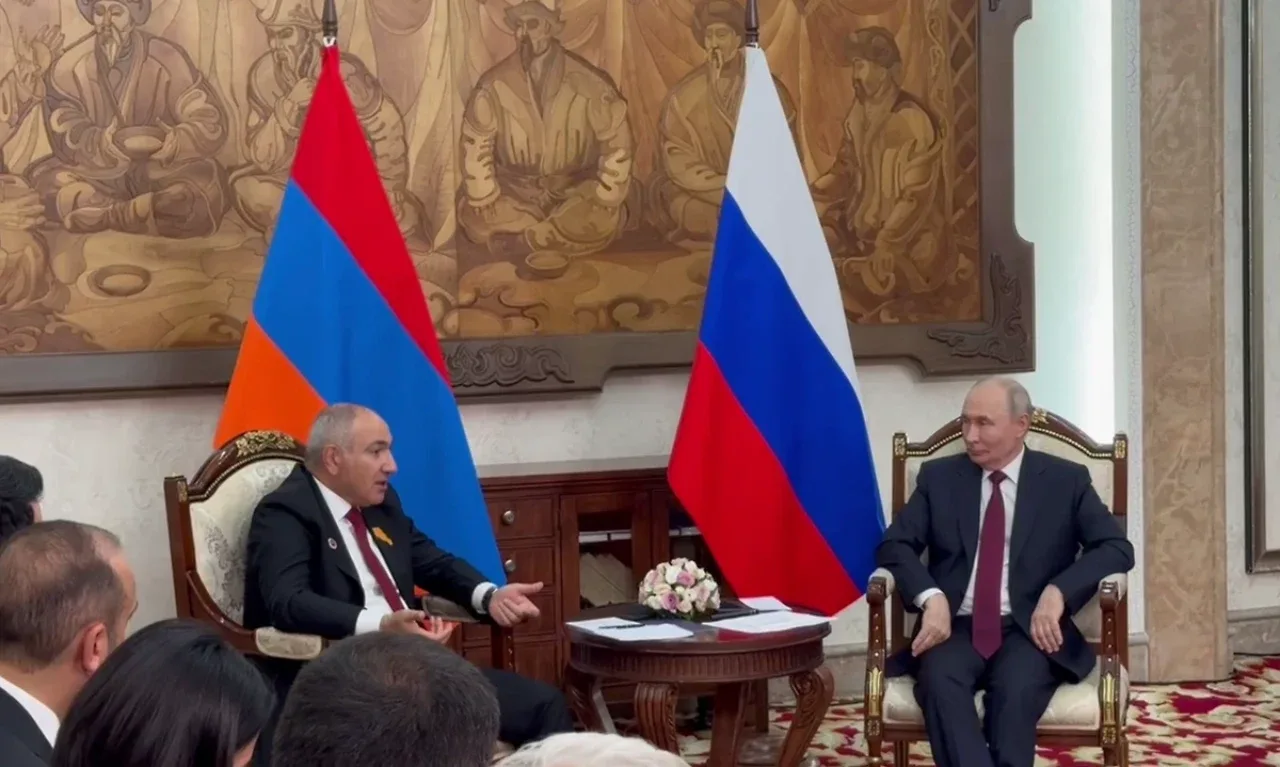
At a meeting in Bishkek, Russian President Vladimir Putin and Armenian Prime Minister Nikol Pashinyan discussed the greatest contradiction in Yerevan's foreign policy: the simultaneous aspiration to join both the European Union (EU) and the Eurasian Economic Union (EAEU). During the meeting, Vladimir Putin stated that Moscow would act based on Armenia's choice, and if Yerevan truly chose the path of Euro-integration, Russia would fundamentally reconsider bilateral relations.
Previously, Kremlin spokesman Dmitry Peskov had openly stated that the only legitimate mechanism to resolve the contradiction between EAEU obligations and European aspirations would be a national referendum. However, in the Bishkek negotiations, Pashinyan made an admission unprecedented in Armenian political history.
The ruse of bypassing the referendum: Why was the step toward Europe taken?
According to the Armenian publication 'Public Tribunal', Nikol Pashinyan emphasized that the law on initiating the EU accession process, adopted by the country's parliament in June 2026, is not Armenia's true strategic choice.
It turns out that public organizations had begun collecting 250,000 signatures to hold a national referendum on this issue. To prevent the people from voting directly and to avoid this scenario, the government urgently pushed the law through parliament. This step, which should have been decisive for the country's fate, was actually used as a mere tactical maneuver to block the will of the population. Pashinyan called holding a referendum 'too early' until an official application to the EU is submitted and candidate status is obtained, postponing it indefinitely.
Analysts believe this admission was an open political ruse directed at three parties at once:
Towards Russia: It was signaled that the national referendum requested and considered legitimate by Moscow was deliberately blocked, and that Euro-integration is actually just a way to navigate the situation;
Towards the European Union: It was shown to Brussels, which is allocating a 2.5 billion euro investment package to Yerevan and negotiating a visa-free regime, that these laws are merely a bureaucratic trick;
Towards the Armenian people: Fearing an answer contrary to their plans, the government deprived citizens of their right to vote directly and relied on the parliamentary majority.
Cooling relations with Moscow: Chronology of 2025–2026
Before the meeting in Bishkek, the Armenian leadership took a series of steps that the Kremlin assessed as unfriendly actions:
December 26, 2025: Pashinyan declared the CSTO 'ineffective' and said he would reconsider participation in it;
February 2026: In Kazakhstan, Yerevan, having refused to participate in CSTO exercises, simultaneously conducted joint drills with military units from NATO members Greece and Bulgaria;
May 2026: Ukrainian President Volodymyr Zelenskyy made a speech in the Armenian parliament with accusations against Russia, and Yerevan offered no diplomatic objection;
June 2026: Parliament adopted a law on initiating the process of joining the EU;
August 2026: In an interview with Western media, Pashinyan stated that he has no intention of returning to the CSTO within the next five years; on the contrary, he wants Armenia to be expelled from the organization to facilitate relations with NATO.
Strategy in the document and verbal denial: Two different realities
In August 2026, the Armenian government approved the socio-economic development program for 2026–2031. This five-year official document clearly specifies deepening strategic partnership with the EU, fully aligning legislation with European standards in trade and customs, absorbing 2.5 billion euros in Euro-investments, and not returning to the CSTO until 2031.
However, the transition to European norms directly contradicts EAEU regulations in practice. Pashinyan's admission in Bishkek that all these steps were a temporary tactic to bypass a referendum rendered the government's own official program a meaningless political facade. While the official document presents the European choice as inevitable and strategic, the Prime Minister himself explained it as a mere situational necessity.
Armenia is currently in a state of severe political uncertainty: the risk of Moscow canceling economic privileges within the EAEU is growing, there is no clear legitimate foundation for integration with the EU, and the strategic direction within the country has been nullified by personal statements.
Do you think Nikol Pashinyan's dual diplomatic maneuvers between Russia and the West can save Armenia from an economic crisis, or will they instead deprive the country of trust from both sides? Leave your analysis in the comments!



Comments 0
…