


Cannavaro reveals why he abandoned Katanec's schemes — Analysis of the 4-3-3 tactic
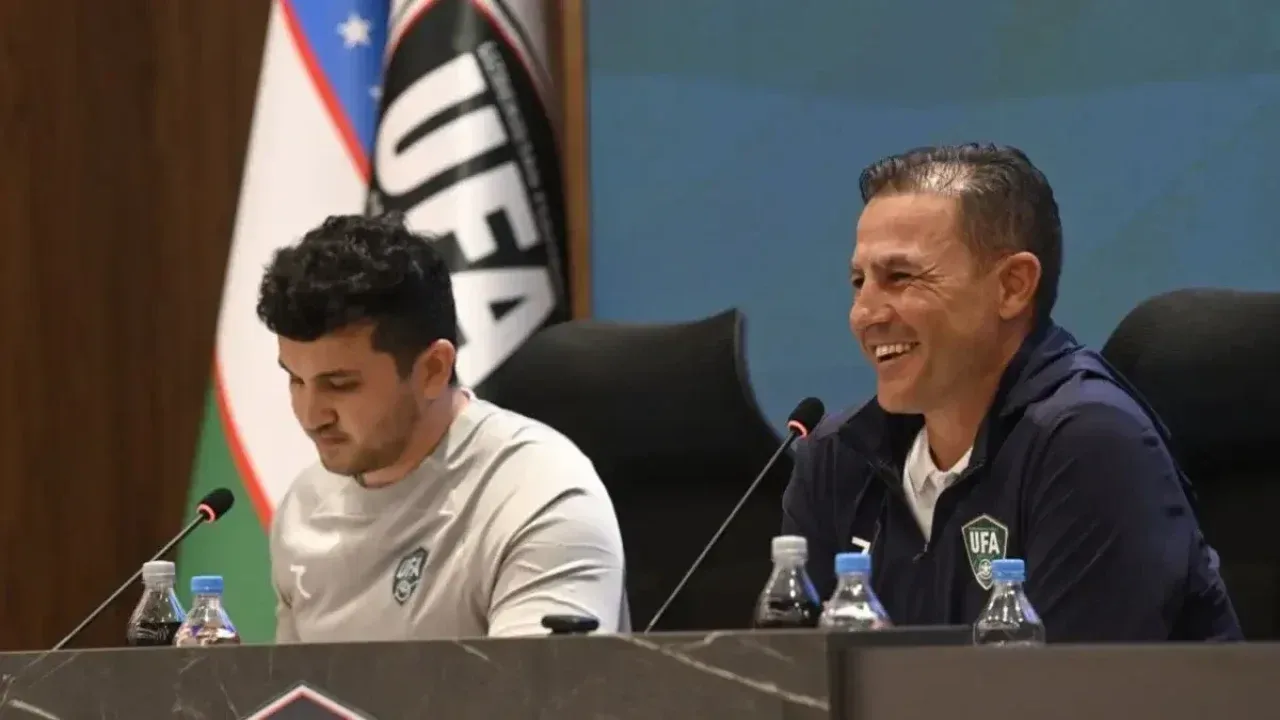
Following the 3-1 victory over the Iran national team at the «Istiqlol» stadium in Fergana, Uzbekistan national team head coach Fabio Cannavaro answered the most controversial and important questions regarding the team's tactical revolution in the second part of the press conference. Instead of the cautious style based on 3 central defenders (a 5-man defensive block) during the Srechko Katanec era, the shift to 2 central defenders and the classic 4-3-3 tactic had been in the spotlight of experts.
To journalists' question, "Aren't you afraid to play with two central defenders?", the Italian specialist, one of the world's most famous defenders, gave a firm and uncompromising answer: «No, I am not afraid! Modern football is built precisely like this. If you are afraid to step forward and break the line, the opponent will trouble you even more. We told the defenders to step forward, press, and not be afraid!». At the same time, Cannavaro put an end to rumors about Aziz Ganiev and other leaders who seemed to move freely on the pitch: «No, nobody has any freedom granted! We believe in our system. Playing in a 4-3-3 scheme requires high dynamics: you need to understand when to stay on the line, when to shift to the flanks, and when to open up behind the opponent!». The coach's statement proved that the philosophy of taking the initiative, rather than "playing on the counter", will prevail in the national team's game.
So, what new opportunities does the transition from Katanec's 3-defender system to Cannavaro's 4-3-3 system give our national team, how will players like Ganiev and Oston Urunov operate in this scheme, and why is it required to forget the World Cup?
«Two central defenders, the 4-3-3 scheme, and the denial of freedom»: 5 main points of Cannavaro's statement
The most important theses and conclusions from Fabio Cannavaro's tactical interview:
Return to the two central defenders system: The scheme consisting of 3 central defenders from the Srechko Katanec era was officially abandoned and a modern pairing model was introduced;
«Fearless high pressing»: Cannavaro stated that sitting back and waiting for mistakes is no longer an option, and that stepping up into the opponent's half to apply aggressive pressure is a requirement of modern football;
«There are no free players»: The coach emphasized that there are no free-roaming footballers on the pitch, and every action strictly submits to the 4-3-3 system;
Aziz Ganiev and midfield dynamics: The role of Ganiev and Hakimov in the center is perfectly coordinated with tasks such as opening up to the flanks, holding the line, and breaking through behind the defenders;
«Forget the World Cup»: The coach called to stop living with the achievements of the mundial and to be mentally prepared to fight on equal terms with any upcoming opponent.
Tactical evolution of the Uzbekistan national team: Comparison of Katanec's model and Cannavaro's system
Changes in the national team's positioning on the pitch, defensive style, and philosophy:
Criteria and parameters | During Srechko Katanec's tenure | The new system proposed by Fabio Cannavaro |
Main tactical scheme | 3-4-2-1 or 5-3-2 (3 central defenders) | 4-3-3 (2 central defenders, active flanks) |
Positioning of the defensive line | Low block, defense close to own penalty area | High line, stepping forward through pressing |
Attitude towards fear and risk | Striving for numerical superiority in defense | «Must not be afraid»: Breaking the line and organizing pressure |
Midfielders' duties | Mostly destroying plays and closing zones | High dynamics, opening up behind the opponent, aggressive attack |
Players' freedom | Free movement rights for certain stars | Absolute system: «We have no players in free roles» |
Attack and pressing integration | Relying on counter-attacks and long passes | Full team pressing by forwards and midfielders |
Football expertise and tactical analysis: Why is Cannavaro's 4-3-3 system a revolutionary step?
Conclusions of international coaches and sports experts:
«An attacking coach who emerged from defense»: World Cup winner and Ballon d'Or holder Fabio Cannavaro prefers to organize defense not by lying deep in his own penalty box, but by suffocating the opponent in their own half; when the 2 central defenders (Husanov and Orozov) rise to the high line, the opponent's space narrows and they are forced to clear the ball inaccurately;
The phenomenon of Ganiev and the central trio: Aziz Ganiev's seemingly free movement in the center was actually Cannavaro's instruction, fulfilling the task of creating space in the opponent's anchor zone, receiving the ball, and quickly delivering it to the flanks or to Shomurodov; because there was order in the system, this was not indiscipline, but a geometric plan;
A new test for Urunov and wingers: The coach openly stated that wingers with individual skills like Oston Urunov need time to fully adapt to this system; in the 4-3-3 scheme, a flank player must not only be able to dribble past opponents but also possess the discipline to track back in defense;
Psychology of «forgetting the past»: Katanec delivered the historic result of taking the team to the World Cup, but being mesmerized by that success stops progress; Cannavaro saying "the World Cup must be forgotten" aims to ignite a thirst for new victories in the team.
These bold thoughts of Fabio Cannavaro after the match against Iran show that the Uzbekistan national team has completely abandoned cowardly and closed football and will play against continental giants only on equal terms and in an active attacking system.
In your opinion, does Fabio Cannavaro abandoning Katanec's 5-man defense and switching to 2 central defenders and a 4-3-3 system bring more benefits or risks to our national team? How do you personally assess the performance of Aziz Ganiev and our central midfielders in the new tactic? Leave your thoughts in the comments and share this exclusive article covering the new tactical era of our national team with all football fans!



Comments 0
…