


Industrial Safety Revolution: Sensing Approaching Robots Through Sound
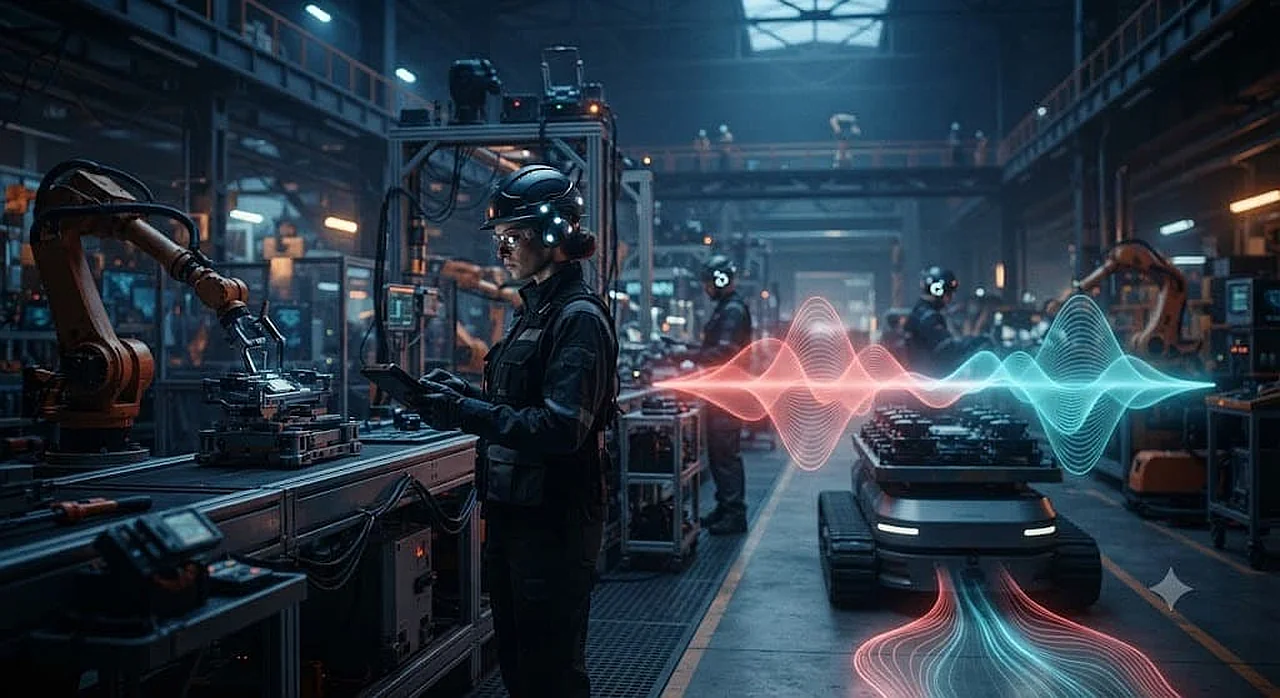
In modern manufacturing plants, humans and automated systems working side-by-side has become the norm. However, the movement of heavy robots often poses unexpected risks to workers. Scientists at the Georgia Institute of Technology in the USA have developed an innovative audio system called Spherephones to solve this problem. This technology converts robot movement into a spatial soundscape, allowing workers to sense danger in advance, much like in horror movies. This is reported by Ixbt.com reports .
Researchers believe that human hearing processes signals faster and more continuously than vision. In cinematography, particularly in the horror genre, music is used to signal an approaching threat to the viewer before it appears visually. Spherephones leverages this natural instinct: as a robot approaches, a special low-intensity tone plays, which changes based on the object's direction and speed.
Transitioning from traditional signals to spatial sound
Standard signaling systems used in industrial facilities are often ineffective. They only indicate the presence of a hazard but do not provide information about which direction it is coming from or how fast it is approaching. Furthermore, in noisy environments, workers eventually become desensitized to such signals and begin to ignore them. Spherephones creates a three-dimensional sound stage using open-ear headphones with four speakers (front, back, top, and bottom) positioned around each ear.According to Ixbt.com, the uniqueness of the system lies in its ability to perform tasks that regular headphones cannot—precisely indicating the sound source, such as one coming from below. This allows the operator to intuitively monitor their surroundings without being distracted from their primary tasks. During tests, participants successfully tracked robot movements based solely on sound while performing assembly and sorting tasks.
Broad prospects
Additional experiments conducted using virtual reality showed unexpected results. Participants reacted instinctively to sound sources coming from behind even without visual stimuli. This proves that the human brain perceives such spatial signals as real threats. The scope of the technology is not limited to factories.Scientists plan to use the Spherephones system in the future in the following areas:
- Creating fully immersive environments in video games;
- Improving navigation systems for visually impaired individuals;
- Therapeutic approaches for treating patients with post-traumatic stress disorder (PTSD);
- Ensuring safe interaction with automated transporters in logistics centers.
In conclusion, this invention relies on human evolutionary mechanisms. Instead of learning new types of complex signals, the system utilizes a principle existing in nature—sound arriving before an event. This is expected to bring safety in high-tech manufacturing environments to an entirely new level.


Comments 0
…