


Are our perceptions of the Universe wrong? The Copernican principle is in doubt
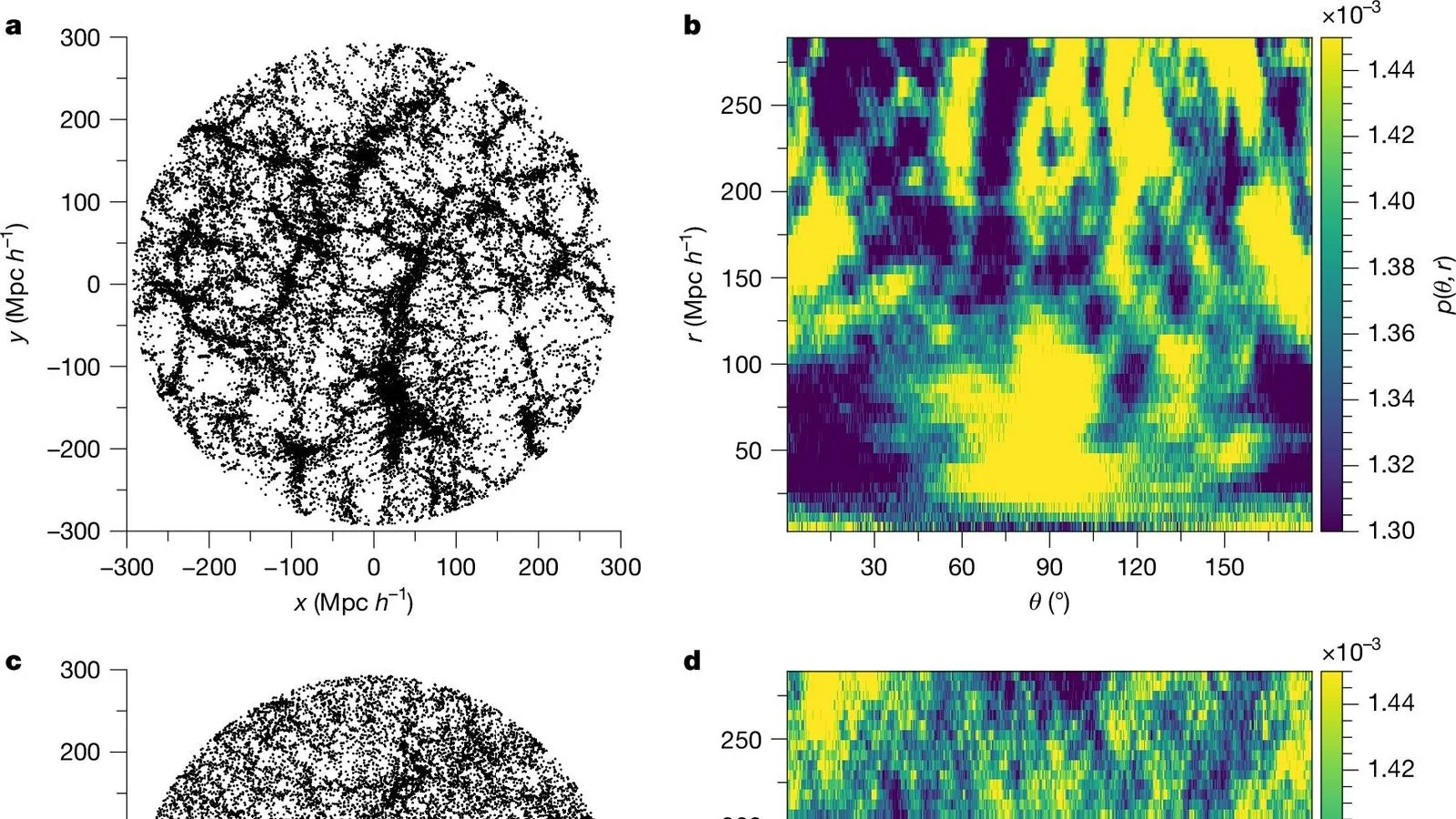
The Copernican principle, one of the cornerstones of modern cosmology, has faced an unexpected blow. Recent research results suggest that the Universe may not have the same structure in all directions as we once thought. This discovery may force a rethink of fundamental theories regarding the origin and evolution of the Universe. This is reported by Ixbt.com reports .
New analyses based on data obtained within the Dark Energy Spectroscopic Instrument (DESI) project have sparked significant debate among physicists. Scientists studied the distribution of nearly 47 million galaxies up to a distance of 11 billion light-years. The research results were published by the ixbt.com edition.
Doubts about the uniformity of the Universe
Research conducted by physicists Francesco Sylos Labini and Marco Galoppo showed that the Universe looks different in various directions, even at extremely large scales. This contradicts the cosmological principle. According to this principle, although galaxies form clusters at close range, matter should be statistically distributed uniformly in all directions at very large distances.In their work, scientists used a new statistical method called Angular Distribution of Pairwise Distances (ADPD). This method allows for the assessment of how galaxy distribution changes depending on distance and direction. The anisotropy (variation of properties depending on direction) identified by the analysis persists up to a distance of approximately 3.26 billion light-years (one gigaparsec).
Will Einstein's equations be revised?
Previously, such non-uniform structures were only observed at scales of tens or hundreds of megaparsecs. The new study shows that this figure is a thousand times larger than expected. If these data are confirmed by independent methods, the base models of cosmic evolution will have to be changed.In particular, scientists will need to take a new approach to Albert Einstein's general relativity equations or account for more complex factors influencing the expansion of the Universe. Hypotheses regarding the interaction of dark matter may also be updated.
For now, the authors of the study are not rushing to final conclusions. Perhaps at even greater distances, the Universe may still become statistically uniform. However, DESI data have already managed to pose unexpected and complex questions for modern physics.


Comments 0
…