


China tests high-speed laser communication between Earth and the Moon
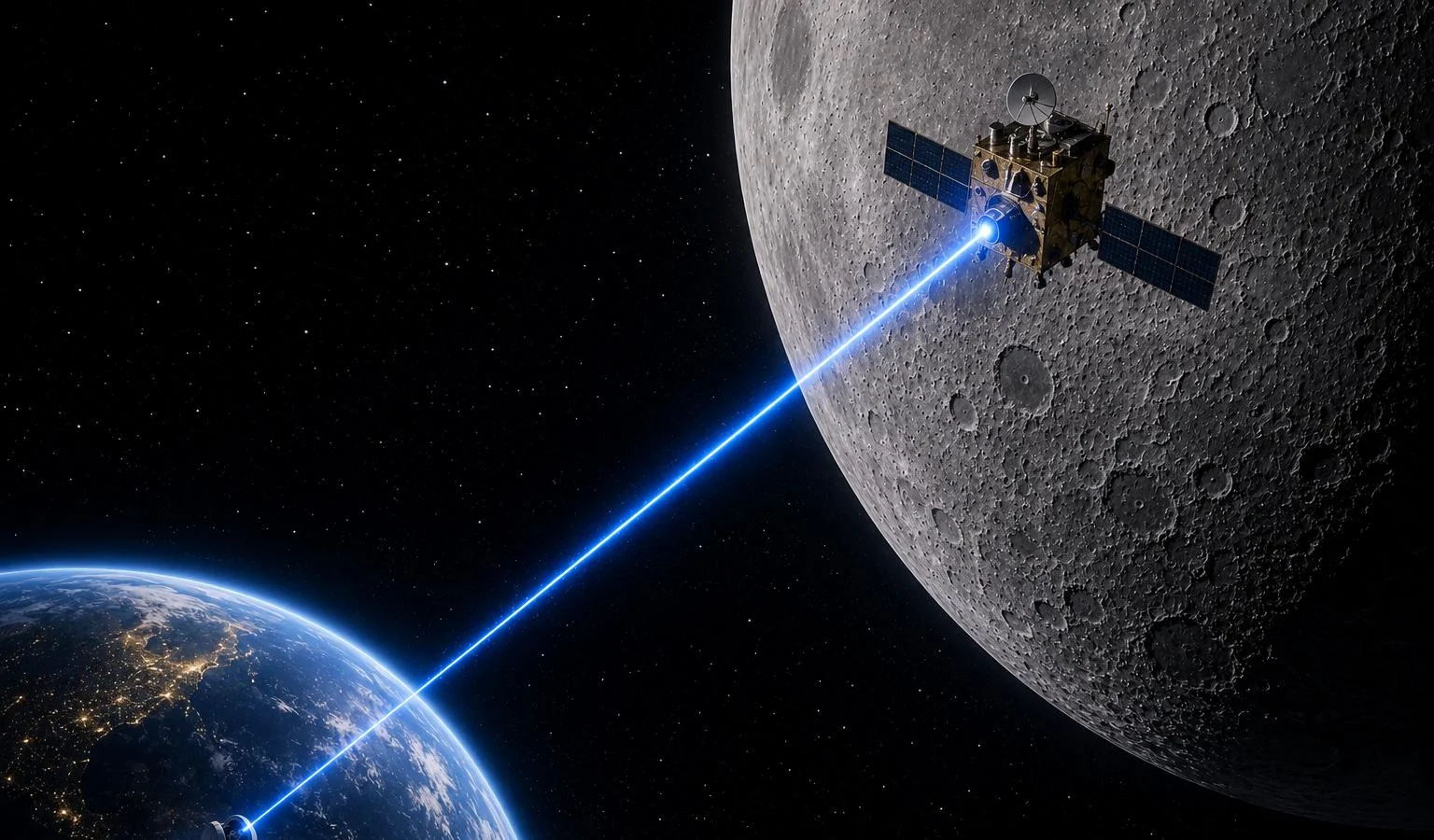
Chinese scientists have successfully established a two-way laser communication channel between Earth and the Moon for the first time over a distance of more than 400,000 kilometers. According to Ixbt.com, this scientific experiment marks a significant milestone in space exploration and data exchange, opening up vast possibilities for future lunar missions. This is reported by Ixbt.com .
During the experiment, the transmission speed from Earth to the spacecraft was 1.25 Mbps, while the return link reached 100 Mbps. High-speed downlink is a critical factor for lunar missions, as it enables the transmission of massive volumes of images, video, and scientific data back to Earth.
Advantages and technical capabilities of laser communication
The superiority of this technology is particularly evident in ultra-high-resolution imagery. Researchers estimate that transmitting a single 8K image using traditional radio communication at 5 Mbps would take 4-5 minutes, whereas the new laser system completes the task in just 12 seconds.Compared to traditional radio communication, laser channels provide significantly higher bandwidth and use a very narrow beam. This not only increases data transmission speeds but also makes it much more difficult for unauthorized parties to intercept the signal.
Complex process and high precision requirements
The main challenge in establishing such a connection is ultra-precise targeting. The laser beam must accurately hit a receiver located over 400,000 kilometers away that is in constant motion along with the spacecraft. Even the slightest angular error could lead to a deviation of several kilometers near the Moon.To maintain the connection, the system simultaneously accounts for the spacecraft's orbit, telescope targeting errors, atmospheric refraction, and even the time it takes for the laser pulse to travel between Earth and the Moon. As a result, the ground-based telescope and the space terminal maintain precise alignment during movement.
Signal reception and future plans
The signal reception process was also complex. After traveling hundreds of thousands of kilometers, literally primary photons reach the detector, and they must be isolated against the background of the Moon, stars, and other sources of interference. To achieve this, engineers used ultra-sensitive single-photon detectors and specialized signal processing algorithms.According to the Center for Space Applied Engineering and Technology of the Chinese Academy of Sciences, this successful experiment is the first step for China toward establishing full-scale optical communication in the Earth-Moon system. In the future, such channels could be used for data exchange with lunar orbiters, automatic stations, and future infrastructure on the lunar surface.


Comments 0
…