


World's Most Efficient Perovskite Solar Cell Created in South Korea
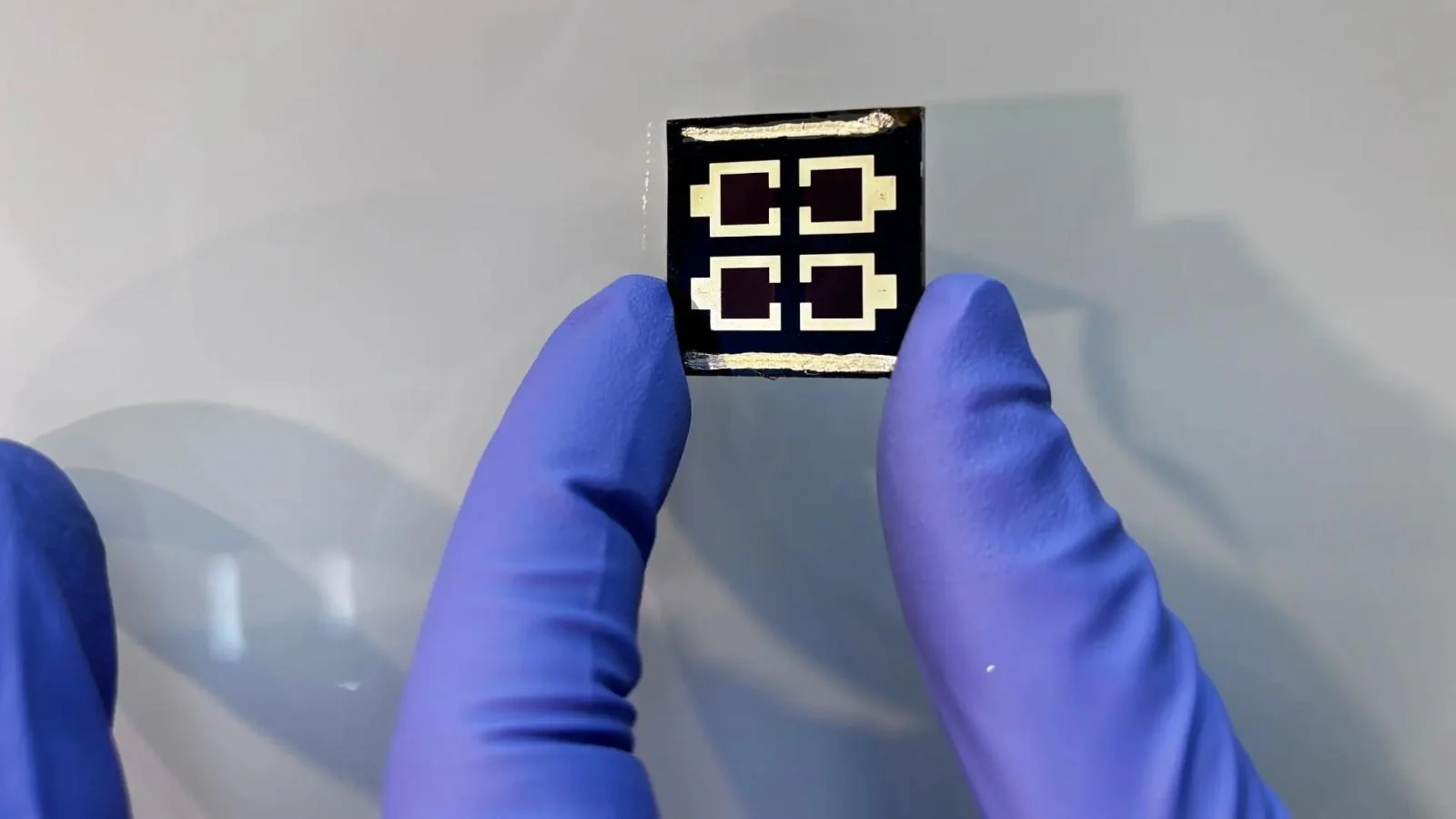
Experts at the Korea Institute of Energy Research (KIER) have set a new world record for the efficiency of tandem solar cells based on perovskite and CIGS (copper indium gallium selenide). According to Ixbt.com, the certified efficiency of this development reached 26.7 percent, with laboratory tests showing up to 27 percent. This was reported by Ixbt.com reporting that.
This high result was officially confirmed by the Fraunhofer Institute for Solar Energy Systems (Fraunhofer ISE) in Germany. Following this, the achievement was added to the international chart for research solar cell efficiency. It is worth noting that the previous world record for this technology was 26.3 percent.
Operating Principle and Advantages of the Technology
The new development consists of a two-layer thin-film solar cell. Its upper perovskite layer absorbs ultraviolet and blue light, which are the most energy-rich parts of the solar spectrum. The lower CIGS layer converts longer wavelengths, including the near-infrared range, into electricity.This spectral distribution allows for significantly more electricity generation compared to traditional single-layer solar cells. Nevertheless, one of the main problems in such tandem systems is energy loss at the interface between materials and damage to sensitive layers during the manufacturing process.
The KIER team found a solution to this problem using a new protective interface layer and an improved transparent top electrode. This allowed for both reducing electrical losses and minimizing light absorption by auxiliary layers.
Prospects and Future Plans
So far, the record has been set on a laboratory cell with an area of less than 1 square centimeter. Applying such high efficiency to full-scale solar panels remains a complex task, so scaling the technology is one of the key engineering challenges. For comparison, the previous best result for tandem perovskite-CIGS elements with an area exceeding 1 square centimeter was 25.5 percent.The main advantage of this technology lies in the combination of high efficiency, low weight, and flexibility. Therefore, it is intended to be used not only in energy but also for integration into building facades, vehicles, and spacecraft. In the next phase, KIER plans to work with industrial partners to transition from small laboratory solutions to creating full-sized commercial solar modules.


Comments 0
…