


Google introduces WeatherNext 3 AI model as a new milestone in meteorology
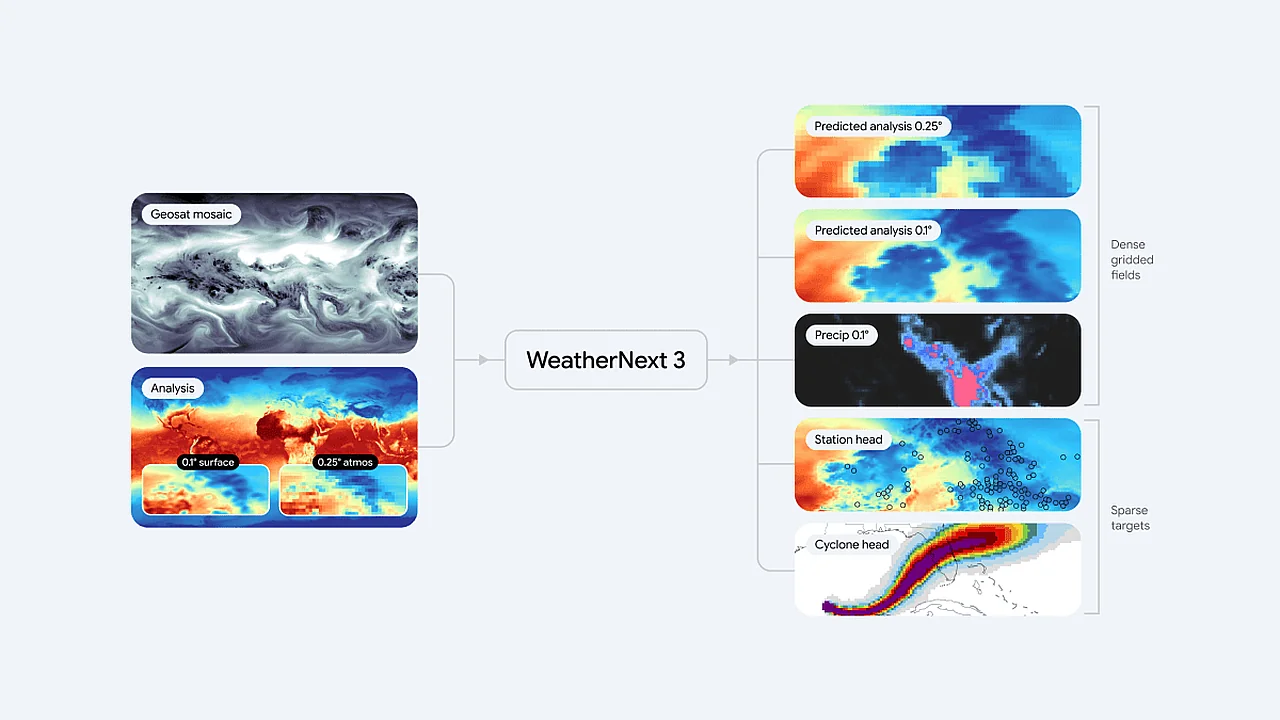
Google DeepMind and Google Research experts have unveiled a new AI model that fundamentally transforms the weather forecasting process. Named WeatherNext 3, this technology allows for more precise monitoring of atmospheric changes and more frequent forecasting of their movement. This innovation represents the latest wave of major changes based on deep learning technologies in the field of meteorology. This is reported by Techcrunch.com reports .
According to ixbt.com and TechCrunch, Google will begin integrating this model into its search engine, Google Maps, and weather data in Gemini apps. It will also be available to regular users and researchers through Google cloud platforms. Google lead engineer Samier Merchant noted that this is the first time these key variables are directly powering company products.
The superiority of AI over traditional supercomputers
Currently, most weather forecasts are generated by government-owned supercomputers by processing mathematical equations representing the laws of physics. While these systems are accurate, they are very expensive and relatively slow. In 2018, after the European Centre for Medium-Range Weather Forecasts (ECMWF) provided more than half a century of weather data, AI researchers began training models that predict faster and with the same level of accuracy as government tools.DeepMind lead research manager Ferran Alet stated that weather is highly chaotic, and small differences can lead to large changes. Machine learning learns approximate physics under conditions of incomplete data and limited computing power, forming patterns from large amounts of data. When tested on the Operational WeatherBench benchmark created by the startup Brightband, the WeatherNext 3 model showed the most accurate results among leading competitors.
Technological improvements and new opportunities
The new model outperformed deep learning models from leading organizations such as Microsoft, NVIDIA, and ECMWF, as well as traditional forecasts from the US National Weather Service, in analyzing indicators such as temperature, wind speed, and humidity. Previously, there were three main problems in AI-assisted weather forecasting: covering a wider area (15-25 square kilometers), difficulties in detecting rain, and dependence on government agency data.The WeatherNext 3 model solves all three of these problems. Researchers state that it can predict with an accuracy of up to 5 kilometers for key variables. Rain assessments have improved by 60 percent compared to the WeatherNext 2 model, and forecasts are now provided every hour instead of every six hours. This was achieved due to the model having 2.4 times more parameters than its predecessor and the precise tuning of objectives for decoder heads.


Comments 0
…