


First microblazar discovered in our galaxy: its jet is pointed at Earth
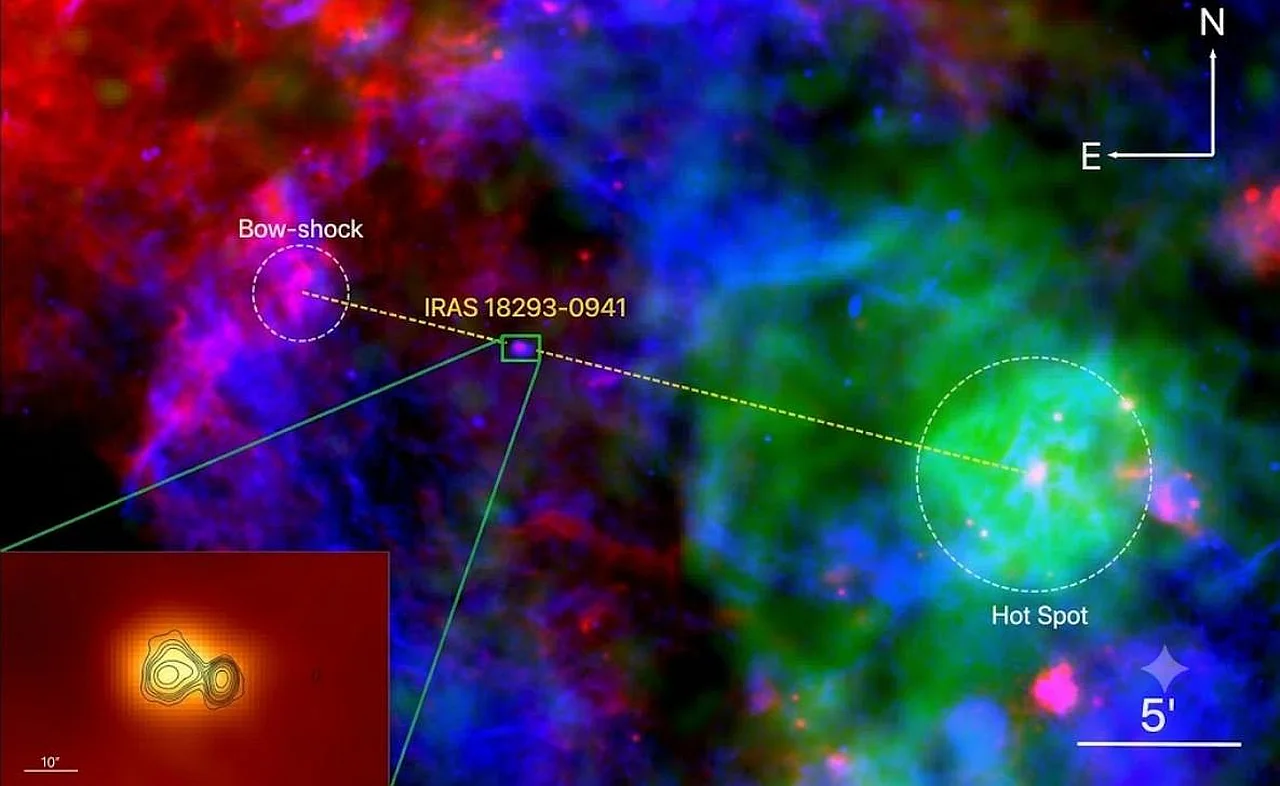
After nearly thirty years of research, an international team of scientists has identified the first microblazar in the Milky Way galaxy — a miniature version of the super-bright cores of distant galaxies. The IRAS 18293−0941 system, first recorded in 1983, has been confirmed as this rare object. This discovery is expected to be a significant step in solving the mystery of the origin of cosmic rays for modern astrophysics. This is reported by Ixbt.com reports .
According to ixbt.com, the discovery was confirmed by an international team led by researchers from the University of Jaén in Spain, using the European VLBI Network (EVN), the world's most sensitive network of radio telescopes. This cosmic system consists of a black hole with a mass of about a dozen suns and a massive companion star that is losing matter to the compact object. An accretion disk forms around the black hole, powering two jets with strong magnetic fields in opposite directions.
During the research, it was determined that one of these jets is pointed almost directly at Earth, with matter moving at approximately 0.75 times the speed of light. The distance to the system is 12,000 light-years. Scientists emphasize that the discovery of such a nearby and clearly visible natural laboratory is of great scientific importance for studying cosmic radiation.
Scientific significance of the unique find
Experts explain that the reason scientists only see one jet can be explained by the relativistic Doppler effect. Radiation from a jet moving at sub-light speed toward an observer is amplified many times, while the one moving in the opposite direction becomes almost invisible. It is precisely because of this effect that the microblazar operates on the same principle as a supermassive black hole, but based on a stellar-mass black hole.Additional optical observations showed that the system's components orbit each other in approximately 11.38 days. Using the South African MeerKAT radio telescope, it was discovered that the second jet created a massive bubble 100 light-years long in the interstellar gas. Its edge collides with a dense gas-dust cloud, creating a natural region capable of accelerating charged particles to energies millions of times higher than those of terrestrial accelerators.
Now, scientists have the opportunity to observe three important processes in a single system: the launch of a jet by a black hole, the massive cavity formed in the medium, and the collision point where particles accumulate energy. Researchers plan to observe this jet and the collision zone more deeply in the near future to study how energy is transferred to the interstellar gas.


Comments 0
…