


Hubble and James Webb discover black hole with the longest orbit in the universe
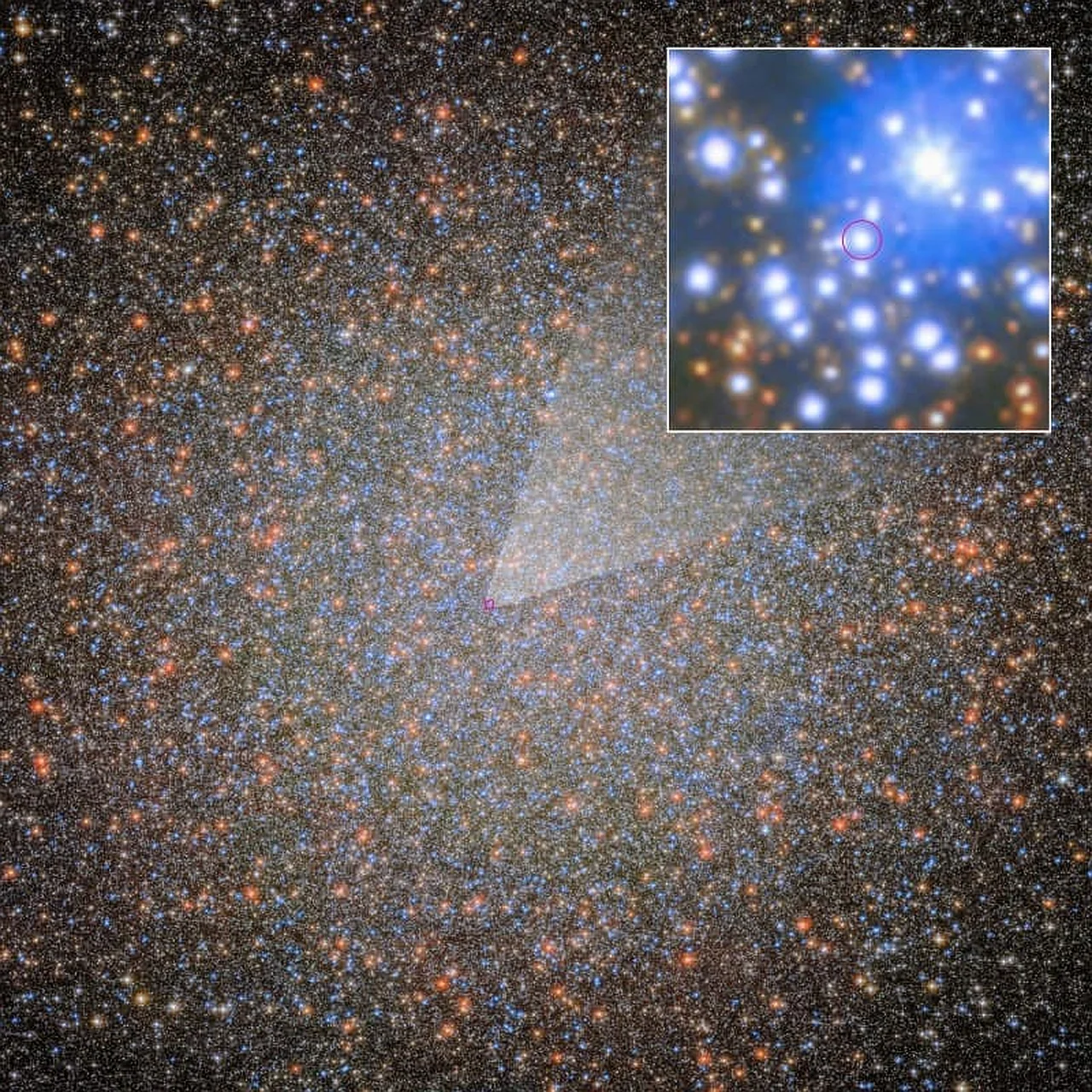
Astronomers have made an unexpected discovery at the center of Omega Centauri, one of the largest and densest star clusters in the Milky Way. Research conducted using NASA's Hubble and James Webb space telescopes has identified a stellar-mass black hole moving in a highly unusual orbit. This discovery could reshape our understanding of how the most mysterious objects in the universe are formed. This is reported by Ixbt.com reports .
According to data published in The Astrophysical Journal Letters, the newly discovered object is named oMEGACat BH-2. This black hole is located approximately 18,000 light-years from Earth and has a unique "hidden" nature. Although scientists cannot see it directly, they proved its existence by analyzing the trajectory of a visible star orbiting it.
94-year record orbit
The most surprising aspect of this system is its orbital period. Researchers studied archival data from the Hubble telescope spanning from 2002 to 2023 and determined that it takes exactly 94 years for the visible star to complete one full orbit around the black hole. This is currently the longest orbital period known to science among binary systems.According to scientists' calculations, the mass of the visible star in the system is 0.78 times that of the Sun, while its invisible companion—the black hole—is 4.46 times more massive. These figures completely rule out the possibility of this object being a neutron star, as it is significantly heavier than the maximum weight limit for neutron stars.
Secrets of Omega Centauri and future plans
The Omega Centauri cluster contains nearly 10 million stars. Previously, scientists hypothesized the existence of a large intermediate-mass black hole here, but finding smaller objects like oMEGACat BH-2 has proven much more difficult. This is because such black holes do not emit X-rays or radio radiation when they are not accreting matter, making them nearly invisible.Researchers believe this binary system may have formed not at the time of star birth, but later as a result of dynamic collisions within the dense cluster. Studying such objects is crucial for understanding sources of gravitational waves in the future. With the upcoming launch of the Nancy Grace Roman Space Telescope, the search for such hidden black holes is expected to expand further.


Comments 0
…