


One visa — five countries: Is the Central Asian «Schengen» near?
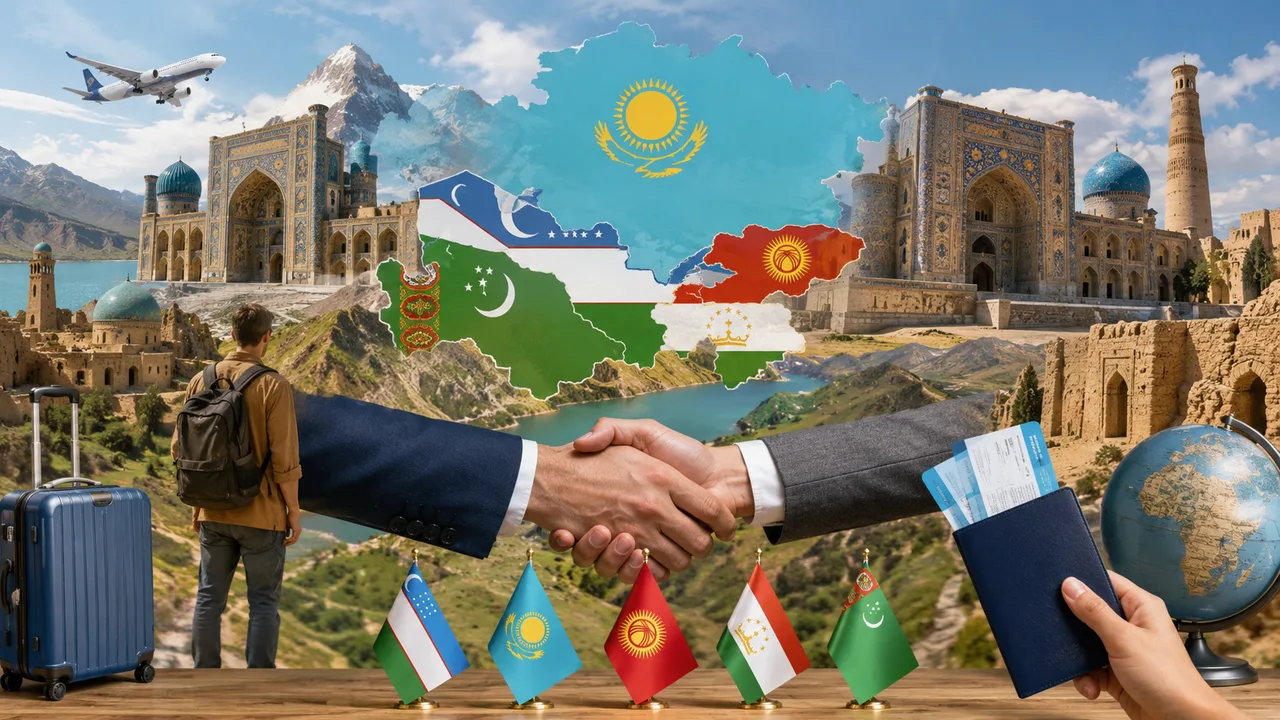
A foreign tourist visiting Central Asia could process documents just once and freely travel across multiple countries in the region. The single tourist visa initiative proposed by Kyrgyz President Sadyr Japarov has once again returned to the regional agenda.
Uzbekistan has officially supported the single visa system, promoting it as a tool to turn Central Asia into a shared tourist space. However, the «Central Asian Schengen» is not yet operational — a final interstate agreement regarding the project's rules, pricing, and launch date has not yet been announced.
What kind of system is Japarov proposing?
According to Sadyr Japarov's idea, a citizen of a third country could obtain a single visa through one of the Central Asian countries and use this document to travel to other countries in the region as well.
The Kyrgyz leader voiced this proposal in March 2025 at a time when border issues in the region were being resolved. Later, at a meeting in Khujand attended by the leaders of Uzbekistan and Tajikistan, he also emphasized that a single visa could create tourism opportunities similar to the European Schengen Area.
However, there is an important difference here: a single tourist visa does not automatically mean the abolition of border controls between countries. Primarily, it aims to reduce the need for foreign visitors to obtain a separate visa for each country.
Uzbekistan officially promotes the initiative
President of Uzbekistan Shavkat Mirziyoyev announced at the first «Central Asia — European Union» summit in Samarkand that a single regional visa project for foreign tourists is being advanced.
In negotiations held in May 2026 with the participation of the Tourism Committee of Uzbekistan, the following issues were also discussed:
a single visa for tourists coming from third countries;
creation of joint tourist routes;
simplification of border-crossing procedures;
opening separate lanes for organized tourist groups;
promoting Central Asia as a unified tourist region at international exhibitions.
These discussions show that the initiative is not remaining merely at the level of political statements, but its technical and infrastructural aspects are also being studied.
How is Kazakhstan's participation manifested?
Kazakhstan is practically developing joint cross-border tourist routes with Uzbekistan and Tajikistan. For example, the «Jibek Joly» tourist train in March 2026 connected Almaty, Turkistan, Samarkand, Dushanbe, and Tashkent into a single travel route.
This project is not a single visa, but it demonstrates that Central Asia can be offered as a united travel destination rather than a collection of separate countries.
At the same time, no final multilateral agreement signed by all five countries introducing the single visa has been announced in open official sources yet. The existing electronic visa systems of Uzbekistan and Kazakhstan also continue to operate separately.
What does a single visa offer to the tourist?
Currently, if a citizen from a visa-required country wants to see multiple countries in the region, they must study the requirements of each separately, submit applications, and make the respective payments.
Once the single system is launched, a potential trip will likely look like this:
Current procedure | If a single visa is introduced |
|---|---|
Separate application for each country | A single general application |
Various fees and requirements | Unified or harmonized requirements |
Short national routes | Tours covering multiple countries |
More bureaucratic processes | Simplified travel itinerary |
For example, a tourist could choose a route covering Almaty, Bishkek, Tashkent, Samarkand, Bukhara, and Dushanbe during a single trip. This is likely to extend the duration of stay in the region and increase demand for hotels, transportation, dining, guiding, and handicraft services.
Who will benefit the most?
A single visa can be attractive primarily to tourists coming to Central Asia from long distances. For a visitor from Europe, America, or East Asia, seeing several countries in a single trip appears more advantageous than visiting just one state.
The following sectors could also benefit from the project:
local hotels and guest houses;
airline and railway operators;
tour operators and guides;
restaurants, bazaars, and souvenir sales;
small businesses in border regions;
historical and cultural sites.
The nature and historical heritage of Central Asian countries do not repeat each other, but rather complement one another: one country sparks interest with its ancient cities, while another does so with its mountains, lakes, or nomadic culture.
What obstacles lie ahead for the project?
Political will alone is not enough for a united visa system. Countries need to agree on several complex issues:
which countries' citizens will be able to use the single visa;
the validity period of the visa;
the total fee amount and revenue distribution;
a unified database for checking applications;
exchange of security and migration data;
common rules regarding rejected applications;
the tourist's points of first and final entry into the region;
border control and temporary registration procedures.
Once one country issues a visa, the other participants will also need to recognize that decision. This requires mutual harmonization of migration and security criteria.
Will all five countries join?
Although the initiative aims to turn Central Asia into a single tourist space, it is not yet officially clear which countries will participate in the first phase.
The project could initially be launched as a pilot between two or three countries and then expanded to other nations. The fact that the Tourism Committee of Uzbekistan discussed pilot projects to improve border infrastructure also indicates the likelihood of a phased approach.
When will the «Central Asian Schengen» launch?
As of August 3, 2026, the exact launch date, official name, price, and application portal for the single visa have not been announced.
Therefore, it is currently incorrect to accept the news that «five countries can be entered with a single visa» as current practice. This is a promising initiative that enjoys political support and whose practical mechanisms are being discussed.
If the countries agree on security, migration, and payment issues, the single visa could become one of the biggest changes for Central Asian tourism in recent years. For tourists, five separate destinations on the map of the region will merge into a single major travel route.
In your opinion, will the number of tourists coming to Central Asia increase sharply if a single visa is introduced? Leave your thoughts in the comments and share the article with your friends on Telegram or other social networks!



Comments 0
…