


Revolution in 3D printing: Microsystems are now printed as a whole in just a few seconds
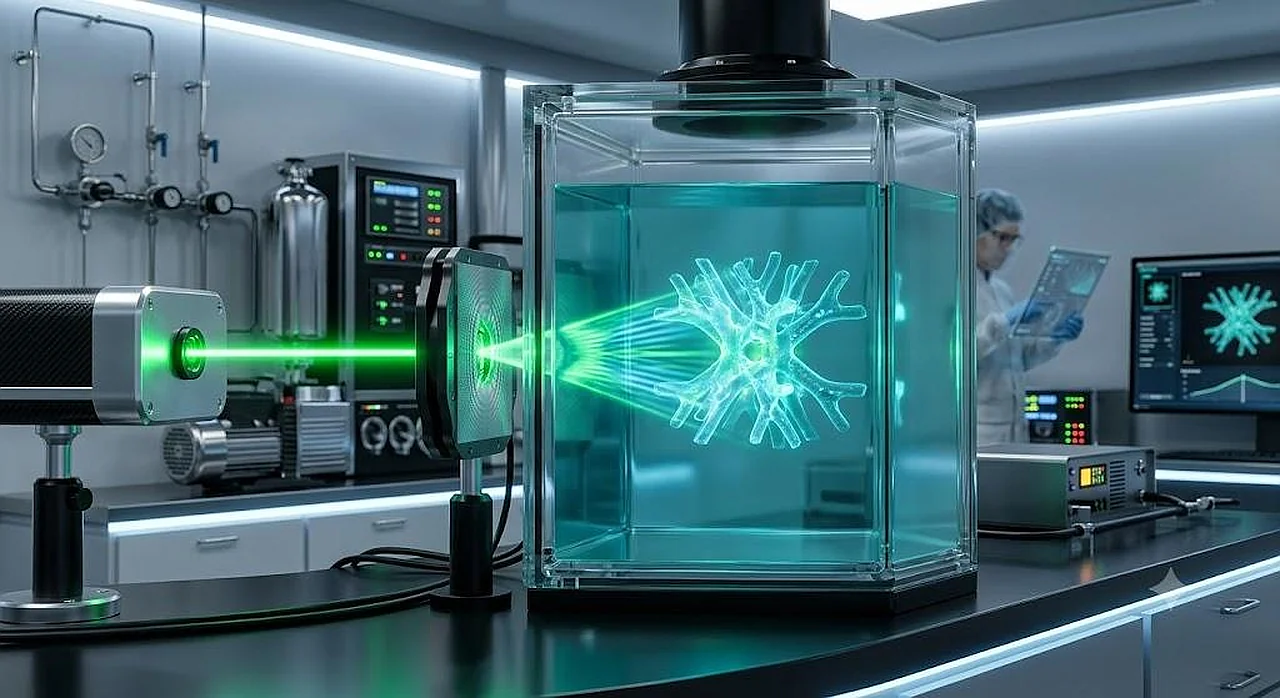
Researchers at the University of Utah have achieved a major breakthrough in 3D printing technology. Their new method allows for the printing of complex microscopic details in just 20 seconds using a single laser pulse. This discovery is expected to move away from traditional layered printing methods and radically improve the speed and quality of microsystem production. This is reported by Ixbt.com reports .
Standard 3D printers form objects layer by layer from the bottom up. However, according to ixbt.com, the new system creates the entire structure at once. This approach not only saves time but also increases the strength of the product. Since the connections between layers are usually the weakest point of 3D parts, in the new method, the part appears as a single whole.
The power of holographic projection
The technology is based on a special nanostructured mask. This mask converts the laser beam into a volumetric holographic projection of the future product. When the light passes through a photosensitive material called SU-8, it simultaneously affects the necessary points within the polymer and instantly forms a three-dimensional structure.This development relies on the principles of photolithography used in microchip manufacturing. The difference is that while this method is used in the semiconductor industry only to create flat images, scientists have adapted it to form volumetric objects. The lensless element of the system compensates for the scattering of light within the polymer and directs energy to precisely defined points.
Practical application and future prospects
During the experiments, researchers managed to prepare an array of micro-tubes with a diameter of only 6 micrometers. Interestingly, although the length of these tubes is 120 times greater than their diameter, they maintained high mechanical strength. Tests proved that these microchannels can move liquid using the capillary effect.The new technology can be widely used in the following areas:
- Microfluidic devices and lab-on-a-chip systems;
- Microelectronics components;
- High-precision optical systems;
- Microscopic sensors for medicine.
For now, the method has specific limitations — in the current version, two spatial dimensions can be fully controlled, but the final product still has a volumetric shape. The team of scientists is currently working on an improved model with full three-dimensional control without losing printing speed and accuracy. This discovery is expected to be the foundation for mass production of microsystems in the future.


Comments 0
…