


Cosmic Mystery: Scientists Detect Mysterious Organic Matter on Pluto and Titan
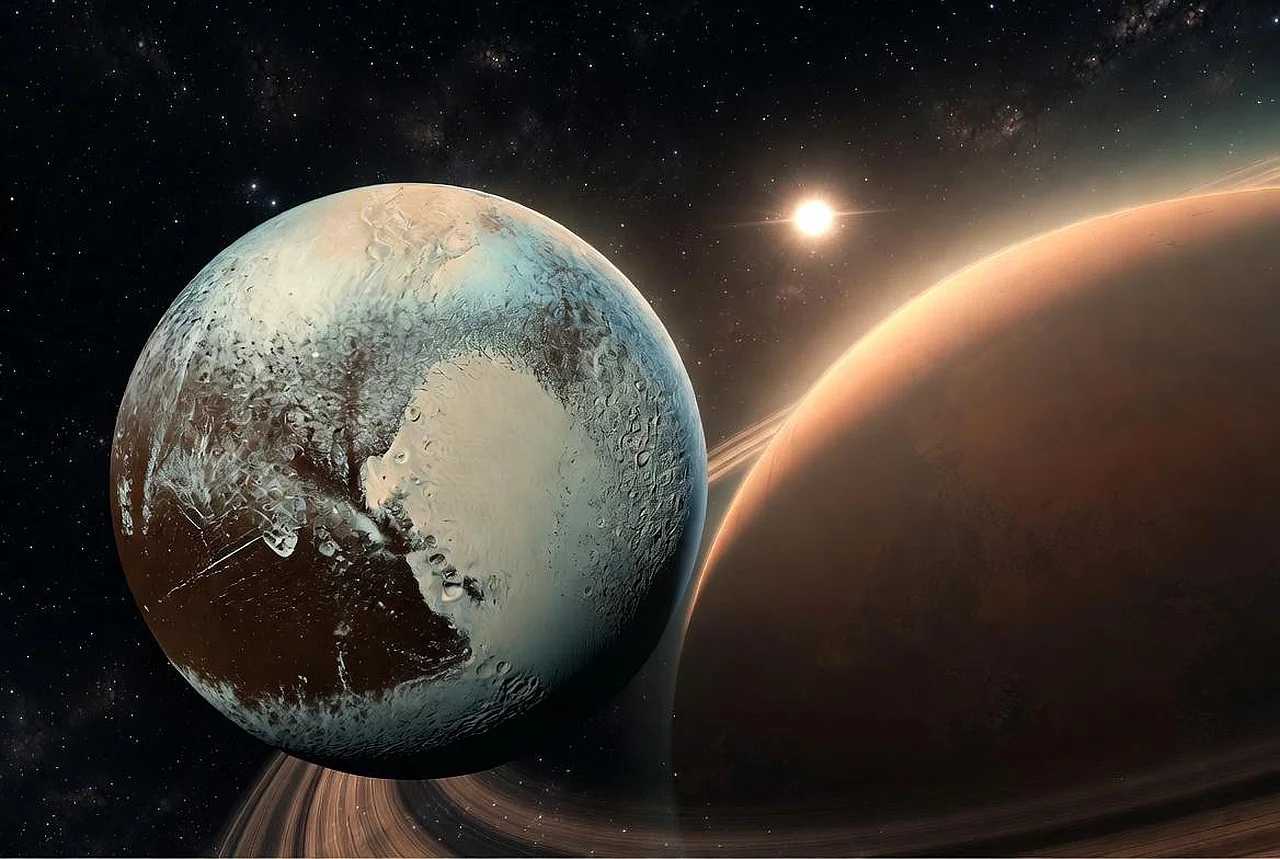
The James Webb (JWST) space telescope, which has ushered in a new era of space exploration, has made another astonishing discovery. Scientists have identified an unknown organic compound on two objects in the solar system that are billions of kilometers apart and have completely different conditions: Saturn's moon Titan and the dwarf planet Pluto. This finding could change our understanding of cosmic chemistry. This is reported by Ixbt.com reports.
Titan and Pluto are worlds that are completely different on paper. Titan is geologically active, has an atmosphere denser than Earth's, and features liquid methane seas and massive dunes made of organic particles on its surface. Pluto, on the other hand, is considered a frozen, dead world with a very thin atmosphere. However, as reported by Space.com, the same "signature" has been recorded in the infrared spectrum of both celestial bodies, indicating that similar chemical processes are occurring on them.
Mysterious spectral trace and scientific analysis
A research team led by planetary scientist Bruno Bézard of the Paris Observatory calls this discovery a "real puzzle." Scientists note that the substance found does not match the spectral trace of any chemical compound known and cataloged by science to date. This absorption line, identified through spectroscopy, showed that light is being absorbed at exactly the same wavelength on both objects.There is no doubt about the accuracy of the discovery, as this signal was simultaneously confirmed by two different James Webb telescope instruments: NIRSpec (Near-Infrared Spectrograph) and MIRI (Mid-Infrared Instrument). This proves that the result is not a technical error or equipment failure, but a real material fact. Bruno Bézard says he was surprised to see the same unknown compound in both places when comparing the Pluto data with his colleague Emmanuel Lellouch.
A sign of life or prebiotic chemistry?
In response to the question that interests many, scientists emphasize that there is currently no basis to call this mysterious molecule a "biosignature," or a sign of life. Instead, this finding may be the product of complex prebiotic chemistry that has formed over more than four billion years in an oxygen-free environment. That is, it is the result of chemical evolution in the stage before the emergence of life.This discovery shows that the chemical composition in the outer regions of the solar system is more complex than we thought. Researchers are now attempting to replicate this mysterious "signature" by testing mixtures of various gases and ices in laboratory conditions. If scientists succeed in identifying this substance, it could answer questions about how the building blocks of organic life are distributed in the universe.
For now, the similarity between these two distant points in the universe remains one of the greatest mysteries of modern astronomy. New data being obtained with the James Webb telescope is expected to help solve this puzzle in the coming years.


Comments 0
…